Key performance
Technical specifications
Engine
- Displacement
- 739 cc
- Power
- 76.0 ch @ 9500 tr/min (55.5 kW)
- Torque
- 62.8 Nm @ 7500 tr/min
- Engine type
- In-line four, four-stroke
- Cooling
- par air
- Compression ratio
- 9.5 : 1
- Bore × stroke
- 66 x 54 mm
- Valves/cylinder
- 2
- Camshafts
- 2 ACT
- Starter
- Electric
Chassis
- Frame
- Double berceau en tubes d’acier
- Gearbox
- 5-speed
- Final drive
- Chain (final drive)
- Front suspension
- fourche téléhydraulique, déb : 130 mm
- Rear suspension
- Mono-amortisseur, déb : 130 mm
Brakes
- Front brakes
- Dual disc
- Rear brakes
- Single disc
- Front tyre
- 120/70-17
- Front tyre pressure
- 2.50 bar
- Rear tyre
- 160/60-17
- Rear tyre pressure
- 2.50 bar
Dimensions
- Seat height
- 815.00 mm
- Fuel capacity
- 22.00 L
- Weight
- 228.00 kg
- Dry weight
- 210.00 kg
- New price
- 7 012 €
Overview
Remember the time when a roadster was simply a motorcycle, without a "hyper-naked" label or promises of stratospheric performance. It is in this simple soil that Kawasaki replanted the ZR-7 S in 2002, an attempt to regain a market then dominated by the Bandit and the Hornet. With its 739 cm3 inline four-cylinder engine, it offered 76 horsepower, a figure that seems almost modest today but which, at the time, represented an honest proposition. The main argument? A torque of 62.8 Nm available fairly low, around 7500 rpm, which gave it a reserve of immediate flexibility, much more tangible than on the smaller 600 competitors often more pointed at high revs.
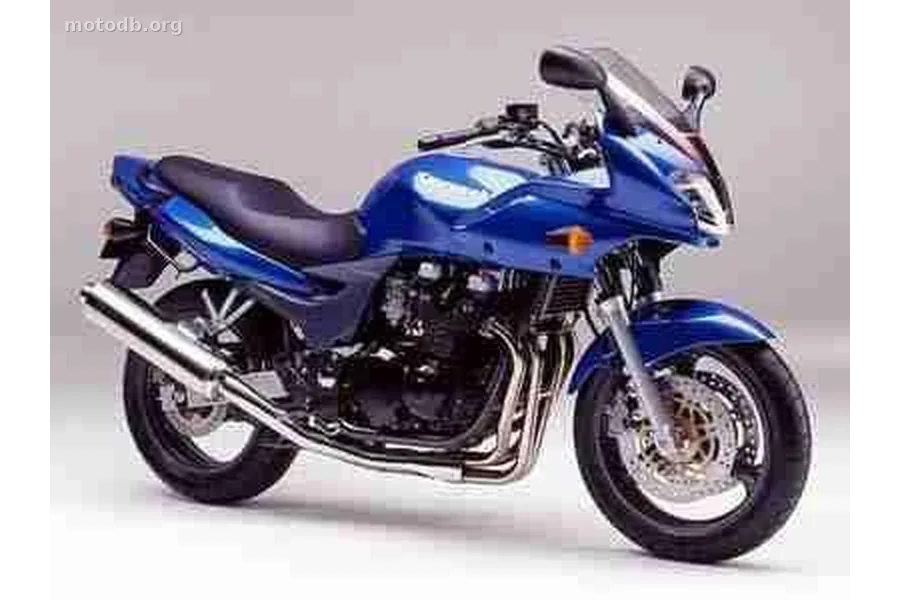
The philosophy of this Kawasaki ZR-7 S was clear: accessibility and daily use. Its steel tube double cradle frame, its weight of 228 kg fully fueled and its 815 mm seat height defined a machine affordable, physically and financially. For around 7000 euros originally, it positioned itself as a serious alternative, less brutal than the large ZRX but more consistent than the entry-level models. The S version, with its headlight fairing, added a touch of aesthetics and a little protection for the traveler, without transforming the motorcycle into a GT.
What still surprises today, especially when looking for a used Kawasaki ZR-7 S, is its road behavior. The chassis, with a telescopic fork and a mono-shock, offers frank handling and intuitive maneuverability. In the city, it weaves effortlessly, benefiting from the flexibility of its two-valve per cylinder engine, a simple architecture that gives it a docile and progressive character. On the open road, it chains curves with a disarming naturalness, even if the rear may show some signs of nervousness on very damaged surfaces. The brakes, progressive and sufficiently powerful, complete a very balanced picture.
For whom? The rider seeking a simple, reliable and versatile motorcycle, without the complexities or exorbitant prices of modern roadsters. A beginner with a little experience could find an excellent progression tool, while the daily commuter would appreciate its correct comfort, its 22-liter tank and its small practical equipment such as tie-down hooks. It does not shine with electric charisma, but with quiet efficiency. Consulting a Kawasaki ZR-7 S technical datasheet confirms this impression: it is an honest machine, without frills, built to ride rather than to impress. In a market today saturated with technologies, finding this fundamental essence sometimes tastes like a beautiful and simple evidence.
Practical info
- La moto est accessible aux permis : A
Reviews & comments
No reviews yet. Be the first to share your opinion!