Key performance
Technical specifications
Engine
- Displacement
- 1084 cc
- Power
- 88.4 ch @ 7000 tr/min (65.0 kW)
- Torque
- 98.0 Nm @ 4750 tr/min
- Engine type
- Bicylindre parallèle, 4 temps, calé à 270°
- Cooling
- liquide
- Compression ratio
- 10.5 : 1
- Bore × stroke
- 92 x 81.5 mm
- Valves/cylinder
- 4
- Camshafts
- 1 ACT
- Fuel system
- Injection
- Starter
- électrique
- Euro standard
- Euro 5+
Chassis
- Frame
- double berceau tubulaire en acier
- Gearbox
- boîte à 6 rapports
- Final drive
- Chaîne
- Front suspension
- Fourche téléhydraulique Ø 43 mm
- Rear suspension
- 2 amortisseurs latéraux
Brakes
- Front brakes
- Freinage 1 disque Ø 330 mm, fixation radiale, étrier 4 pistons
- Rear brakes
- Freinage 1 disque Ø 256 mm, étrier simple piston
- Front tyre
- 130/70-18
- Front tyre pressure
- 2.30 bar
- Rear tyre
- 180/65-16
- Rear tyre pressure
- 2.30 bar
Dimensions
- Seat height
- 710.00 mm
- Seat type
- Selle biplaces
- Fuel capacity
- 13.60 L
- Weight
- 250.00 kg
- New price
- 12 949 €
Overview
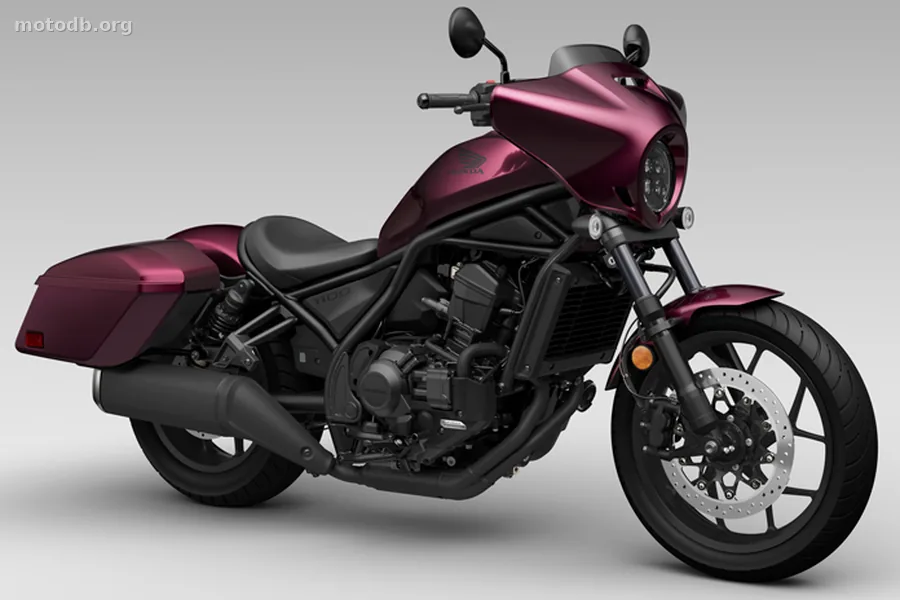
Let's talk Touring, let's go light, sorry about the luggage, let's get to the essentials. Because that's what the "baggerized" CMX 1100 offers: a limited carrying capacity and a bit of protection. Except in 2025, it offers a bit more. The range has decided to modernize, with a more responsive twin. Honda's engine department has worked to make it docile for Euro5+ while reinforcing its power (+1.4 hp). Torque is revised upwards; not in maxi figures, but in its intervention at low RPM, more full.
This is also the time to equip with a more modern instrument panel. A surprising but practical choice to have adopted the 5-inch color TFT screen common to all Honda - we still expect to discover a retro instrumentation on this type of machine. But practicality wins with a good dose of information and smartphone connectivity. Part of the user base will be satisfied to have control of their playlist, calls, notifications and simplified navigation.
But the most surprising thing about it all remains the very existence of the CMX 1100 Rebel Touring: because regarding the bagger offering on the market, it almost boils down to three words: Harley-Davidson / Indian. The Americans dominate the market, with a wide offering, entirely made up of enormous engines.
Let's include the Germans. BMW recently launched its offensive with the 1800 R 18 B; also with significant tonnage. Honda somewhat goes against the grain with a lighter bagger, in engine and in price. By grafting the essentials of road equipment onto its large custom, the manufacturer offers its CMX 1100 Touring.
The essentials, and nothing superfluous. The CMX is equipped in a backpack-style outing – with a fairing. It does not aim for long-distance travel as a Street Glide or a Challenger might. Its flanks accommodate rigid luggage cases of 19 liters and 16 liters; the exhaust eats into some of the available space on the right. Not enough to store a helmet or gear for an extended stay. It would be more accurate to speak of large glove boxes, which will still find plenty of use in everyday life or on a beautiful day ride. And besides, it’s much more elegant than a top case.
The other distinctive element of the CMX Touring is its fairing head. With its Batwing-style design, it blends perfectly into the style of the category. It completely changes the face of the motorcycle. We will applaud the added protection but do not expect an aerodynamic shield. Although as wide as the handlebar, the small bubble and the lightweight dimensions of this bit of fairing will have more of a role in relieving air pressure. The CMX can also count on an asset of choice: a seat height of only 710 mm.
But the Honda does not claim to play in the clan of Tourers or to cruise in the slipstream of GTs. For travel, there’s the Gold Wing. Here, the word is style and large pockets. With a rather atypical engine, even if it announces the card of the twin.
Yes, a custom is only conceived with a twin. In V and well fat. Except the CMX 1100 moves with its own version of the Africa Twin block. A 1084 cm3 where the pistons move next to each other, in parallel. Honda has brought it back to 88.4 horsepower and has practiced some changes to make it more vigorous at low RPM. Torque loses only 7 Nm while its maximum is available much earlier: at 4,750 rpm compared to 6,250 rpm on the trail.
An American competitor certainly offers more, with its enormous displacement. So let's set the record straight because you have to deal with 80 to 100 kilos more; not to mention prices close to double that of the Honda. The target clientele is thus not really the same, although the appearance presents obvious similarities.
The CMX 1100 T is also a product highlighting its technology. The Americans like to show their excessive and authentic side; the Japanese are more modernism and / or futurism. On board this bagger, the rider can appreciate a TFT instrument panel, a USB-C port, full LED lighting, cruise control, and four Riding Modes*. Each modifying the power delivery, the level of torque control (Honda's version of traction control), the wheelie control and engine braking.
The distant cousin Africa Twin being available with the robotic DCT gearbox, the CMX 1100 also receives it - the manual gearbox version is no longer offered. The system requires a certain financial effort but the action is bluffingly effective on Honda models. Auto mode will lend itself perfectly to cruising with Rain or Standard selection. Otherwise, the user can ask for more dynamism with the Sport mode or the Manual mode to downshift with the left thumb. A User mode also allows you to record your personal settings. 2025 brings more finesse in the reactions of the gearbox at low speed.
There's no point in incurring expenses to modify the chassis. Rebel or Touring, the CMX 1100 is built on a steel tubular frame, with a very conservative rake angle of 30°. The handling of this custom is intended to be entertaining, not muscular. In any case, once you exceed 35° of lateral lean, you will quickly understand that you will use the boot and the heel plate. The 43 mm fork and the two shock absorbers have little adjustment, only preload, and there is only one brake disc per wheel. With still 330 mm at the front and a 4-piston caliper. The rear is quite timid with 256 mm and a single piston.
Honda is not going to upset the clan of baggers with the CMX 1100 Touring. The goal is rather to offer a large CMX, a little road-going, a little stylish and not too expensive. The electronics are abundant but are they really suitable for this machine...? But the Honda doesn’t care... It has no direct competitor and can afford to show its strengths as it sees fit.
M.B - Photos manufacturer
- STANDARD: responds to most situations with low-speed comfort and the ability to exploit a large part of the Rebel's potential in the rev range. Intermediate level for power, engine braking, torque control and wheelie control.
- RAIN: for peaceful use, with extra assurance on slippery surfaces. Low power and engine braking, high level of torque control and wheelie control.
- SPORT: for optimal performance. Dynamic engine behavior, normal engine braking, low level of intervention of torque control and wheelie control.
- USER: allows the rider to define custom settings. Once determined, the choices are automatically memorized.
Standard equipment
- Assistance au freinage : ABS
- Nombre de mode de conduite : 4
- Volume de rangement : 35 litres
- Taille de l'écran TFT couleur : 12,70 cm / 5 pouces
- Indicateur de vitesse engagée
- Régulateur de vitesse
- Boîte automatique
- Prise USB
- Contrôle de couple
- Contrôle anti wheeling
- Contrôle du frein moteur
Practical info
- La moto est accessible aux permis : A
Indicators & positioning
Similar bikes
Scrambler 1100 Dark Pro
Reviews & comments
No reviews yet. Be the first to share your opinion!