Key performance
Technical specifications
Engine
- Displacement
- 738 cc
- Power
- 76.0 ch @ 9500 tr/min (55.9 kW)
- Torque
- 62.8 Nm @ 7500 tr/min
- Engine type
- 4 cylindres en ligne, 4 temps
- Cooling
- par air
- Compression ratio
- 9.5 : 1
- Bore × stroke
- 66 x 54 mm
- Valves/cylinder
- 2
- Camshafts
- 2 ACT
Chassis
- Frame
- Double berceau en tubes d’acier
- Gearbox
- boîte à 5 rapports
- Final drive
- Chaîne
- Front suspension
- Fourche téléhydraulique Ø 41 mm, déb : 130 mm
- Rear suspension
- Mono-amortisseur, déb : 130 mm
Brakes
- Front brakes
- Freinage 2 disques Ø 300 mm, étrier 2 pistons
- Rear brakes
- Freinage 1 disque Ø 240 mm, étrier 2 pistons
- Front tyre
- 120/70-17
- Front tyre pressure
- 2.50 bar
- Rear tyre
- 160/60-17
- Rear tyre pressure
- 2.50 bar
Dimensions
- Seat height
- 815.00 mm
- Fuel capacity
- 22.00 L
- Weight
- 220.00 kg
- Dry weight
- 202.00 kg
- New price
- 6 097 €
Overview
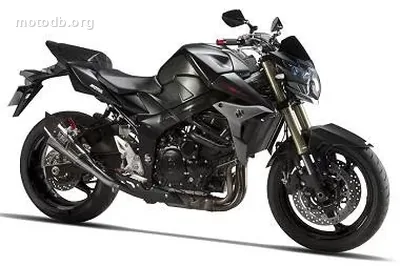
When Kawasaki decided to fill the void left by the Zephyr, the brand made a bold choice: offering a 750 cc machine at a time when all the competition was fighting it out with 600s. Between an ER-5 that was too tame and a ZRX 1100 that was too muscular, the ZR-7 N occupies a precise niche, sold at around €6,097 — roughly the same price as a Suzuki Bandit. Up against the Fazer, GSF, and Hornet, the positioning demands a strong personality. Kawasaki chose its own: mechanical honesty.
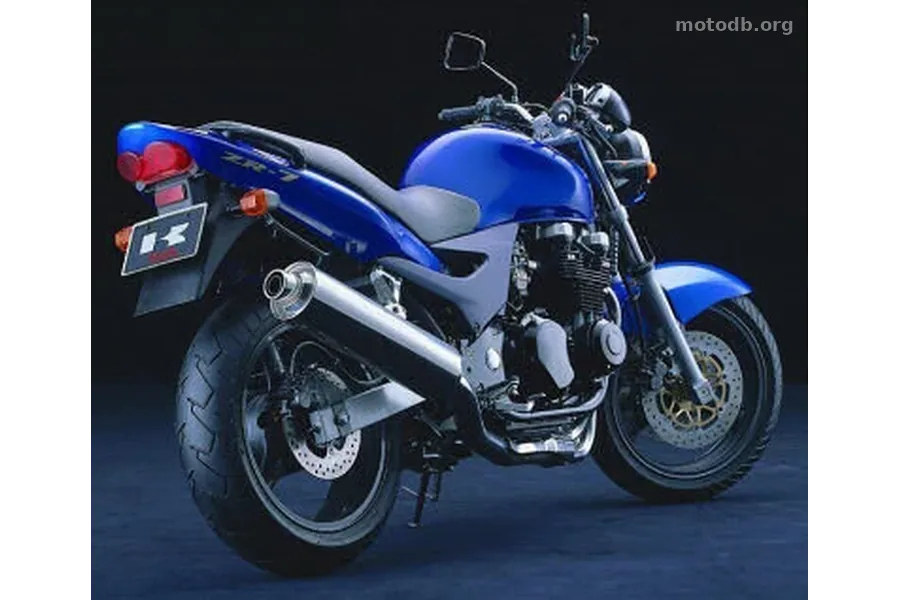
The engine immediately betrays its origins. This air-cooled inline four-cylinder, with its prominent cooling fins and two valves per cylinder, carries the unmistakable scent of the 1980s. That's not a flaw — it's an identity. The result is 76 horsepower at 9,500 rpm and, more importantly, 62.8 Nm of torque available from 7,500 rpm — figures that give this motorcycle a mid-range generosity that the competition's 600 four-cylinders struggle to match. The K-TRIC system, which optimises the ignition mapping, adds responsiveness in the mid-range, precisely where a sports bike stripped of its finery can feel hollow. Those who look into owner reviews of the 2000 Kawasaki 750 ZR-7 N will find one constant: it's in the mid-range that this motorcycle is most convincing.
The steel double-cradle frame is no technological revelation, but it does its job with integrity. The 41 mm fork and the single shock absorber, each with 130 mm of travel, soak up road imperfections without drama. The front end communicates well, corners are approached with confidence, and the pace rises naturally. One caveat, however: on degraded surfaces, the rear can become unpredictable when pushed hard. The brakes — twin 300 mm discs up front and a 240 mm disc at the rear — build progressively with pressure and inspire confidence, even if the rear brake remains somewhat in the background. At 220 kg fully fuelled, the machine is no lightweight, but it doesn't feel that way in the city, where it slips easily through traffic.
The ergonomics lean slightly forward without being aggressive. You sit down and ride off, no particular ritual required. The 22-litre tank allows for long stretches between stops, and Kawasaki has attended to practical details: a fuel gauge, a lock storage compartment under the seat, tie-down hooks, and a centre stand. The stripped-down N version targets the versatile urban rider or the intermediate motorcyclist who wants a mount free of unnecessary pretension. The S version, with its wind deflector, will be better suited to long-distance touring. The ZR-7 N reaches a top speed of 210 km/h — an honest figure for a machine that makes no claim to compete with sports bikes.
What one can hold against this Kawasaki is precisely that lack of fire, that absence of a sharp edge that keeps it out of café conversations. It doesn't provoke. But for anyone seeking a reliable, flexible, practical motorcycle equipped with an engine more generous than the norm for its price bracket, this is a very solid proposition. The disappearance of the eccentric chain adjustment system, replaced by a more conventional setup, remains the only real disappointment on a machine that, in every other respect, delivers on all its promises.
Practical info
- La moto est accessible aux permis : A
Reviews & comments
No reviews yet. Be the first to share your opinion!