Key performance
Technical specifications
Engine
- Displacement
- 738 cc
- Power
- 76.0 ch @ 9500 tr/min (55.9 kW)
- Torque
- 62.8 Nm @ 7500 tr/min
- Engine type
- 4 cylindres en ligne, 4 temps
- Cooling
- par air
- Compression ratio
- 9.5 : 1
- Bore × stroke
- 66 x 54 mm
- Valves/cylinder
- 2
- Camshafts
- 2 ACT
Chassis
- Frame
- Double berceau en tubes d’acier
- Gearbox
- boîte à 5 rapports
- Final drive
- Chaîne
- Front suspension
- Fourche téléhydraulique Ø 41 mm, déb : 130 mm
- Rear suspension
- Mono-amortisseur, déb : 130 mm
Brakes
- Front brakes
- Freinage 2 disques Ø 300 mm, étrier 2 pistons
- Rear brakes
- Freinage 1 disque Ø 240 mm, étrier 2 pistons
- Front tyre
- 120/70-17
- Front tyre pressure
- 2.50 bar
- Rear tyre
- 160/60-17
- Rear tyre pressure
- 2.50 bar
Dimensions
- Seat height
- 815.00 mm
- Fuel capacity
- 22.00 L
- Weight
- 220.00 kg
- Dry weight
- 202.00 kg
- New price
- 6 097 €
Overview
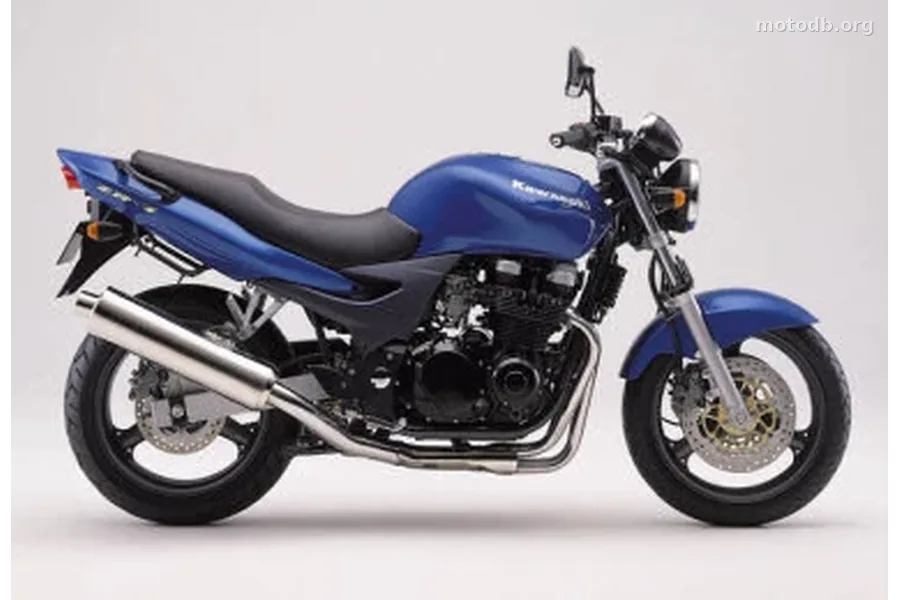
When everyone was fighting it out with 600cc machines at the turn of the 2000s, Kawasaki chose to play a different card. Rather than line up yet another sporty four-cylinder in the scrum of Fazers, Bandits, and Hornets, the Akashi brand carved its ZR-7 from a 738cc block with a decidedly retro architecture, complete with visible cooling fins and just two valves per cylinder. On paper, it looks like an admission of weakness. In practice, it's exactly what makes the machine interesting.
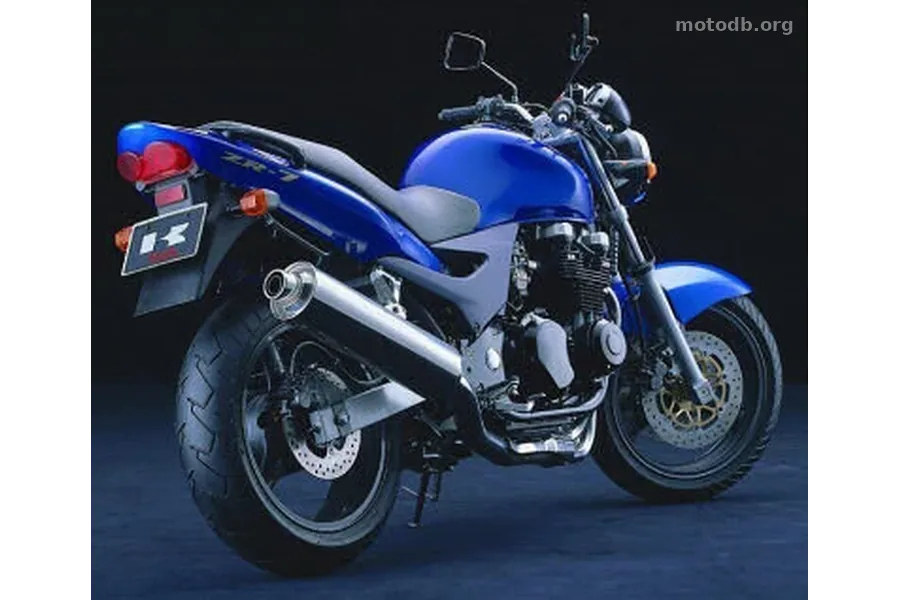
This inline four-cylinder develops 76 horsepower at 9,500 rpm, but it's above all its torque of 62.8 Nm available from 7,500 rpm that defines the motorcycle's character. Where a Hornet of the same era forces you to keep the needle high to feel anything, the Kawasaki responds readily from mid-range. The K-TRIC system, which manages ignition timing, contributes to this without getting nearly enough credit. In urban riding as much as on open roads, this mid-range availability genuinely transforms the everyday experience. Reviews of the Kawasaki 750 ZR-7 N consistently converge on this point: the engine is its trump card.
The chassis follows without letting the side down. At 202 kg dry, the ZR-7 proves manageable and predictable, with a front end that communicates road surface conditions clearly. Corners can be chained together without particular effort, the pace can be raised progressively — right up until the footpegs start writing their story on the tarmac. The maximum lean angle before grounding is there to remind you that this is no track weapon. On degraded surfaces, the rear can get nervous if pushed too hard. The brakes — two 300 mm discs up front and a 240 mm disc at the rear — deliver progressive stopping power, even if the rear lacks a little bite.
Day to day, the ZR-7 reveals another side of its personality. The riding position, slightly forward-leaning without being aggressive, suits a range of rider sizes, though the 815 mm seat height may dampen the enthusiasm of shorter riders. The 22-litre tank provides reassuring range, and the practical equipment is serious for the era: fuel gauge, space for a lock under the seat, tie-down hooks, centre stand. Kawasaki had thought about the real-world user, not the garage showpiece owner.
Priced at 6,097 euros in 2002, it was positioned directly against the Bandit 600 with a genuine displacement advantage. Its main shortcoming remains its image: a composed, fever-free engine that doesn't turn heads in a car park. Riders seeking raw sensation will look elsewhere. But for anyone wanting a versatile, honest, solid, and enjoyable roadster that doesn't fight back, the ZR-7 N remains a coherent proposition. The S version with its half-fairing is well worth the attention of high-mileage riders.
Practical info
- La moto est accessible aux permis : A
Reviews & comments
No reviews yet. Be the first to share your opinion!