Key performance
Technical specifications
Engine
- Displacement
- 738 cc
- Power
- 76.0 ch @ 9500 tr/min (55.9 kW)
- Torque
- 62.8 Nm @ 7500 tr/min
- Engine type
- 4 cylindres en ligne, 4 temps
- Cooling
- par air
- Compression ratio
- 9.5 : 1
- Bore × stroke
- 66 x 54 mm
- Valves/cylinder
- 2
- Camshafts
- 2 ACT
Chassis
- Frame
- Double berceau en tubes d’acier
- Gearbox
- boîte à 5 rapports
- Final drive
- Chaîne
- Front suspension
- Fourche téléhydraulique Ø 41 mm, déb : 130 mm
- Rear suspension
- Mono-amortisseur, déb : 130 mm
Brakes
- Front brakes
- Freinage 2 disques Ø 300 mm, étrier 2 pistons
- Rear brakes
- Freinage 1 disque Ø 240 mm, étrier 2 pistons
- Front tyre
- 120/70-17
- Front tyre pressure
- 2.50 bar
- Rear tyre
- 160/60-17
- Rear tyre pressure
- 2.50 bar
Dimensions
- Seat height
- 815.00 mm
- Fuel capacity
- 22.00 L
- Weight
- 220.00 kg
- Dry weight
- 202.00 kg
- New price
- 6 097 €
Overview
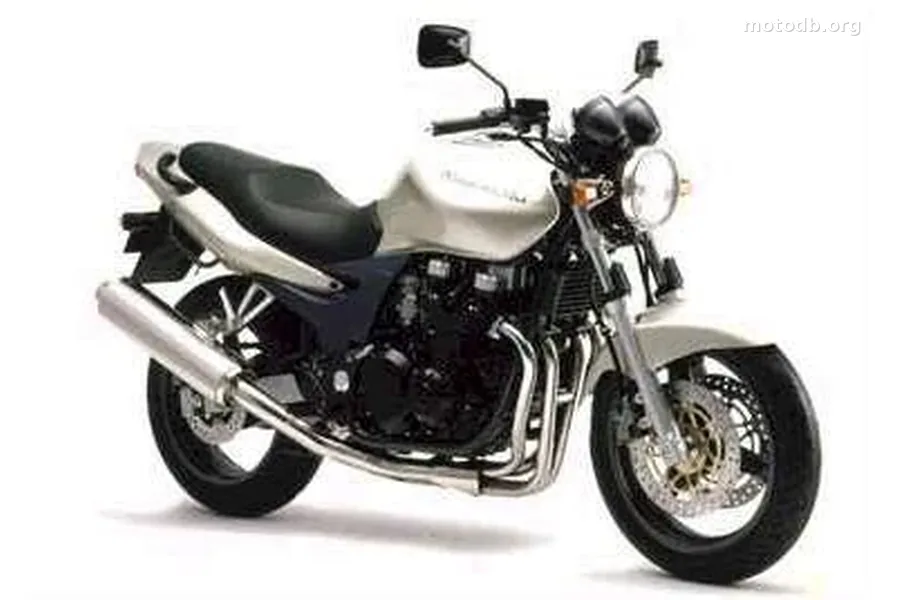
Kawasaki had a problem to solve in 2000: filling the void left by the aging Zephyr without falling into the trap of following the crowd. While Yamaha, Suzuki and Honda were battling it out with razor-sharp 600cc machines, the green brand played a different card. Slotted between the ER-5 and the ZRX 1100, the ZR-7 arrives with 738cc beneath its 22-litre tank, an inline four-cylinder whose architecture dates back to another era, and a price tag set at around €6,097 — exactly what Suzuki was asking for its Bandit. The message is clear: more displacement for the same budget, against competitors like the Fazer, the GSF and the Hornet.
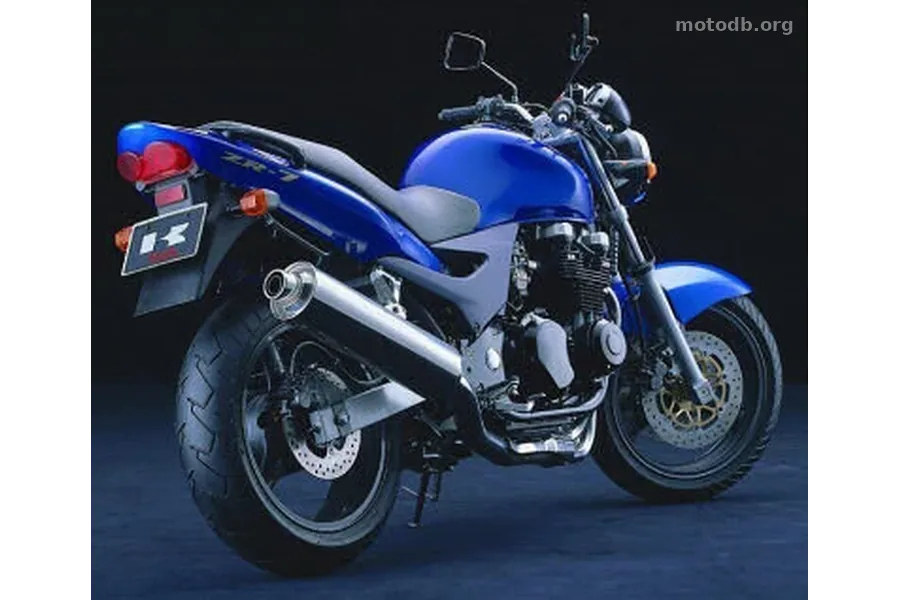
That engine, in particular, deserves a closer look. Two valves per cylinder, visible cooling fins, a compression ratio of 9.5:1 and a bore of 66 mm for a stroke of 54 mm: this is far removed from modern architectures. Yet this old-school powerplant produces 62.8 Nm of torque at 7,500 rpm, compared to rivals that hunt for their power high in the rev range. The ZR-7 responds from mid-revs, without artificial eagerness, with a progressiveness that the K-TRIC ignition optimisation system further enhances. The 76 horsepower arrives at 9,500 rpm, which remains reasonable, but it is in the everyday rev ranges that this four-cylinder holds the upper hand. Those who wonder what riders think of the 2000 Kawasaki 750 ZR-7 N generally get the same answer: a healthy, predictable engine that grows on you with use.
The steel double-cradle frame accompanies without betraying. 220 kg fully fuelled, a 41 mm fork with 130 mm of travel, an equivalent rear monoshock: nothing revolutionary, but an overall coherence that works. The 815 mm seat height does not exclude average-sized riders, and the slightly forward-leaning riding position remains natural over time. In town, the bike turns tight, filters through traffic effortlessly, and the engine's flexibility allows tall gearing even at low speeds. On open roads, the front end proves precise and corner sequences flow with fluidity. Be careful, however, on degraded surfaces: the rear can become unsettled when pushed. The brakes — two 300 mm front discs with twin-piston calipers, a 240 mm rear disc — work with progressive feel. The rear lacks a little bite, but nothing alarming.
On the equipment front, the ZR-7 holds nothing back: fuel gauge, centre stand, tie-down hooks, underseat storage for a U-lock. These are details that carry weight when choosing an everyday motorcycle. The only regret comes from the chain adjustment, which reverted to a conventional system whereas the previous version offered an elegant eccentric adjuster. Minor, but symptomatic of a rationalisation that irritates purists. For long-distance riders, the S version with its headstock fairing provides welcome protection on motorway stretches.
The ZR-7 does not try to dazzle. It embraces dated mechanics, a sober style, and an all-round vocation with no sporting pretension. That is precisely what may put off buyers drawn to the image of race-derived supersports machines, and win over everyone else: regular riders who want a reliable motorcycle, engaging without being exhausting, and well-equipped enough to serve equally well on weekdays and weekend back-road runs. An honest roadster, built for those who actually ride.
Practical info
- La moto est accessible aux permis : A
Reviews & comments
No reviews yet. Be the first to share your opinion!