Key performance
Technical specifications
Engine
- Displacement
- 498 cc
- Power
- 60.0 ch @ 9800 tr/min (44.1 kW)
- Torque
- 46.1 Nm @ 8500 tr/min
- Engine type
- Bicylindre Vertical, 4 temps
- Cooling
- liquide
- Compression ratio
- 10.8:1
- Bore × stroke
- 74 x 58 mm
- Valves/cylinder
- 4
- Camshafts
- 2 ACT
Chassis
- Frame
- Double berceau tubulaire en acier
- Gearbox
- boîte à 6 rapports
- Final drive
- Chaîne
- Front suspension
- Fourche hydraulique Ø 37 mm, déb : 130 mm
- Rear suspension
- Mono-amortisseur, déb : 100 mm
Brakes
- Front brakes
- Freinage 2 disques Ø 270 mm, étrier 2 pistons
- Rear brakes
- Freinage 1 disque Ø 230 mm, étrier simple piston
- Front tyre
- 110/70-17
- Front tyre pressure
- 2.25 bar
- Rear tyre
- 130/70-17
- Rear tyre pressure
- 2.50 bar
Dimensions
- Seat height
- 775.00 mm
- Fuel capacity
- 18.00 L
- Weight
- 202.00 kg
- Dry weight
- 179.00 kg
- New price
- 5 599 €
Overview
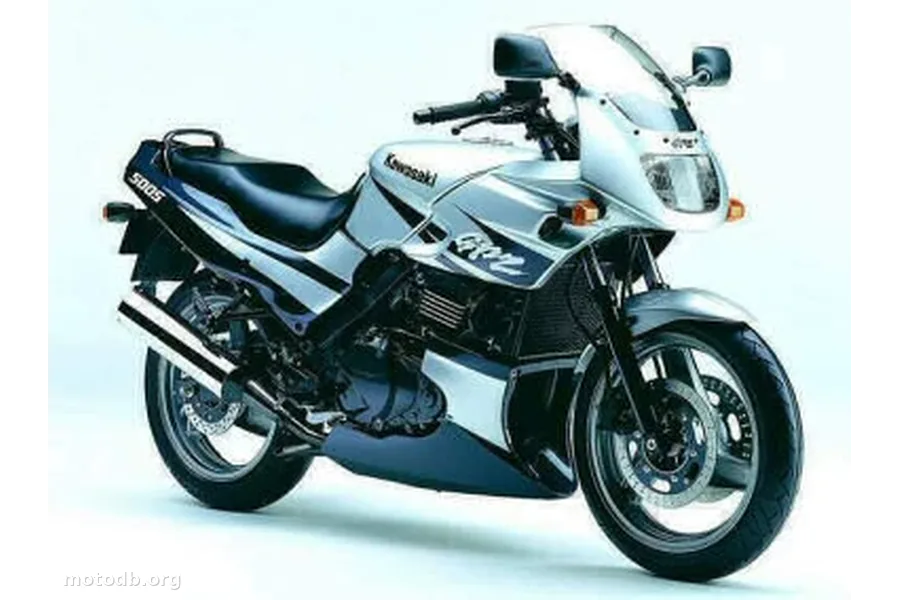
When Kawasaki launched the GPZ 500 in the late 1980s, nobody was betting on its longevity. Yet this 498 cc parallel twin spent nearly two decades in the catalog without ever truly aging. The Kawasaki 500 GPZ spec sheet tells a story of measured evolution: in 1988, the belly pan and second front disc joined the standard equipment, then 1994 brought the real turning point, with 17-inch wheels, a rear disc replacing the drum, and restyled bodywork. Since then, only the color schemes have changed. That's not much, and yet the machine still holds its own.
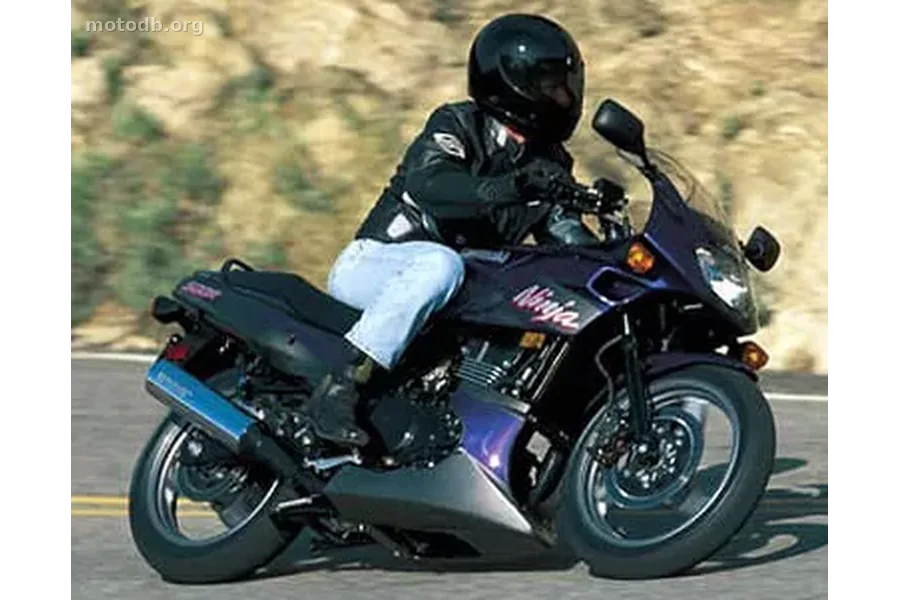
What gives the Kawasaki 500 GPZ engine its character is its old-school temperament. The twin spins to 9,800 rpm to release 60 horsepower, with a 10.8:1 compression ratio and a short-stroke 74 x 58 mm bore that needs warming up before giving its best. The 46.1 Nm of torque arrives at 8,500 rpm, which sums up the beast's profile well: it doesn't like loafing around at low revs. Those looking for tractability from idle will head toward a Honda CB500 or a Suzuki GS500, two direct rivals that play more to the easy-riding card. The GPZ, on the other hand, rewards those willing to work the 6-speed gearbox.
For a wet weight of 202 kg and a seat height of 775 mm, the package remains accessible. The chassis, with its steel tubular double cradle frame and 37 mm fork, delivers honest agility without ever tipping into nervousness. On twisty roads, the bike places precisely, and the Kawasaki 500 GPZ A2 license restriction doesn't fundamentally alter the machine's character. That's precisely what makes it an honest learning tool for a rider in progression, provided you don't mistake accessibility for forgiveness.
The braking, however, deserves attention. Two 270 mm front discs with twin-piston calipers, a 230 mm rear disc with single-piston caliper, tires sized 110/70-17 and 130/70-17. On paper, it seems adequate. In practice, when you push the GPZ toward its claimed 195 km/h, you reach the system's limits. It's not a deal-breaking flaw, but a clear signal that the bike was designed for mountain road enjoyment, not sustained high-speed adventures. Those considering a Kawasaki 500 GPZ exhaust upgrade and some suspension tuning will find genuine room for improvement on this front.
Today, finding a good-condition used Kawasaki 500 GPZ remains feasible, and the market for examples from 1989 to 1994 stays active. Kawasaki 500 GPZ maintenance questions come up regularly on Kawasaki 500 GPZ motorcycle forums, particularly around the Kawasaki 500 GPZ fuel tap and the Kawasaki 500 GPZ battery, two watch points on older examples. Listed new at 5,599 euros in its final version, it isn't cheap for the 500 cc category, but that's the price of a machine that has never had to be ashamed of its reliability. For an urban rider who also wants weekend enjoyment, it's a solid compromise — no frills, no shortcuts.
Practical info
- Moto bridable à 34 ch pour l'ancien permis A MTT1 - pas garanti pour le permis A2
- La moto est accessible aux permis : A, A (MTT1)
Reviews & comments
No reviews yet. Be the first to share your opinion!