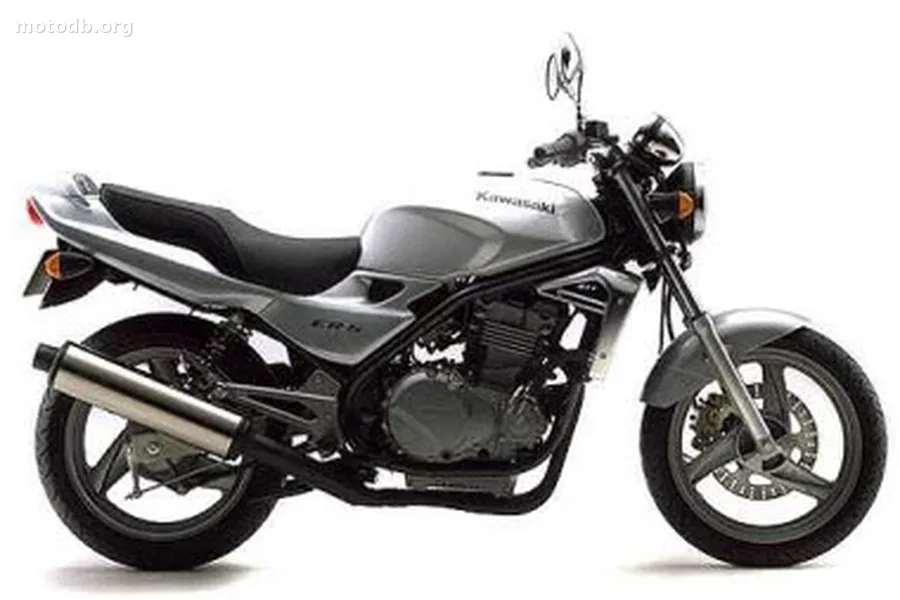
Key performance
Technical specifications
Engine
- Displacement
- 498 cc
- Power
- 60.0 ch @ 9800 tr/min (44.1 kW)
- Torque
- 46.1 Nm @ 8500 tr/min
- Engine type
- Bicylindre Vertical, 4 temps
- Cooling
- liquide
- Compression ratio
- 10.8:1
- Bore × stroke
- 74 x 58 mm
- Valves/cylinder
- 4
- Camshafts
- 2 ACT
Chassis
- Frame
- Double berceau tubulaire en acier
- Gearbox
- boîte à 6 rapports
- Final drive
- Chaîne
- Front suspension
- Fourche hydraulique Ø 37 mm, déb : 130 mm
- Rear suspension
- Mono-amortisseur, déb : 100 mm
Brakes
- Front brakes
- Freinage 2 disques Ø 270 mm, étrier 2 pistons
- Rear brakes
- Freinage 1 disque Ø 230 mm, étrier simple piston
- Front tyre
- 110/70-17
- Front tyre pressure
- 2.25 bar
- Rear tyre
- 130/70-17
- Rear tyre pressure
- 2.50 bar
Dimensions
- Seat height
- 775.00 mm
- Fuel capacity
- 18.00 L
- Weight
- 202.00 kg
- Dry weight
- 179.00 kg
- New price
- 5 599 €
Overview
Someone once said that the motorcycles that endure are those that never try to revolutionize anything. The Kawasaki 500 GPZ perfectly illustrates this maxim. Born in the late 1980s, it made its way through much of the 1990s with minimal evolution, almost reluctantly. The earliest versions, as the 1989 Kawasaki 500 GPZ spec sheet reveals, had a few shortcomings — no engine spoiler and a single front disc. Kawasaki corrected course as early as 1988, then carried out a more thorough revision in 1994: a rear disc replacing the drum brake, a switch to 17-inch wheels, and a revised fairing. Since then, the Kawasaki 500 GPZ has changed only its livery. It is a philosophy of deliberate stability.
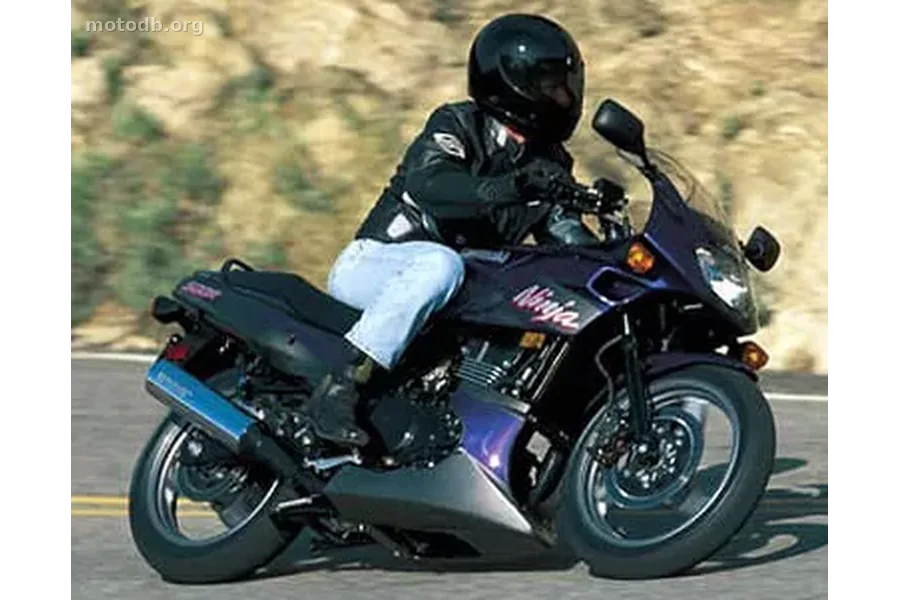
What strikes you about this machine is the sonic and mechanical signature of the 498 cc vertical twin. The Kawasaki 500 GPZ engine does not have the temperament of an easy-going tourer. It delivers its 60 horsepower at 9,800 rpm, its 46.1 Nm of torque only arrives at 8,500 rpm, and you have to work it hard to get anything out of it. At low revs it struggles, it grumbles, it refuses to play along. That is the price to pay for an engine built for high rpm, with a compression ratio of 10.8:1 and a four-valve-per-cylinder layout. Riders coming from a smoother parallel twin — a Bandit 500, for instance — may find it unsettling at first. But push it beyond 6,000 rpm and the character changes completely.
At 179 kg dry and 202 kg fully fuelled, the GPZ remains light in its segment. The 775 mm seat height is accessible, the tubular double-cradle frame delivers precise feedback, and the 110/70-17 front and 130/70-17 rear tyres provide a healthy base of grip. The 37 mm fork with 130 mm of travel handles road imperfections adequately, and the rear monoshock proves effective without being sophisticated. In the mountains, on winding roads, riding it hard becomes genuinely enjoyable. It corners cleanly, without unwanted nervousness, and encourages both beginner and intermediate riders to progressively push beyond their own limits. The sporting yet not extreme riding position and the 18-litre fuel tank also allow for real distance riding. The 195 km/h top speed is not merely theoretical.
The braking deserves a special mention, and not for the right reasons. The two 270 mm front discs with twin-piston calipers and the 230 mm rear disc do the job in relaxed riding, but when the machine is genuinely pushed, the limits of the system become apparent. This is the GPZ's long-standing flaw, flagged on every forum and well known among owners. An aftermarket Kawasaki 500 GPZ exhaust and brake pad replacement are often among the first modifications made when buying a used example.
On the used Kawasaki 500 GPZ market, examples from 1990, 1991, 1992 or 1993 can still be found in good condition, provided the Kawasaki 500 GPZ service history is checked thoroughly — particularly the Kawasaki 500 GPZ fuel tap, which is prone to clogging, the Kawasaki 500 GPZ battery, often neglected on bikes that have been sitting idle, and the Kawasaki 500 GPZ A2 restriction, which should be removed if acquiring a machine that was originally sold in restricted form. Some owners take customisation as far as a Kawasaki 500 GPZ café racer build, the machine's clean lines lending themselves well to the style. At 5,599 euros in recent trim, it positions itself as an accessible and reliable sports bike, without frills. For someone looking to discover committed riding without breaking the bank, the GPZ is a coherent choice. It does not impress on paper, but it teaches, it entertains, and it stands the test of time.
Practical info
- Moto bridable à 34 ch pour l'ancien permis A MTT1 - pas garanti pour le permis A2
- La moto est accessible aux permis : A, A (MTT1)
Reviews & comments
No reviews yet. Be the first to share your opinion!