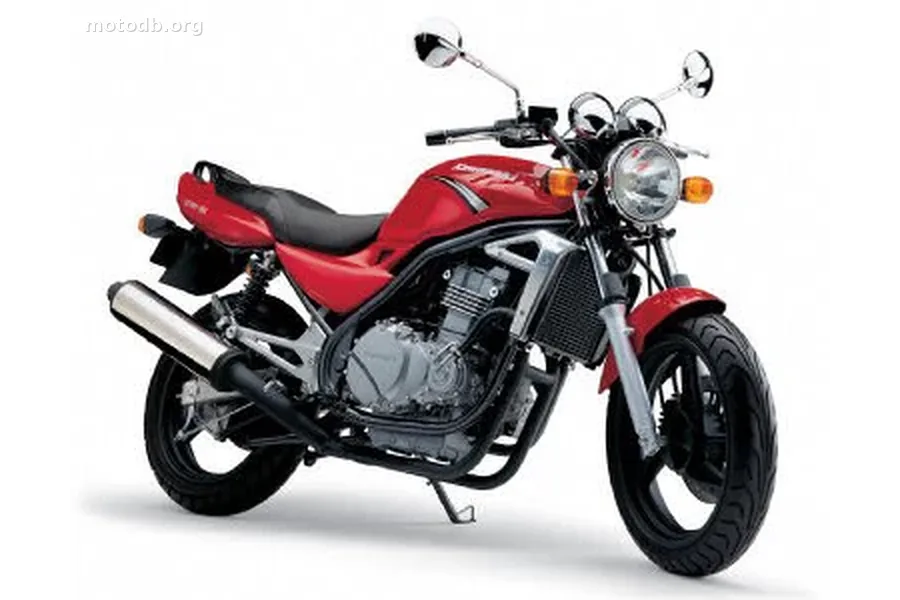
Key performance
Technical specifications
Engine
- Displacement
- 498 cc
- Power
- 60.0 ch @ 9800 tr/min (44.1 kW)
- Torque
- 46.1 Nm @ 8500 tr/min
- Engine type
- Bicylindre Vertical, 4 temps
- Cooling
- liquide
- Compression ratio
- 10.8:1
- Bore × stroke
- 74 x 58 mm
- Valves/cylinder
- 4
- Camshafts
- 2 ACT
Chassis
- Frame
- Double berceau tubulaire en acier
- Gearbox
- boîte à 6 rapports
- Final drive
- Chaîne
- Front suspension
- Fourche hydraulique Ø 37 mm, déb : 130 mm
- Rear suspension
- Mono-amortisseur, déb : 100 mm
Brakes
- Front brakes
- Freinage 2 disques Ø 270 mm, étrier 2 pistons
- Rear brakes
- Freinage 1 disque Ø 230 mm, étrier simple piston
- Front tyre
- 110/70-17
- Front tyre pressure
- 2.25 bar
- Rear tyre
- 130/70-17
- Rear tyre pressure
- 2.50 bar
Dimensions
- Seat height
- 775.00 mm
- Fuel capacity
- 18.00 L
- Weight
- 202.00 kg
- Dry weight
- 179.00 kg
- New price
- 5 599 €
Overview
When Kawasaki launched the GPZ 500 in the late 1980s, nobody expected it to hold its ground in the catalogues for so long. Yet, without any technical revolution or flashy marketing move, this 498 cc parallel twin crossed generations almost untouched, accumulating loyal fans the way others rack up miles. The Kawasaki 500 GPZ is the kind of bike you don't immediately notice in a parking lot, but one you always end up watching pull away with a touch of envy.
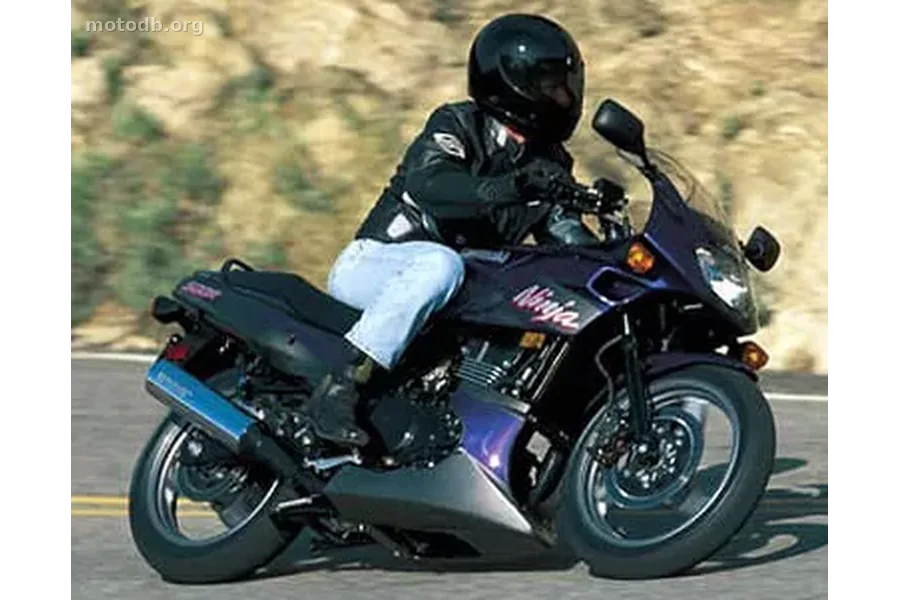
The machine's mechanical history can be read through a few key dates. The Kawasaki 500 GPZ spec sheet from the early years — the 1987 or 1989 models — was more spartan: no engine spoiler, a single front disc. From 1988, Kawasaki made corrections. Then in 1994, the last major revision arrived: the rear drum gave way to a 230 mm disc, the wheels moved to 17 inches, and the fairing was redesigned. The 1994 Kawasaki 500 GPZ thus became the definitive version still found in abundance on the used Kawasaki 500 GPZ market today. Since then, only the color schemes have changed.
The engine is the heart of the matter. This vertical twin produces 60 horsepower at 9,800 rpm with a torque figure of 46.1 Nm reached at 8,500 rpm. The power delivery is clearly oriented toward high revs: below 5,000 rpm, the Kawasaki 500 GPZ engine lacks smoothness, pulling lazily and demanding to be worked hard before it comes alive. This is a well-known Kawasaki trait — that tendency to wake up higher in the rev range — and you have to work with it. A rider used to singles or low-compression twins may be caught off guard at first. But once past that threshold, the top-end pull is real, the climb through the rev range is clean, and the claimed top speed of 195 km/h is anything but theoretical on an open road.
The chassis is fully focused on versatility. At 179 kg dry and 202 kg fully fuelled, the GPZ sits in a reasonable weight class. A seat height of 775 mm makes it accessible to riders of average build, and the riding position — neither too aggressive nor too upright — suits a Sunday mountain run just as well as a daily urban commute. The 18-litre tank offers a decent range, useful for those who want to use it as a light tourer. The steel tubular double-cradle frame and 37 mm fork do their job without excessive sophistication, delivering honest and predictable handling. This is precisely what appeals to Kawasaki 500 GPZ café racer enthusiasts, who sometimes swap the stock look for a louder Kawasaki 500 GPZ exhaust to accentuate the machine's sporting character.
The main drawback lies in the braking. Two 270 mm front discs with twin-piston calipers and a 230 mm rear disc: on paper it sounds adequate. In practice, when you start pushing the bike through a tight series of bends, you realize the bite lacks conviction to match the engine's performance. It's not dangerous, but it's the first item most owners address during Kawasaki 500 GPZ servicing.
At 5,599 euros for a recent example, or considerably less on the used market depending on condition and year, the Kawasaki 500 GPZ is aimed primarily at the rider who wants an involving motorcycle without breaking the bank — reliable without being dull. Kawasaki 500 GPZ forums are full of testimonials from owners clocking up years and miles without major issues, which speaks volumes about the machine's overall robustness. Whether chosen as a serious first bike or for everyday enjoyment, this 500 always has something to say.
Practical info
- Moto bridable à 34 ch pour l'ancien permis A MTT1 - pas garanti pour le permis A2
- La moto est accessible aux permis : A, A (MTT1)
Reviews & comments
No reviews yet. Be the first to share your opinion!