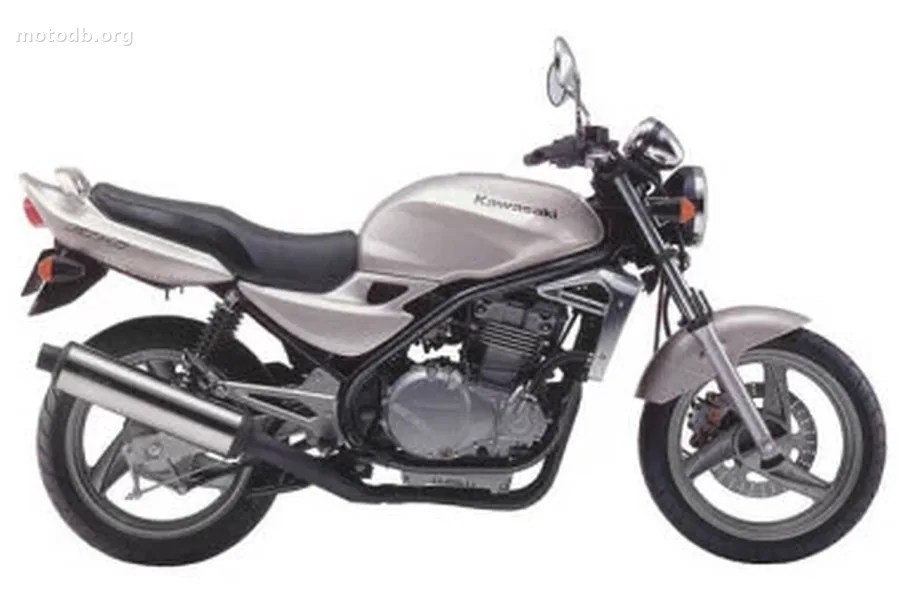
Key performance
Technical specifications
Engine
- Displacement
- 498 cc
- Power
- 60.0 ch @ 9800 tr/min (44.1 kW)
- Torque
- 46.1 Nm @ 8500 tr/min
- Engine type
- Bicylindre Vertical, 4 temps
- Cooling
- liquide
- Compression ratio
- 10.8:1
- Bore × stroke
- 74 x 58 mm
- Valves/cylinder
- 4
- Camshafts
- 2 ACT
Chassis
- Frame
- Double berceau tubulaire en acier
- Gearbox
- boîte à 6 rapports
- Final drive
- Chaîne
- Front suspension
- Fourche hydraulique Ø 37 mm, déb : 130 mm
- Rear suspension
- Mono-amortisseur, déb : 100 mm
Brakes
- Front brakes
- Freinage 2 disques Ø 270 mm, étrier 2 pistons
- Rear brakes
- Freinage 1 disque Ø 230 mm, étrier simple piston
- Front tyre
- 110/70-17
- Front tyre pressure
- 2.25 bar
- Rear tyre
- 130/70-17
- Rear tyre pressure
- 2.50 bar
Dimensions
- Seat height
- 775.00 mm
- Fuel capacity
- 18.00 L
- Weight
- 202.00 kg
- Dry weight
- 179.00 kg
- New price
- 5 599 €
Overview
When Kawasaki launched the GPZ 500 in the late eighties, the Akashi manufacturer wasn't looking to revolutionize the middleweight category. It offered something more subtle: a well-bred machine, designed for the long haul, capable of spanning decades without showing its age. The Kawasaki GPZ 500 would indeed enjoy a career of some fifteen years with disconcerting serenity, barely undergoing a few tweaks across model years. The earliest versions arrived without a belly pan or front double disc; both elements joined the standard specification from 1988 onwards. The 1994 model year marked the last truly significant update: out went the rear drum, in came the disc, the wheels moved to 17 inches and the bodywork was redesigned. After that, the 1994 Kawasaki GPZ 500 and its successors would change nothing but their livery. A longevity that commands respect, and which still fuels the Kawasaki GPZ 500 forums today, where owners exchange tips and maintenance advice.
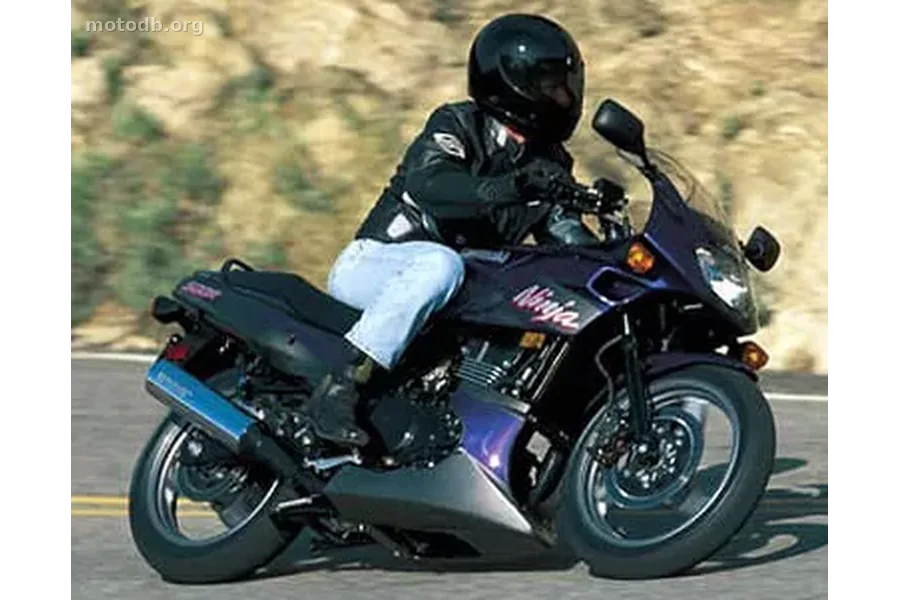
The heart of the beast is a 498 cc vertical twin with four valves per cylinder, a compression ratio of 10.8:1, and a short stroke of 58 mm for a bore of 74 mm. The recipe is typically Kawasaki: an engine that loves high revs, coming alive above 7,000 rpm, delivering its 60 horsepower at 9,800 rpm with a strong pull all the way to the redline. The 46 Nm of torque arrives at 8,500 rpm, which says a great deal about the machine's temperament. Below 4,000 rpm, it's a different story: the engine drags its feet, lacks cohesion, and demands that you work the six-speed gearbox to stay within the power band. This isn't a deal-breaking flaw, but it's worth knowing, especially if daily urban use is on the agenda.
At 179 kg dry and a seat height of 775 mm, the GPZ can be picked up without ceremony. The chassis, with its 37 mm hydraulic fork and rear monoshock, delivers a sound and predictable ride, particularly at home on twisting roads. This is where the bike reveals its true character: light on the front end, quick to lean, it invites you to play with corners without ever turning treacherous. The A2 licence restriction poses no structural issue, the bike being naturally well-proportioned for progressive riding. The 18-litre tank, combined with reasonable fuel consumption, provides a decent range for eating up the miles.
The braking deserves a few words, and not all of them complimentary. The two 270 mm front discs with twin-piston calipers stop the bike honestly enough, but show their limits when pushing the machine toward its claimed top speed of 195 km/h. The 230 mm rear disc rounds out the package without distinction. This system clearly belongs to another era and represents the most obvious weak point on an otherwise well-built machine. Those considering an aftermarket exhaust to gain a few horsepower would do well to also think about a braking upgrade.
Available at around 5,599 euros in current trim, the Kawasaki GPZ 500 remains a solid value on the used market. It appeals to riders in search of a genuine, accessible sports bike without the complexity or price tag of modern machinery. Café racer enthusiasts see an interesting base in it, with the Kawasaki GPZ 500 café racer being a popular styling exercise on the forums. Sober, reliable, and economical to run when the battery and fuel tap are in good order, it rewards those willing to keep the revs up. For a new licence holder or a rider on a tight budget, it's a choice that won't disappoint.
Practical info
- Moto bridable à 34 ch pour l'ancien permis A MTT1 - pas garanti pour le permis A2
- La moto est accessible aux permis : A, A (MTT1)
Reviews & comments
No reviews yet. Be the first to share your opinion!