Key performance
Technical specifications
Engine
- Displacement
- 498 cc
- Power
- 60.0 ch @ 9800 tr/min (44.1 kW)
- Torque
- 46.1 Nm @ 8500 tr/min
- Engine type
- Bicylindre Vertical, 4 temps
- Cooling
- liquide
- Compression ratio
- 10.8:1
- Bore × stroke
- 74 x 58 mm
- Valves/cylinder
- 4
- Camshafts
- 2 ACT
Chassis
- Frame
- Double berceau tubulaire en acier
- Gearbox
- boîte à 6 rapports
- Final drive
- Chaîne
- Front suspension
- Fourche hydraulique Ø 37 mm, déb : 130 mm
- Rear suspension
- Mono-amortisseur, déb : 100 mm
Brakes
- Front brakes
- Freinage 2 disques Ø 270 mm, étrier 2 pistons
- Rear brakes
- Freinage 1 disque Ø 230 mm, étrier simple piston
- Front tyre
- 110/70-17
- Front tyre pressure
- 2.25 bar
- Rear tyre
- 130/70-17
- Rear tyre pressure
- 2.50 bar
Dimensions
- Seat height
- 775.00 mm
- Fuel capacity
- 18.00 L
- Weight
- 202.00 kg
- Dry weight
- 179.00 kg
- New price
- 5 599 €
Overview
When a motorcycle stays in the catalog without major modification for nearly twenty years, you can call it either commercial laziness or lasting success. With the Kawasaki 500 GPZ, the second hypothesis clearly wins out. Launched in the late 1980s, this small sport-GT crossed the decades with an almost provocative sobriety, building a loyal following without ever trying to seduce it through passing trends. Its spec sheet doesn't inspire dreams on paper, and that's precisely why it's interesting.
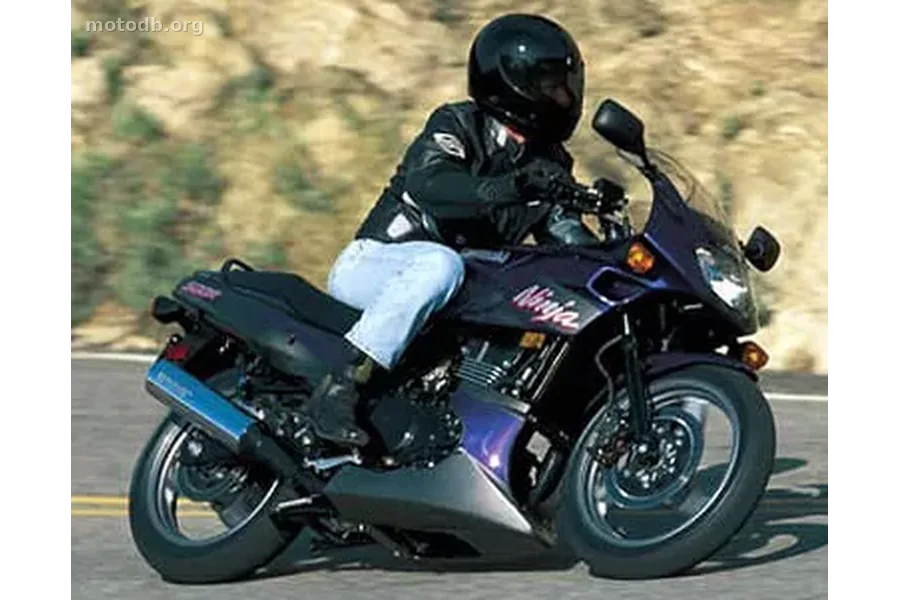
The Kawasaki 500 GPZ engine is a 498 cc vertical twin built to rev. Its 60 horsepower peaks at 9,800 rpm, and the 46.1 Nm of torque arrives at 8,500 rpm — meaning you have to give it room to breathe before it comes alive. Low in the rev range, the twin lacks flexibility and makes no apologies for not being designed for idle urban cruising. Those looking for a smooth, torquey engine from 3,000 rpm will find what they need in a Honda CB500 or Suzuki GS500. But those willing to play the game discover a strong top-end pull and a well-defined character — a trademark of the Akashi manufacturer since its glory days in sport. The 10.8:1 compression ratio and four-valve-per-cylinder layout confirm the machine's ambitions.
The GPZ's career was not without evolution, however. While the Kawasaki 500 GPZ 1987 and Kawasaki 500 GPZ 1989 came without a belly pan and with only a single front disc, the machine gained specification from 1988 onwards. The Kawasaki 500 GPZ 1990, Kawasaki 500 GPZ 1991, Kawasaki 500 GPZ 1992, and Kawasaki 500 GPZ 1993 all benefit from this enhanced configuration. In 1994, the date of the last significant changes, the rear drum gave way to a 230 mm disc, the wheels moved to 17-inch rims, and the fairing was redesigned. The Kawasaki 500 GPZ 1994 therefore marks a genuine aesthetic and technical break, after which the machine would change nothing but colors through to its final European sale in 2005. This final model year is precisely the one covered by the spec sheet presented here, at 5,599 euros.
On the road, the tubular steel double-cradle frame paired with the 37 mm fork and rear monoshock delivers an honest performance. The bike weighs 179 kg dry and 202 kg fully fuelled — a contained weight that makes it easy to get to grips with. The 775 mm seat height remains accessible, and the overall handling proves sound and predictable. Through linked corners, particularly in the mountains, the GPZ shows a playful side without ever becoming treacherous. It's the ideal machine for a newly licensed rider looking to improve without frightening themselves, or for an experienced rider seeking a lightweight and economical everyday tool. The 18-litre tank pushes range to a reasonable level, Kawasaki 500 GPZ maintenance is well regarded as simple and accessible, and parts remain available — which explains why Kawasaki 500 GPZ motorcycle forums continue to show regular activity. The Kawasaki 500 GPZ A2 licence restriction is also a frequently raised topic, the machine lending itself well to this regulatory requirement.
One real weakness deserves to be clearly stated: the braking. The two 270 mm front discs and single 230 mm rear disc lack the bite you would expect from a sports machine capable of approaching 195 km/h. At high speed, deceleration lacks authority, and it is one of the first modifications owners rush to address — often starting with a Kawasaki 500 GPZ exhaust to free up the horsepower, then moving on to the calipers. The fuel system, notably the Kawasaki 500 GPZ fuel tap and the Kawasaki 500 GPZ battery, are also classic watchpoints on used Kawasaki 500 GPZ examples, of which plenty still circulate. In the United States, where it survived under the Ninja 500R name for several years after its European discontinuation, it built a reputation as a versatile and reliable machine that holds to this day.
Practical info
- Moto bridable à 34 ch pour l'ancien permis A MTT1 - pas garanti pour le permis A2
- La moto est accessible aux permis : A, A (MTT1)
Reviews & comments
No reviews yet. Be the first to share your opinion!