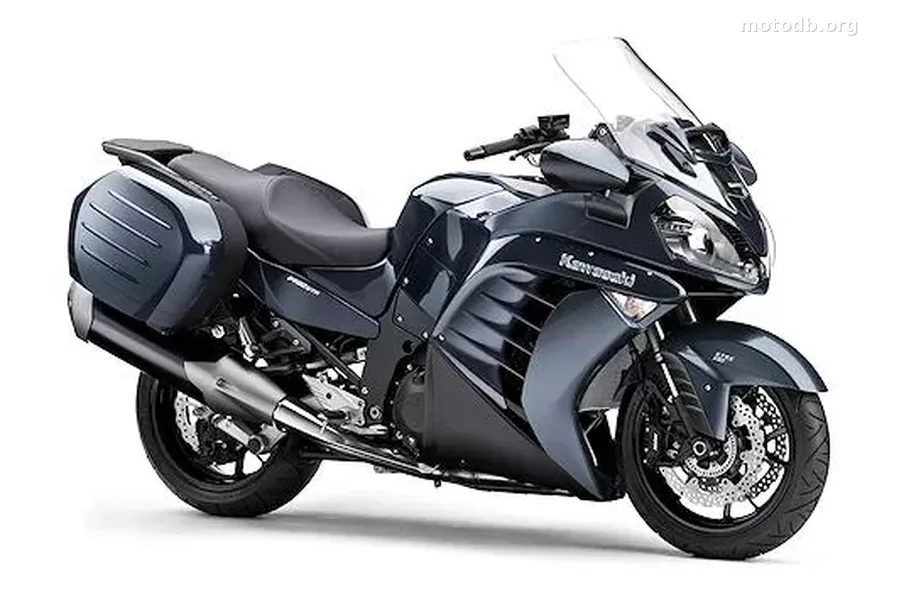
Key performance
Technical specifications
- Power
- 155.0 ch @ 8800 tr/min (114.0 kW) → 155.0 ch @ 8800 tr/min (113.1 kW)
- Camshafts
- 2 ACT → —
- Fuel system
- Injection. Digital → Injection. 40 mm x 4
- Ignition
- TCBI with Digital Advance → Digital
- Front suspension
- 43mm inverted, telescopic fork with adjustable rebound damping and spring preload / 4.4 in. → 43 mm inverted fork with adjustable rebound damping and spring preload
- Rear suspension
- Tetra-Lever with stepless rebound damping adjustment and remote spring preload adjuster / 5.4 in. → Bottom-Link Uni-Trak with gas-charged shock, Tetra-Lever.
- Front wheel travel
- — → 113 mm (4.4 inches)
- Rear wheel travel
- — → 136 mm (5.4 inches)
- Front brakes
- Double disc → Double disc. Floating discs. Dual radial-mount, opposed 4-piston, 4-pad caliper.
- Rear brakes
- Single disc → Single disc. Opposed 2-piston caliper
- Front tyre pressure
- 2.90 bar → —
- Rear tyre pressure
- 2.90 bar → —
- Wheelbase
- 1519.00 mm → 1520.00 mm
- Length
- 2271.00 mm → 2230.00 mm
- Width
- 780.00 mm → 790.00 mm
- Height
- — → 1345.00 mm
- Fuel capacity
- 21.95 L → 22.00 L
- Weight
- 308.00 kg → 312.00 kg
- Dry weight
- 304.00 kg → —
- New price
- 16 049 € → —
Engine
- Displacement
- 1352 cc
- Power
- 155.0 ch @ 8800 tr/min (113.1 kW)
- Torque
- 136.0 Nm @ 6200 tr/min
- Engine type
- In-line four, four-stroke
- Cooling
- Liquid
- Compression ratio
- 10.7:1
- Bore × stroke
- 84.0 x 61.0 mm (3.3 x 2.4 inches)
- Valves/cylinder
- 4
- Fuel system
- Injection. 40 mm x 4
- Valve timing
- Double Overhead Cams/Twin Cam (DOHC)
- Lubrication
- Forced lubrication, wet sump
- Ignition
- Digital
- Starter
- Electric
Chassis
- Frame
- Monocoque, pressed-aluminium
- Gearbox
- 6-speed
- Final drive
- Shaft drive (cardan) (final drive)
- Clutch
- Wet multi-disc, manual
- Front suspension
- 43 mm inverted fork with adjustable rebound damping and spring preload
- Rear suspension
- Bottom-Link Uni-Trak with gas-charged shock, Tetra-Lever.
- Front wheel travel
- 113 mm (4.4 inches)
- Rear wheel travel
- 136 mm (5.4 inches)
Brakes
- Front brakes
- Double disc. Floating discs. Dual radial-mount, opposed 4-piston, 4-pad caliper.
- Rear brakes
- Single disc. Opposed 2-piston caliper
- Front tyre
- 120/70-ZR17
- Rear tyre
- 190/50-ZR17
Dimensions
- Seat height
- 815.00 mm
- Wheelbase
- 1520.00 mm
- Ground clearance
- 125.00 mm
- Length
- 2230.00 mm
- Width
- 790.00 mm
- Height
- 1345.00 mm
- Fuel capacity
- 22.00 L
- Weight
- 312.00 kg
Overview
When we talk about grand touring, the names that always come up are the same: the BMW R1200RT, the Honda Gold Wing, the Yamaha FJR1300. The Kawasaki 1400 GTR, on the other hand, has never sought to conform. Pressed aluminum monocoque frame, inline four-cylinder engine with variable valve timing, Tetra-lever rear shaft drive: technically, it has no clone in its category. And that’s something no one can take away from it since the first 2007 Kawasaki 1400 GTR.
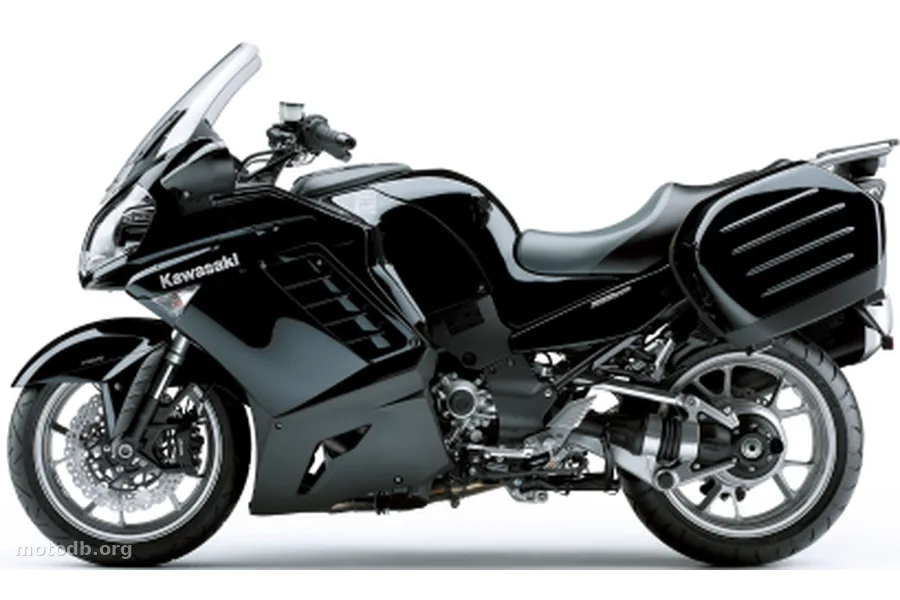
The 2016 version is a surgical evolution of the previous generation. Kawasaki didn't redesign everything; they refined it. The seat has been reworked in shape so that the rider can more easily place their feet, which is not insignificant on a machine that weighs 312 kg fully fueled and has a seat height of 815 mm. The electric windscreen, adjustable with the left thumb without releasing the handlebars, now has a window at its base adjustable in two positions to break up turbulence in the bubble. ABS has been revised in a more compact format with improved response granularity. The first gear has been shortened and the ECU recalibrated to make starts more docile. With 136 Nm available from 6,200 rpm and 155 horsepower at the peak at 8,800 rpm, one might find the change superfluous. It is not superfluous. Such torque on wet pavement deserves to be managed with care, especially when fully loaded.
Because that’s the whole logic of the Kawasaki 1400 GTR specifications: it is designed to travel for real, not to parade on Sunday mornings. The 22-liter tank provides comfortable range, the integrated cases offer 37 liters per side, the optional top case holds 47 liters. On board, heated grips are standard, keyless start KIPASS, tire pressure monitoring, a 12V socket, and KTRC power mode selection and traction control are part of the standard package. The second-generation K-ACT coactive assisted braking system offers two maps depending on the rider's style or conditions. This level of equipment, at €17,499 in the catalog, remains within the standard of a segment where the FJR1300 and the R1200RT play on the same prices. The GTR gives nothing away to its rivals in this area.
Where the debate arises is on accessibility. 312 kg, 125 mm of ground clearance, and a wheelbase of 1,520 mm do not forgive errors in underground parking garages. It is clearly not the tool for beginners. The Kawasaki 1400 GTR is aimed at the seasoned globetrotter, the one who does 800 km in a day without a second thought and who wants solid mechanics beneath him rather than an over-the-top technological gadget. Its four-cylinder engine has that little something of the ZZR1400 in its gut, a frank revving that recalls that the GTR is not entirely confined to the heavy tourer label. The announced top speed of 250 km/h is not a selling point for this audience, but it says something about the nature of the engine.
The Kawasaki 1400 GTR used motorcycle market remains active precisely because the machine ages well. Examples from the 2008, 2009, 2010 model years are still running without particular problems, and the more recent 2018, 2019, 2020 versions have benefited from regular adjustments without a break in philosophy. Kawasaki has built here a consistent road bike, without excess embellishment, with a real technical identity. Not the lightest, not the most technologically advanced, but a machine that does what it promises, kilometer after kilometer.
Indicators & positioning
Similar bikes
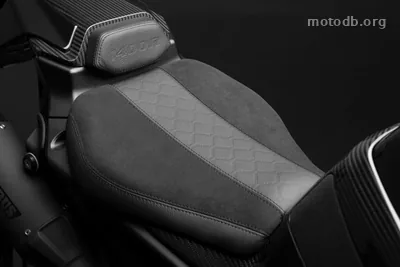
Brabus 1400 R Signature Edition
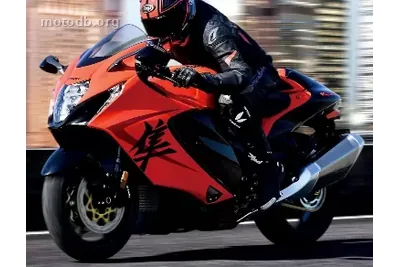
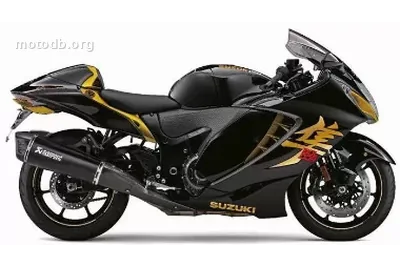
GSX 1300 R Hayabusa 25th anniversary
Reviews & comments
No reviews yet. Be the first to share your opinion!