Key performance
Technical specifications
Engine
- Displacement
- 124 cc
- Power
- 11.0 ch @ 8250 tr/min (8.1 kW)
- Torque
- 10.2 Nm @ 6500 tr/min
- Engine type
- Single cylinder, four-stroke
- Cooling
- Air
- Compression ratio
- 9.2 : 1
- Bore × stroke
- 56.5 x 49.5 mm
- Valves/cylinder
- 2
- Camshafts
- 1 ACT
- Valve timing
- Overhead Valves (OHV)
- Ignition
- Electric
Chassis
- Frame
- simple berceau tubulaire en acier
- Gearbox
- 5-speed
- Final drive
- Chain (final drive)
- Front suspension
- Fourche téléhydraulique Ø 37 mm, déb : 162 mm
- Rear suspension
- Mono-amortisseur, déb : 128 mm
Brakes
- Front brakes
- Single disc. 2-piston calipers
- Rear brakes
- Freinage tambour Ø 110 mm
- Front tyre
- 90/90-19
- Front tyre pressure
- 1.75 bar
- Rear tyre
- 110/90-17
- Rear tyre pressure
- 1.75 bar
Dimensions
- Seat height
- 815.00 mm
- Wheelbase
- 1380.00 mm
- Fuel capacity
- 12.00 L
- Weight
- 128.00 kg
- Dry weight
- 119.00 kg
- New price
- 3 047 €
Overview
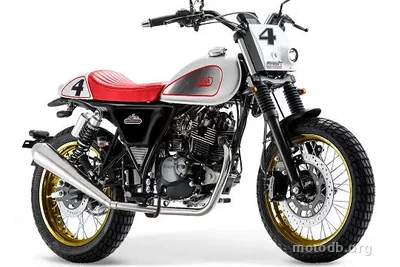
Do you remember a time when a 125 wasn’t necessarily a stylized missile for pimply teenagers? A time when you could have fun without breaking the bank, with simple mechanics and a look that had character without going overboard. The Honda CLR CityFly, which arrived in 2002, was of that ilk. It was a small, honest motorcycle, an urban Swiss Army knife borrowing its appearance from a retro scrambler and its posture from a light trail bike. Weighing 128 kg fully fueled and with a seat height of 81.5 cm, it welcomed beginners or pragmatic city dwellers without any apprehension. Its simple tubular frame and 124 cm3 single-cylinder engine with two valves announced its intentions: simplicity above all.
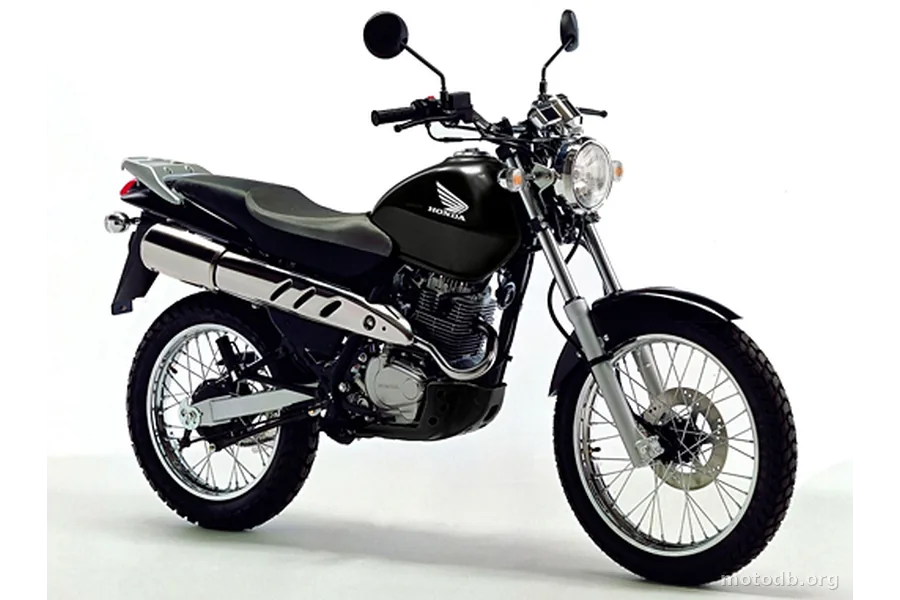
Under the hood, you’ll find an engine that isn’t looking for a fight. With 11 horsepower at 8250 rpm and 10.2 Nm of torque, the CityFly will never yank the handlebars from your hands. The power delivery is linear, almost bland, but terribly predictable and reassuring for those new to motorcycles. This placidity comes at a price: a top speed capped around 65 km/h. Forget any thoughts of highway riding, and even on national roads, overtaking a utility vehicle becomes a maneuver that requires planning and courage. This is clearly the machine’s weak point; it was born for urban asphalt and cannot tolerate exile. The minimal fuel consumption and 12-liter tank, on the other hand, are significant assets for this role.
Where the Honda CLR CityFly redeems itself is in the balance of its chassis. A wheelbase of 1380 mm and generously sized tires (90/90 front, 110/90 rear) offer surprising stability. The 37 mm telescopic fork and single shock absorber effectively absorb road imperfections. The braking, with a disc at the front and a drum at the rear, is quite bitey for its intended use. It flows through roundabouts and weaves with the agility of a cat. In the city, it’s an effective and economical rebel. Only the mirrors, a little too symbolic, force you to turn your head to check your blind spots, an annoying flaw.
Ultimately, what remains of this Honda today? The memory of a well-conceived machine, without pretension but perfectly suited to its mission. Sold new for over 3000 euros, it offered a coherent package with electric starter and luggage rack as standard, and even a fork headstock as an option to perfect its scrambler look. It didn’t make performance enthusiasts dream, but it fulfilled its role as a first motorcycle or utility vehicle with a rare honesty. Faced with the competitors of the time, often more specialized or more lively, the CityFly played the card of quiet versatility. A friendly little urban vehicle, that’s exactly what it was, and sometimes, that’s already a lot.
Practical info
- La moto est accessible aux permis : A
Reviews & comments
No reviews yet. Be the first to share your opinion!