Key performance
Technical specifications
Engine
- Displacement
- 124 cc
- Power
- 24.0 ch @ 8500 tr/min (17.7 kW)
- Torque
- 18.6 Nm @ 8000 tr/min
- Engine type
- Monocylindre, 2 temps
- Cooling
- liquide
- Compression ratio
- 8 : 1
- Bore × stroke
- 55 x 52.4 mm
Chassis
- Frame
- Périmétrique en tubes d\'acier
- Gearbox
- boîte à 6 rapports
- Final drive
- Chaîne
- Front suspension
- Fourche téléhydraulique inversée Ø nc, déb : 275 mm
- Rear suspension
- Mono-amortisseur, déb : 275 mm
Brakes
- Front brakes
- Freinage 1 disque Ø 250 mm, étrier 2 pistons
- Rear brakes
- Freinage 1 disque Ø 220 mm, étrier simple piston
- Front tyre
- 70/100-21
- Front tyre pressure
- 1.50 bar
- Rear tyre
- 4/10-18
- Rear tyre pressure
- 1.50 bar
Dimensions
- Seat height
- 860.00 mm
- Fuel capacity
- 9.00 L
- Dry weight
- 107.00 kg
- New price
- 3 895 €
Overview
Imagine a fifteen-year-old kid, eyes fixed on a green machine parked in front of a TT club stand. That's exactly the effect the Kawasaki KDX 125 has had for years on those who grew up with it. This two-stroke with a no-nonsense character never tried to win hearts through refinement: it convinces through raw efficiency, light weight, and that exhaust note that reminds you a single-cylinder piston engine can still make your heart race.
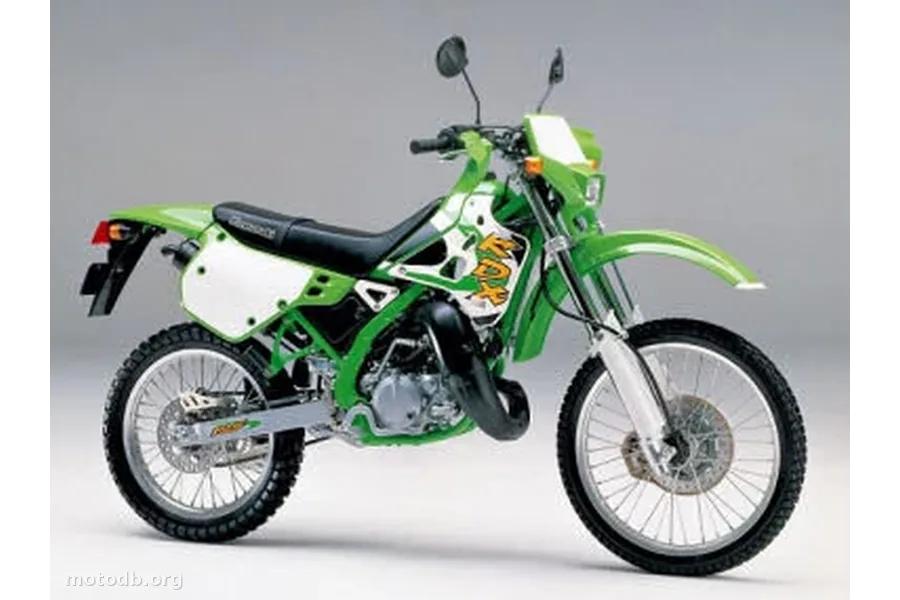
On the specs side, the numbers speak for themselves. 107 kg dry on a steel perimeter frame — a solid foundation without excess. The inverted fork with 275 mm of travel and the rear monoshock with matching travel absorb hard impacts without transmitting all the violence to the rider. For a machine of this displacement, that's a serious level of kit. The brakes follow suit: a 250 mm front disc with a twin-piston caliper, 220 mm at the rear. Nobody will claim you brake too much off-road, but the setup is coherent with the intended use.
The engine is where the KDX truly sets itself apart from its contemporaries. This 124 cc unit develops 24 horsepower at 8,500 rpm once freed from its regulatory restrictor, with 18.6 Nm of torque available at 8,000 rpm. The bore-stroke ratio of 55 x 52.4 mm, combined with a compression ratio of 8:1, gives a fairly linear character for a two-stroke — reassuring without betraying the fun. The exhaust valve broadens the powerband, and the six-speed gearbox lets you keep the engine in its power range even on rough terrain. Top speed reaches 130 km/h, which is obviously not the point on a rutted track, but it speaks to the health of the engine.
The 860 mm seat height suits a rider of average build better than a beginner still finding their bearings. The KDX clearly targets a junior or intermediate rider with some track time already under their belt, not the first-timer still fumbling with the controls. In that respect, it differs from the road-oriented Kawasaki KMX 125, or from a Honda CR 125 aimed more squarely at pure competition. The KDX carves out a convincing middle ground: capable without being temperamental, enduring without being soft.
Today, a used Kawasaki KDX 125 sells well below its original price of 3,895 euros. Parts remain available, community forums overflow with tuning and maintenance advice, and well-kept examples from the 1990s through 2001 hold their value. It's not a perfect machine: the seat height rules out shorter riders, the 9-liter tank demands careful range management, and any two-stroke requires regular maintenance or it deteriorates quickly. But for anyone looking for a versatile, punchy, and reliable two-stroke on the trails, the KDX remains an honest benchmark that time hasn't really dulled.
Practical info
- La moto est accessible aux permis : A
Reviews & comments
No reviews yet. Be the first to share your opinion!