Key performance
Technical specifications
Engine
- Displacement
- 929 cc
- Power
- 153.0 ch @ 11000 tr/min (107.3 kW)
- Torque
- 101.0 Nm @ 9000 tr/min
- Engine type
- In-line four, four-stroke
- Cooling
- Liquid
- Compression ratio
- 11.3:1
- Bore × stroke
- 74.0 x 54.0 mm (2.9 x 2.1 inches)
- Valves/cylinder
- 4
- Camshafts
- 2 ACT
- Fuel system
- Injection
- Starter
- Electric
Chassis
- Frame
- Double poutre alu
- Gearbox
- 6-speed
- Final drive
- Chain (final drive)
- Front suspension
- Fourche téléhydraulique inversée Ø 43 mm, déb : 135 mm
- Rear suspension
- Monoamortisseur Unit Pro-Link , déb : 135 mm
- Front wheel travel
- 120 mm (4.7 inches)
- Rear wheel travel
- 135 mm (5.3 inches)
Brakes
- Front brakes
- Dual disc
- Rear brakes
- Single disc
- Front tyre
- 120/70-ZR17
- Front tyre pressure
- 2.50 bar
- Rear tyre
- 190/50-ZR17
- Rear tyre pressure
- 2.90 bar
Dimensions
- Seat height
- 815.00 mm
- Wheelbase
- 1400.00 mm
- Fuel capacity
- 18.00 L
- Weight
- 199.00 kg
- Dry weight
- 170.00 kg
- New price
- 12 346 €
Overview
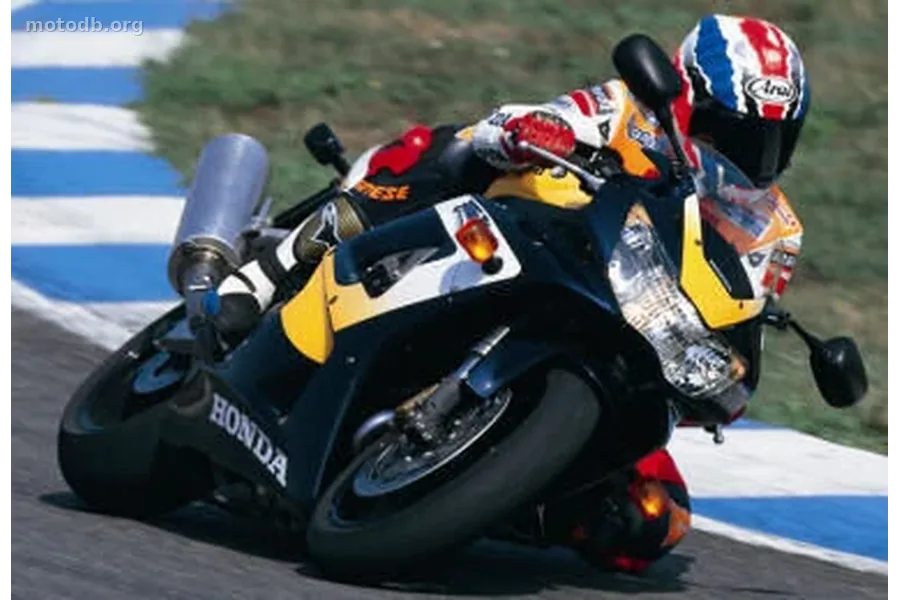
When Honda launched the first CBR 900 RR Fireblade in 1992, the world of sport riding was turned on its head. A 750-class motorcycle in a 900's body — light, sharp, formidable. Nearly a decade later, the competition had closed the gap. The Yamaha R1 reshuffled the deck, the Kawasaki ZX-9R was gaining ground. For the 2001 model year, Honda went back to the drawing board and delivered a thoroughly reworked Honda CBR 900 RR Fireblade. Not a mere facelift: a full mechanical and chassis overhaul aimed at reclaiming the hypersport throne.
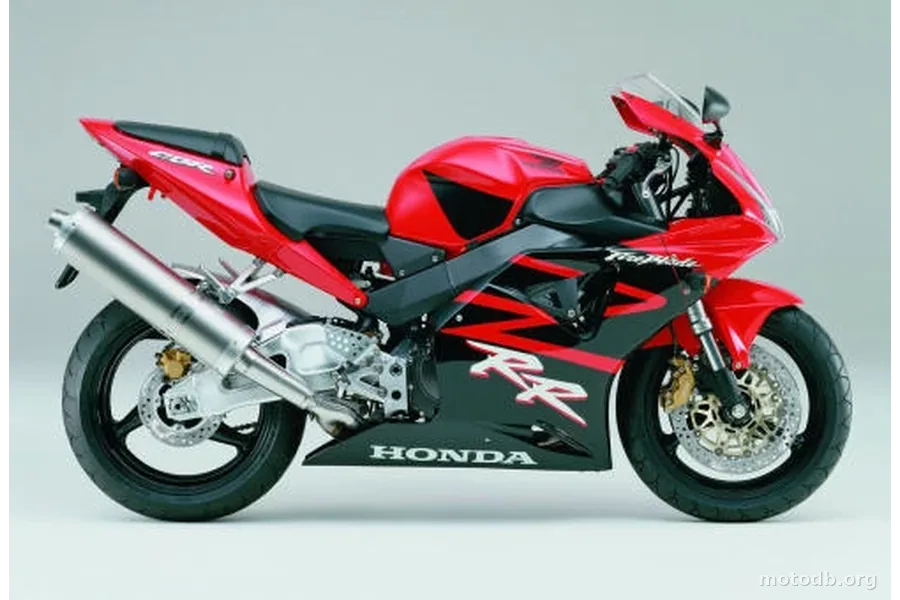
The inline four-cylinder grew to 929 cc, gained PGM-FI electronic fuel injection, and was fitted with an exhaust valve to beef up midrange torque. The result: 153 hp at 11,000 rpm and 101 Nm at 9,000 rpm. On paper, the figures sit squarely within class norms. On the road, it's the delivery that makes the difference. This engine doesn't lunge at you the way the R1's twin-cam does. It builds revs with a velvety progressiveness, almost too refined for some. Riders craving raw thrills will fault its civilized temperament. But that's been the Fireblade's signature since the SC33 of 1992: power in service of the rider, never against him. The injection is clean from the very first crack of the throttle — no jerkiness, no hesitation. A well-mannered engine that pulls smoothly from 3,000 to 11,000 rpm.
On the chassis front, Honda brought out the heavy artillery. The aluminum twin-spar frame houses a 43 mm inverted fork and a swingarm bolted directly to the engine cases, in the manner of Grand Prix machinery. This layout shortens the distance to the gearbox output sprocket and improves traction on corner exit. With a compact 1,400 mm wheelbase and weight trimmed to 170 kg dry and 199 kg wet, the 2001 Honda CBR 900 RR Fireblade hunts in the same waters as far more radical machines. The dual front disc brakes bite with conviction, and the front end inspires immediate confidence. Steering precision is scalpel-like. You tip the bike into a corner with a simple push on the clip-on, and the line traces itself without waver, even on deteriorated surfaces. The suspension filters out imperfections while maintaining precise feedback. This is what Honda calls "Total Control," and on this generation, the concept comes into its own.
The downside? Wind protection remains spartan. Beyond 200 km/h on the way to a claimed 273 km/h top speed, the wind becomes a serious adversary. The screen is shaped for style, not highway comfort. The seat perched at 815 mm and the forward-leaning riding position suit average builds, but taller riders will find space at a premium. The 18-liter tank provides decent range, nothing more. As for the price tag of 12,346 euros in 2001, it placed the Honda CBR 900 RR Fireblade at the top of its class — a confident positioning against its Japanese rivals. Today on the used market, the CBR 900 RR Fireblade trades for around 3,490 euros depending on condition and mileage, making it an accessible sportbike for anyone seeking serious thrills without mortgaging the garage.
Between the 1998 Fireblade and this 2001 version, the qualitative leap is clear. Honda closed the gap it had accumulated on track while preserving the road versatility that built the model's reputation since 1992. Against the R1, it perhaps lacks that touch of madness that electrifies dedicated track riders. Against the ZX-9R, it counters with superior build quality and overall coherence. The CBR 900 RR Fireblade 2000–2003 remains a sportbike designed for the demanding rider who wants to go fast everywhere, not just between curbing strips. A motorcycle that forgives approximations instead of punishing them — and that may well be its greatest quality.
Practical info
- La moto est accessible aux permis : A
Reviews & comments
No reviews yet. Be the first to share your opinion!