Key performance
Technical specifications
Engine
- Displacement
- 471 cc
- Power
- 48.0 ch @ 8600 tr/min (35.3 kW)
- Torque
- 44.1 Nm @ 6500 tr/min
- Engine type
- Bicylindre en ligne, 4 temps, calé à 180°
- Cooling
- liquide
- Compression ratio
- 10.7 : 1
- Bore × stroke
- 67 x 66.8 mm
- Valves/cylinder
- 4
- Camshafts
- 2 ACT
- Fuel system
- Injection Ø 34 mm
- Starter
- électrique
- Euro standard
- Euro 5+
Chassis
- Frame
- en acier de type Diamant
- Gearbox
- boîte à 6 rapports
- Final drive
- Chaîne
- Front suspension
- Fourche téléhydraulique inversée Ø 41 mm, déb : 120 mm
- Rear suspension
- Mono-amortisseur
Brakes
- Front brakes
- Freinage 2 disques en pétale Nissin Ø 296 mm, étrier 4 pistons
- Rear brakes
- Freinage 1 disque en pétale Nissin Ø 240 mm, étrier simple piston
- Front tyre
- 120/70-17
- Front tyre pressure
- 2.50 bar
- Rear tyre
- 160/60-17
- Rear tyre pressure
- 2.90 bar
Dimensions
- Seat height
- 785.00 mm
- Seat type
- Selle biplaces
- Fuel capacity
- 17.10 L
- Weight
- 188.00 kg
- New price
- 6 199 €
Overview
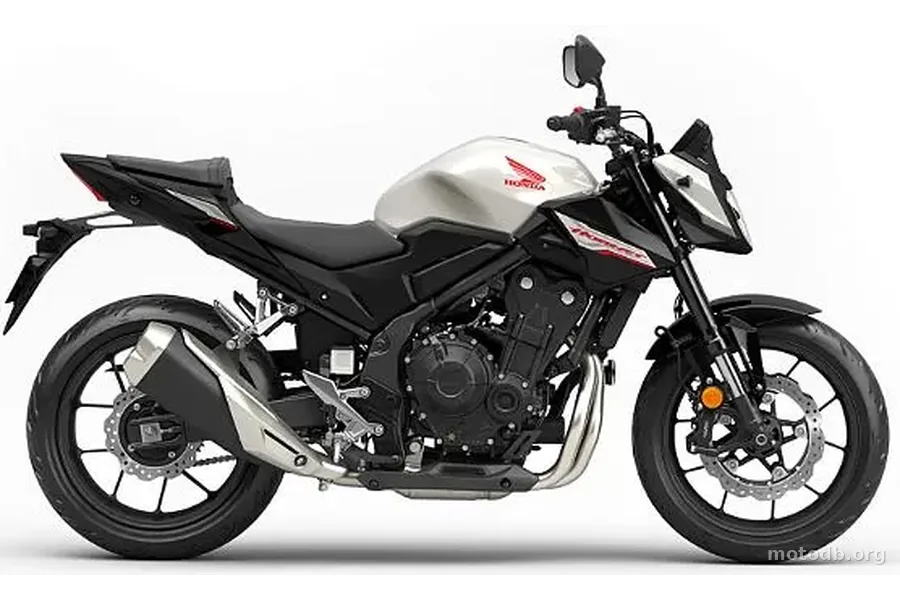
The CB 500 Hornet is one of the iconic models for stepping up to larger displacement motorcycles. Of course, that’s a way of speaking, given the size and power of current engines... True to Honda form, it aims to be very accessible; even more so with the now optional E-Clutch assistance. A robotic clutch that eliminates the need for a lever and left-hand clutch action. With it, you can forget all clutch phases! It takes care of everything. Still, you’re going to have to shift with your foot; it’s not an automatic transmission.
The E-Clutch system adds 2 kg to the scale, costs a few hundred euros, aims to be smoother and faster than a quickshifter, and can be adjusted according to 3 levels of "feel," for a Hard, Medium, or Soft feel. The clutch lever remains. Not out of nostalgia, but to allow the rider to take over at will.
The CB 500 changed its face and name in 2024. The model that has accompanied young riders for more than 30 years now sees its future within the most striking family of Honda: the Hornets. It is not more aggressive than before, but this identifier has become very demonstrative since the success of the 750. The CB 500 would be wrong to deprive itself of this image. But has it really changed that much?
It presents a new look but is mainly an evolution rather than a renewal. After all, a host of improvements since 2013, the year it was given a new technical platform and engine, this phase retains the essence and densifies the form. The face abandons angles for a more robotic mimicry, with a wide-eyed gaze that sniffs out its path. The rear light allows itself a little more dynamism. The new shoulders are more restrained, as if to prepare for a simple reunion.
Because the mechanical and cycling components of the 500 Hornet are virtually unchanged from the CB 500 F. Only the engine receives a few adjustments, to make it more responsive at low RPM and to distribute its power more progressively. The most notable addition is the arrival of the disconnectable HSTC traction control. An extra safety feature, but the twin-cylinder is not known for being violent. You're always surprised to see this kind of assistance on a 35 kW machine.... With good tires, it won't work much this torque control.
Designed with a versatile engine in mind, calibrated for A2 and still revving high, the Honda twin-cylinder is not of an insolent or festive temperament. Its linear character does not really correspond to the mischievous image one can have of a Hornet, but it allows for reassuring riding in all circumstances. A good engine, with smoothness everywhere, but a distinctly gentle face. Although its PGM-FI injection has been refined, it still delivers the same power and torque figures: 47.5 horsepower at 8,600 rpm and 4.5 mkg of torque at 6,500 rpm.
But let's return to the elements that have changed. That’s what interests us most. Pay attention to the new left-hand multi-function switch. There’s a button to control the HSTC, and a small backlit control pad. An indispensable appendage for piloting all the functions of the new dashboard. Because the CB 500 has finally shed its blue crystal liquid-crystal numeric pad to equip a 5-inch color TFT screen. A screen with good dimensions, well-arranged information, and understated graphics (Honda style). It offers its rider three types of displays and a good dose of interaction with the smartphone. Once retrieved and synchronized with the RoadSync app, the interface allows you to display a step-by-step GPS navigator, manage your calls, listen to your text messages (the system converts them into audio), listen to stored music, and even check the weather.
A complete modernization, necessary to bring the dose of digital that everyone craves. This will not prevent it from being interested in the priority organs of the motorcycle, transposed from the previous generation without modification. The 17-liter tank thinks it won't empty quickly, Honda having measured a consumption of 3.5 liters / 100 km. A diamond-type frame made of steel tubes rests on the engine and supports a monoshock and an inverted Showa SFF-BP fork. Quite a nice front end for a 500, with separate functions for each tube and a large-piston damping system.
We also find the same braking system, quite flattering with its two 296 mm discs and, above all, its 4-piston radial Nissin calipers. Some bikes from the higher segment would do well to be inspired by it. Between the work of the suspension and the efficiency of the braking, the 500 Hornet can claim the same serene and effective riding experience as before, without however raising the emotion as a MT-07 would. You have to know how to be reasonable, and that’s exactly what the CB 500 has always wanted and proposed, and will again tomorrow.
M.B - Photos constructeur
-When the clutch lever is engaged, the Honda electronic clutch system reactivates in less than one second above a certain engine speed, and after 5 seconds at low speed. If the rider wishes to deactivate the system, he can do so via the control located on the left handlebar. Manual mode is indicated by the letter “M” on the dashboard.
-The E-Clutch allows you to select a gear shift feel, by adjusting the force required on the pedal. Three settings are available: hard, medium, and soft, each being selectable independently for upshifting and downshifting. It also informs you if the selected gear is too high.
-It manages engagement and disengagement based on several parameters, including vehicle speed, throttle opening angle, engine speed, pressure exerted on the shift pedal, angle of the engine reduction gear, intermediate shaft speed, and gear ratio. The clutch is actuated by a two-motor actuator located in the right engine case. During engagement or disengagement, ignition advance and fuel injection are also controlled, ensuring smooth and jerk-free gear changes in all circumstances.
Standard equipment
- Assistance au freinage : ABS de série
- Taille de l'écran TFT couleur : 12,70 cm / 5 pouces
- Indicateur de vitesse engagée
- Contrôle de couple
- Embrayage anti-dribble
Practical info
- La moto est accessible aux permis : A
Reviews & comments
No reviews yet. Be the first to share your opinion!