Key performance
Technical specifications
- Power
- 75.0 ch @ 8250 tr/min (55.2 kW) → 75.0 ch @ 8250 tr/min (54.4 kW)
- Torque
- 69.6 Nm @ 6250 tr/min → 70.0 Nm @ 6250 tr/min
- Engine type
- Bicylindre en L à 90°, 4 temps → V2, four-stroke
- Cooling
- combiné air / huile → Air
- Compression ratio
- 10.3 : 1 → 10.5:1
- Bore × stroke
- 88 x 66 mm → 88.0 x 66.0 mm (3.5 x 2.6 inches)
- Fuel system
- Injection Ø 45 mm → Injection
- Valve timing
- — → Desmodromic valve control
- Frame
- treillis en tube d\'acier → Tubular steel trellis
- Gearbox
- boîte à 6 rapports → 6-speed
- Final drive
- Chaîne → Chain (final drive)
- Front suspension
- Fourche téléhydraulique inversée Ø 45 mm, déb : 120 mm → Marzocchi 43 mm upside-down fork
- Rear suspension
- Mono-amortisseur type Cantilever, déb : 136 mm → Progressive cantilever linkage with fully adjustable Sachs monoshoshock. Steel swingarm
- Front wheel travel
- — → 120 mm (4.7 inches)
- Rear wheel travel
- — → 136 mm (5.4 inches)
- Front brakes
- Freinage 2 disques Ø 320 mm, étrier 4 pistons → Double disc
- Rear brakes
- Freinage 1 disque Ø 245 mm, étrier 2 pistons → Single disc
- Front tyre
- 120/70-17 → 120/70-ZR17
- Rear tyre
- 170/60-17 → 170/60-ZR17
- Wheelbase
- — → 1405.00 mm
- Length
- — → 2030.00 mm
- Height
- — → 1110.00 mm
- Weight
- — → 185.40 kg
Engine
- Displacement
- 803 cc
- Power
- 75.0 ch @ 8250 tr/min (54.4 kW)
- Torque
- 70.0 Nm @ 6250 tr/min
- Engine type
- V2, four-stroke
- Cooling
- Air
- Compression ratio
- 10.5:1
- Bore × stroke
- 88.0 x 66.0 mm (3.5 x 2.6 inches)
- Valves/cylinder
- 2
- Camshafts
- 1 ACT
- Fuel system
- Injection
- Valve timing
- Desmodromic valve control
Chassis
- Frame
- Tubular steel trellis
- Gearbox
- 6-speed
- Final drive
- Chain (final drive)
- Front suspension
- Marzocchi 43 mm upside-down fork
- Rear suspension
- Progressive cantilever linkage with fully adjustable Sachs monoshoshock. Steel swingarm
- Front wheel travel
- 120 mm (4.7 inches)
- Rear wheel travel
- 136 mm (5.4 inches)
Brakes
- Front brakes
- Double disc
- Rear brakes
- Single disc
- Front tyre
- 120/70-ZR17
- Front tyre pressure
- 2.10 bar
- Rear tyre
- 170/60-ZR17
- Rear tyre pressure
- 2.10 bar
Dimensions
- Seat height
- 815.00 mm
- Wheelbase
- 1405.00 mm
- Length
- 2030.00 mm
- Height
- 1110.00 mm
- Fuel capacity
- 16.00 L
- Weight
- 185.40 kg
- Dry weight
- 183.00 kg
- New price
- 8 995 €
Overview
At the dawn of the 2000s, Ducati navigated blindly between its sporting legend and the need to seduce a less experienced public. The Supersport 800 of 2004 perfectly embodies this compromise. It is not a revolution, but a calculated evolution of the 750, with a longer stroke to reach 803 cc. The gain is modest but tangible: 75 horsepower at 8250 rpm and 7 Nm of torque more, which is enough to scrape 225 km/h at top speed and, above all, offer a more fleshy response from 2500 rpm. This is where the interest of this machine lies: it claims less for the race than for sporting comfort. The steel trellis frame, adjustable Marzocchi and Sachs suspensions, and front dual-disc braking give it an honest technical base, but its soul is more accessible.
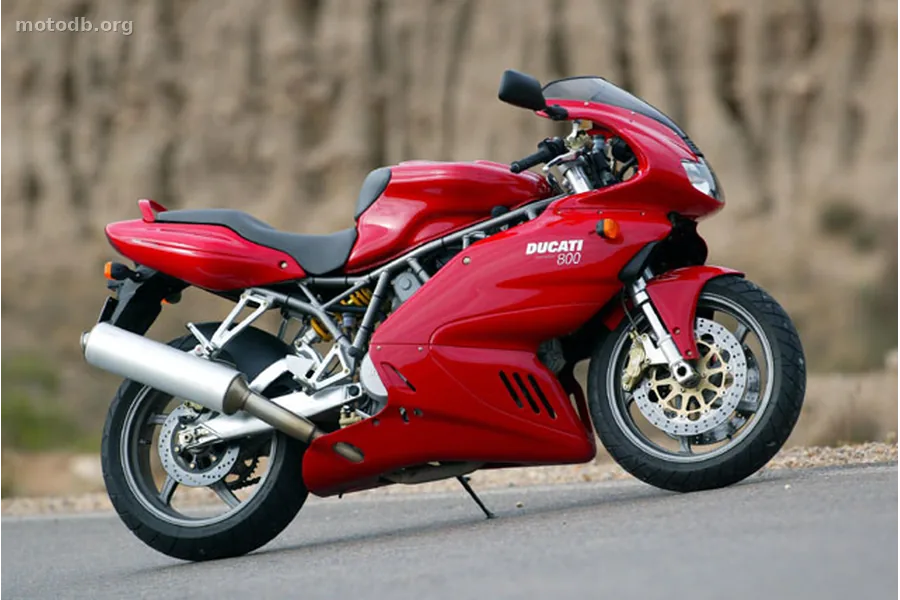
Compared to a purebred 900 SS, the 800 plays the card of flexibility. The air-cooled two-valve V2 engine breathes better in the low and mid ranges, and the six-speed gearbox facilitates gear changes. On the other hand, do not expect a rolling sofa. With a 815 mm seat height and a 16-liter tank, the riding position remains committed, and the comfort, typical of Ducati from that era, remains spartan. At 185 kg fully fueled, it is not a featherweight, but its wheelbase of 1405 mm gives it reassuring stability. It is a sportbike that forgives more than it punishes, ideal for those who want to taste Italian riding without the jolts of a Superbike.
The Ducati catalog even allowed for personalization of the experience. One could opt for a full or semi fairing, a more aesthetic than technical choice. The Sport version, with its steel swingarm and three-spoke rims, offered a more affordable alternative, but the SS with its aluminum swingarm and Marzocchi remained the most accomplished option. At nearly 9000 euros at the time, it positioned itself against Japanese models such as the Honda CBR600F or the Yamaha YZF-R6, much more lively, but also more demanding. The Ducati did not win by fractions, it won on character.
Who rides this machine? For the motorcyclist who has gone beyond the beginner stage and who wants to confirm their riding skills without fear. For the enthusiast of beautiful mechanics who wants an authentic Ducati, with a deep sound and a retro look, without the hassles of an antique. It is a transitional motorcycle, a road sportbike that does more good for the ego than for the spine. It will not go down in history like a 916, but it has managed, with its means, to offer a seductive and harmonious gateway into the demanding world of Italian sportbikes. A choice of heart, more than of reason.
Practical info
- La moto est accessible aux permis : A

Reviews & comments
No reviews yet. Be the first to share your opinion!