Key performance
Technical specifications
- Power
- 148.0 ch @ 10750 tr/min (106.7 kW) → 148.0 ch @ 10750 tr/min (108.0 kW)
- Fuel system
- Injection. Electronic fuel injection system. Single injector per cylinder. Full ride-by-wire elliptical throttle bodies. → Injection. Single injector per cylinder. Full ride-by-wire elliptical throttle bodies.
- Front wheel travel
- — → 120 mm (4.7 inches)
- Rear wheel travel
- — → 130 mm (5.1 inches)
- Length
- — → 2050.00 mm
- New price
- 15 790 € → 15 890 €
Engine
- Displacement
- 898 cc
- Power
- 148.0 ch @ 10750 tr/min (108.0 kW)
- Torque
- 99.0 Nm @ 9000 tr/min
- Engine type
- V2, four-stroke
- Cooling
- Liquid
- Compression ratio
- 12.5:1
- Bore × stroke
- 100.0 x 57.2 mm (3.9 x 2.3 inches)
- Valves/cylinder
- 4
- Camshafts
- 2 ACT
- Fuel system
- Injection. Single injector per cylinder. Full ride-by-wire elliptical throttle bodies.
- Valve timing
- Desmodromic valve control
- Starter
- Electric
Chassis
- Frame
- Monocoque Aluminium
- Gearbox
- 6-speed
- Final drive
- Chain (final drive)
- Clutch
- Wet multiplate clutch with hydraulic control
- Front suspension
- Fully adjustable BPF forks. 43 mm chromed inner tubes
- Rear suspension
- Fully adjustable unit. Aluminum double-sided swingarm
- Front wheel travel
- 120 mm (4.7 inches)
- Rear wheel travel
- 130 mm (5.1 inches)
Brakes
- Front brakes
- Double disc. ABS. Floating discs. Four-piston calipers. Radially mounted.
- Rear brakes
- Single disc. ABS. Two-piston calipers.
- Front tyre
- 120/70-ZR17
- Rear tyre
- 180/60-ZR17
Dimensions
- Seat height
- 830.00 mm
- Wheelbase
- 1426.00 mm
- Length
- 2050.00 mm
- Fuel capacity
- 17.00 L
- Weight
- 193.00 kg
- Dry weight
- 169.00 kg
- New price
- 15 890 €
Overview
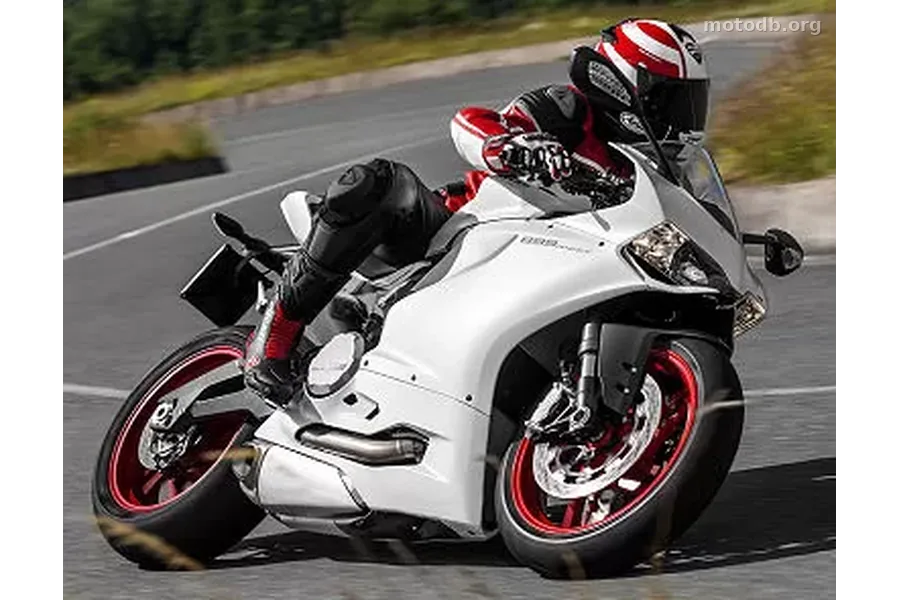
Certain machines embody the dream; others bring it within reach for enthusiasts. This has been true of Ducati Desmoquattro engines for generations. The 899 Panigale now joins a collection of the most iconic models. It replicates and complements the revolutionary 1199 Panigale, as did the 748-916, 749-999, and those it supersedes, the 848–1098. Marked with a racing seal, the 899 Panigale sings like a siren, a melody that stirs desires for the road: a thicker seat and a shorter final transmission than on the 1199. Could this be a tamed racetrack machine? Not at all. Simply a Panigale that uses the road to get to the track... Or vice versa?
From the LED eyes to the pierced prow, the illusion is (almost) perfect. An authentic racetrack muse, a tempting, unadulterated force in the service of sport, the 899 opens the doors to the Panigale for those with less robust budgets, without the fierce power of a Superbike twin, but preserving quite a few horsepower to enjoy on the road and on the track. Among the Panigale models, the 1199 competes in the Superbike arena; the 899 strives for high-definition sport. But... BUT!!! For once, the copy is not total. And it even lacks a key stylistic element. The monobras! The 899 Panigale did not deem it appropriate to adopt this superb element. Consequently, a classic swingarm marries the wheel to the twin’s crankcases. A pity...
The style suffers somewhat, but the machine’s silhouette remains as captivating. It is equally logical to find the aluminum monocoque concept underneath the bodywork, housing the airbox and supporting the steering column. The essential part of the chassis confidently anchors to the engine cases. The weight distribution, 52% on the front and 48% on the rear, is identical to that of the 1199. However, at the front, things begin to change. The 50 mm Marzocchi fork, borrowed from the 1199, has been replaced on the 899 by a 43 mm Showa BPF with large pistons. The lateral Sachs rear shock remains as striking to look at. On these elements, the trio of settings is customary, with preload, compression, and rebound. And we note 10 mm less diameter for the brake discs. Consequently, there is just enough power to stop a tank. And with style: because the 899 has drawn a great deal of inspiration from the larger Panigale’s equipment to assist its braking. Large Brembo radial monoblock calipers, M4-32 instead of M50, ABS Sport 9ME, and the engine braking control EBC. I’m going to detail a bit:
ABS is programmable in 3 levels: the first is circuit-type, acting only on the front. The second, more sport-road, benefits from a rear wheel lift-up system. Level 3 optimizes stability and the anti-lift function is pushed to the maximum. Each level is associated with a riding mode. ABS is disconnectable as an option for each Riding Mode via the dashboard. The EBC also acts on 3 levels and is also associated with each riding mode. It acts on the throttle to reverse the torque and optimize stability during heavy braking.
Will the electronics be called upon to intervene extensively? More than a mere sporty twin. Here, we border on Superbike territory. The "small" Superquadro spits fire into its pistons. With dimensions of 100 mm x 57.2 mm, the engine clearly prioritizes power. From the block of the 1199, the bore has lost 12 mm and the stroke 3.6 mm. The maximum torque of 10.1 mkg, barely more important than that of the 848, is obtained 750 rpm lower, at 9,000 rpm. And how many horsepower do we extract from this superb desmo? No less than 148. Quite a beautiful performance for a twin on the border of the 900 cc class. It is simply the power of the R1 at its launch... which had 2 cylinders and 100 cc more. Technically, this block incorporates all the technological equipment of the large 1199 cc Superquadro. Like the Vacural process for the crankcases, the ovalized injection bodies, the secondary air intake, the desmo distribution driven by a chain-sprocket assembly, and the same gearbox.
As we have seen previously, the clever chips come to assist in braking. But this is not the only area where they intervene. Ducati have been masters of high-tech for some time, with the Panigale leading the way. The smaller model will thus have access to the multitude of copilots developed at Ducati. We have therefore listed the engine braking control, the 3-mode ABS, the ride-by-wire throttle... What else is taken from the 1199 Panigale? Ah yes, the riding modes. In a number of 3, they play on the engine mapping, the ABS, the traction control and the engine braking. Let's see the level of intervention:
Race Mode: It delivers 148 hp to the rider as well as a direct response to the throttle, reducing the intervention of traction control, an engine braking oriented "race" and an ABS only at the front with a reduction in rear wheel lift-up.
Sport Mode: All the power is also available but is delivered with a soft throttle response, increased anti-wheelie intervention, more important engine braking control and an ABS with increased rear wheel lift-up.
Rain Mode: The power drops to 110 hp, delivered smoothly by the electronic throttle (RbW), increases the intervention of the traction control (DTC), an appropriate engine braking control and full action of the ABS for low-grip conditions.
A small quickshifter to complete the whole thing, gain a few crumbs of performance and reassure the left hand when accelerating. Optional DDA+ data analysis module with GPS. And every motorcyclist who has approached the 1199 Panigale could only marvel at this exceptional dashboard, a true competition tablet. So, we will find the same tab... Well no, it's a new dashboard that the 899 Panigale has reserved for us. An LCD bargraph model like on the former 1198 and 848. Did Ducati really need to make savings at this level?
Hence this chapter that relieves and hurts at the same time. By removing a little nobility and reducing its displacement, Ducati offers a Panigale that goes from more than 20,000 euros in its 1299 version to less than 16,000 euros in this 899 version. It is also 1000 euros more than the 848 that it has put on the shelf. The 748 and 749 exuded SuperSport; the 848 opened the door to the Superbike dream; the 899 Panigale brings it to the road.
M.B - Photo constructeur
Standard equipment
- Assistance au freinage : ABS de série
Practical info
- La moto est accessible aux permis : A
Reviews & comments
No reviews yet. Be the first to share your opinion!