Key performance
Technical specifications
Engine
- Displacement
- 1199 cc
- Power
- 86.0 ch @ 6000 tr/min (63.3 kW)
- Torque
- 103.0 Nm @ 5400 tr/min
- Engine type
- Bicylindre en V à 45°, 4 temps
- Cooling
- par air
- Compression ratio
- 10:1
- Bore × stroke
- 88.8 x 96.8 mm
- Valves/cylinder
- 2
Chassis
- Frame
- structure en tubes d\'acier
- Gearbox
- boîte à 5 rapports
- Final drive
- Courroie
- Front suspension
- Fourche téléhydraulique Ø 43 mm, déb : 120 mm
- Rear suspension
- Mono-amortisseur, déb : 125 mm
Brakes
- Front brakes
- Freinage
- Rear brakes
- Freinage 1 disque
- Front tyre
- 120/70-17
- Front tyre pressure
- 2.20 bar
- Rear tyre
- 170/60-17
- Rear tyre pressure
- 2.48 bar
Dimensions
- Fuel capacity
- 15.00 L
- Dry weight
- 193.00 kg
- New price
- 9 450 €
Overview
When Harley-Davidson decides to let Erik Buell play with its engines, the result goes far beyond a simple sporty derivative. The M2 Cyclone, marketed around €9,450 in 2001, starts with a familiar base: the 45-degree V-twin of 1,199 cm3, from Milwaukee’s workshops. But once it has passed through the hands of the brand’s founding father, this engine no longer really resembles what Harley riders would recognize. Bore of 88.8 mm, long stroke of 96.8 mm, compression ratio of 10:1: Buell reworked the whole thing to extract 86 horsepower at 6,000 rpm and a torque of 103 Nm available from 5,400 rpm. Compared to the standard version, this is a power increase of around 50%. On a machine that weighs 193 kg dry, the equation becomes serious.
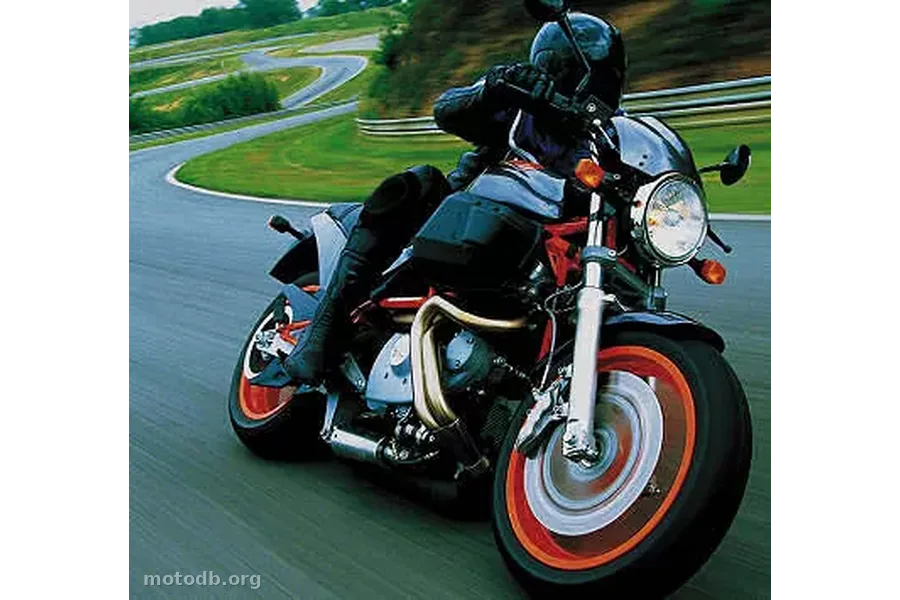
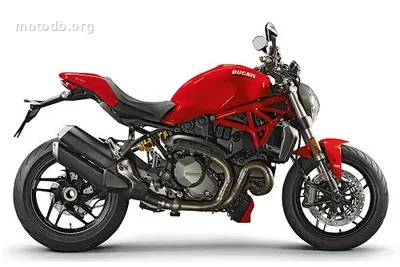
What first strikes you is the aesthetics. The M2 does not seek to seduce the crowds with consensual lines. The bulky airbox that protrudes from the silhouette, the steel tube frame, the muscular but asymmetrical proportions: it is far from the Japanese sportbikes that dominate the niche at the time. At Buell, functionality dictates form, not the other way around. Some love it, others pass by. This division is part of the brand’s DNA.
On the road, the V-twin delivers exactly what it promises: frank horsepower, raw mechanical sensations, and a sound that recalls the American origin of the project. The belt drive, five-speed gearbox, accompanies the engine’s character correctly at intermediate speeds. On the other hand, the gearbox shows its limits when you push the pace: gear changes lack the precision you would expect from a machine positioned as a sportbike. This is the main drawback, and it is noticeable.
The chassis, however, does not disappoint. The 43 mm telehydraulic fork with 120 mm of travel and the single rear shock absorber with 125 mm perform their role well on smooth surfaces. The handling is healthy, predictable, precise. The front brake with its oversized disc and six-piston caliper offers a deceleration power that impresses, but requires a certain gentleness in wet conditions. The announced top speed of 206 km/h is consistent with the 86 horsepower available. But be warned: as soon as the road deforms, the sensitivity to suspension settings is felt. The M2 is not a tolerant touring machine that forgives everything. It prefers clean roads where its temperament can express itself freely.
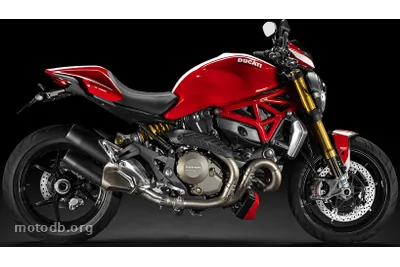
This model targets a very specific audience: the experienced motorcyclist, lover of characterful machines, who is looking for something other than Japanese or European sportiness. It is not suitable for a beginner, and its positioning does not correspond to daily urban use either. The Cyclone is a sensation machine, with its strengths and assumed weaknesses. In a segment where the Ducati Monster S4 and the Honda VTR 1000 offered more polished alternatives, Buell deliberately chose eccentricity. It was its only real commercial argument, and it was enough to retain those who chose it.
Practical info
- La moto est accessible aux permis : A
Reviews & comments
No reviews yet. Be the first to share your opinion!