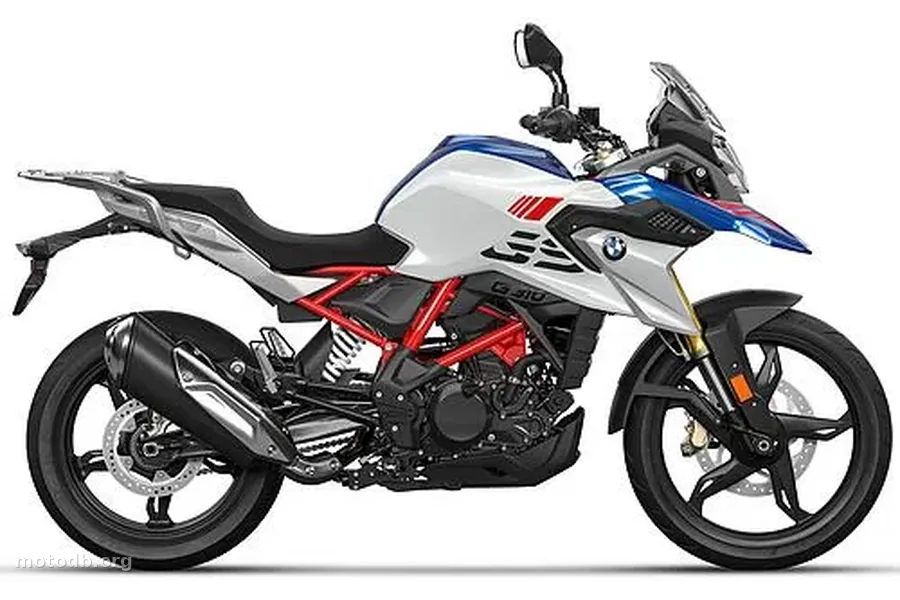
Key performance
Technical specifications
Engine
- Displacement
- 313 cc
- Power
- 34.0 ch @ 9500 tr/min (24.8 kW)
- Torque
- 28.0 Nm @ 7500 tr/min
- Engine type
- Single cylinder, four-stroke
- Cooling
- Liquid
- Compression ratio
- 10.6:1
- Bore × stroke
- 80.0 x 62.1 mm (3.1 x 2.4 inches)
- Valves/cylinder
- 4
- Camshafts
- 2 ACT
- Fuel system
- Injection. Electronic fuel injection, BMS-E2.
- Valve timing
- Double Overhead Cams/Twin Cam (DOHC)
- Lubrication
- Wet sump
- Starter
- Electric
Chassis
- Frame
- Tubular spaceframe
- Gearbox
- 6-speed
- Final drive
- Chain (final drive)
- Clutch
- Multiple-disc clutch in oil bath, mechanically operated
- Front suspension
- Upside down fork , 41 mm
- Rear suspension
- Solid die-cast aluminum swingarm, directly hinged monoshock, adjustable preload
- Front wheel travel
- 180 mm (7.1 inches)
- Rear wheel travel
- 180 mm (7.1 inches)
Brakes
- Front brakes
- Single disc. ABS. Four-piston calipers. Radially mounted.
- Rear brakes
- Single disc. ABS. Floating disc. Single-piston caliper.
- Front tyre
- 110/80-19
- Front tyre pressure
- 1.70 bar
- Rear tyre
- 150/70-17
- Rear tyre pressure
- 1.90 bar
Dimensions
- Seat height
- 835.00 mm
- Wheelbase
- 1420.00 mm
- Length
- 2075.00 mm
- Width
- 880.00 mm
- Height
- 1080.00 mm
- Fuel capacity
- 11.00 L
- Weight
- 169.50 kg
- New price
- 5 990 €
Overview
Imagine the logo of the world’s most famous adventure family, miniaturized, placed on a trellis frame that doesn’t exceed 170 kilograms when fully fueled. That’s exactly the bet that BMW Motorrad took with the BMW G 310 GS: to distill the rugged DNA of the large GS into a 313 cc displacement, at a new price of €5,990. A stylistic exercise as much as an assumed commercial strategy, targeting rapidly expanding Asian markets and, as a result, A2 license holders in Europe.
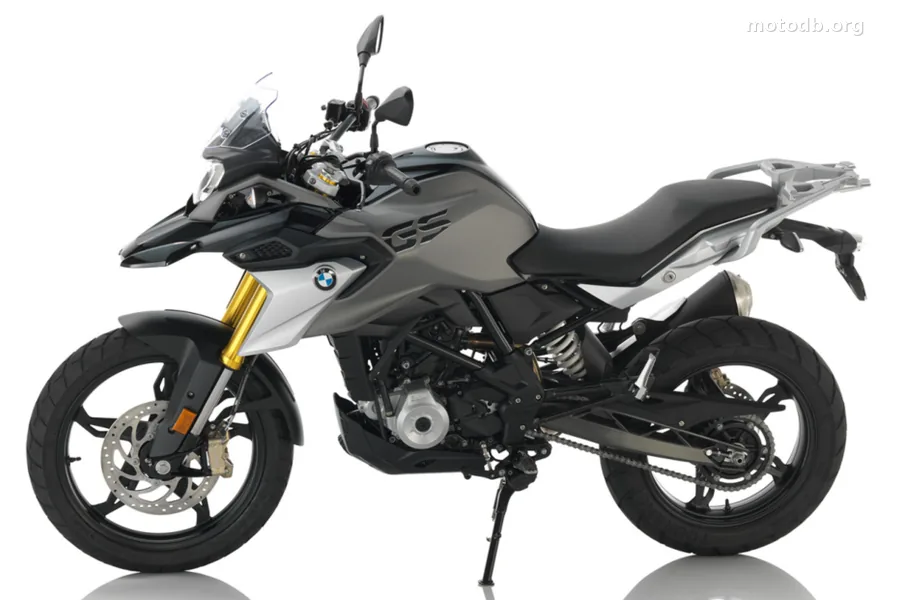
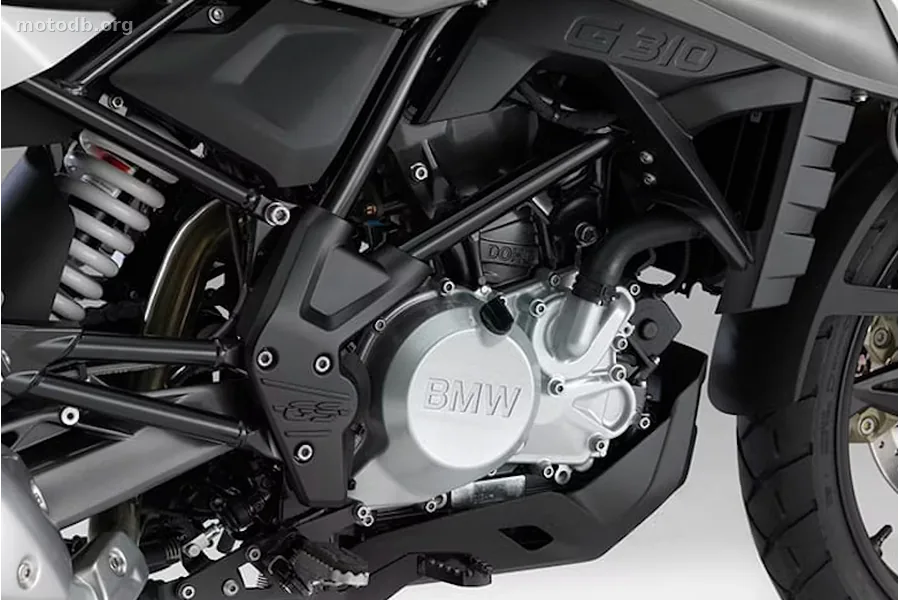
Under the bodywork, which borrows without complex the visual codes of the R 1200 GS, is a four-stroke single-cylinder engine with a reverse cylinder head, a technical particularity that places the intake on the front. This engineering choice lowers the center of gravity and brings the mass closer to the front wheel, which translates into a noticeable agility in direction changes. The engine develops 34 horsepower at 9,500 rpm and a torque of 28 Nm at 7,500 rpm. It’s not the fury of a twin, but it is consistent with the machine’s vocation. The BMW G 310 GS announced consumption is around 3.3 liters per 100 km, which makes the 11-liter tank reasonably autonomous for daily use. Top speed is capped at 143 km/h, a figure sufficient for occasional highway use but which recalls that this motorcycle was not designed for repetitive highway journeys.
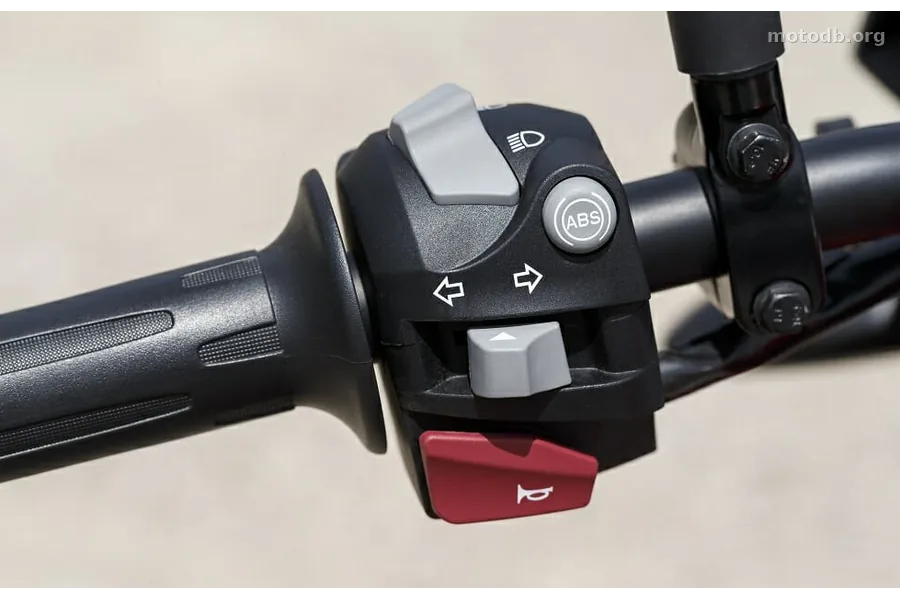
The chassis borrows the base of the G 310 R, with significant adjustments. The wheelbase is extended to 1,420 mm thanks to a swingarm lengthened by 46 mm, the 41 mm inverted fork gains 49 mm of travel to reach 180 mm of stroke, the rear follows with 180 mm as well. This kinematic generosity allows for digesting bumpy trails without too much suffering. The BMW G 310 GS seat height is a direct result: 835 mm, which selects the public. Intermediate builds will need to put a toe down when stopped, and smaller riders will seek saddle lowering accessories. The 19-inch front wheel assumes the classic trail compromise between handling on asphalt and the ability to swallow a trail. We regret the absence of spoked wheels, even as an option, on a motorcycle that displays mixed ambitions. The brakes, a 300 mm disc at the front with a Bybre four-piston radial caliper and a 240 mm disc at the rear, do the job. ABS is disconnectable, which is a truly good decision for anyone venturing off asphalt.
Faced with the Kawasaki Versys-X 300, the Suzuki V-Strom 250 or the Honda CRF 250 L, the BMW G 310 GS new price positions itself slightly above. It justifies this difference through the perceived quality, the careful finish and the strength of a brand whose name alone opens doors within the motorcycle traveler community. The fully digital dashboard, with gear indicator, consumption calculation, gauge and clock, brings an appreciable modernity within this displacement range. Manufacturing is handled by TVS Motor Company in Bangalore, as for the 310 R roadster. KTM does the same with Bajaj, Harley with its Streets. The subject has been closed for a long time.
The BMW G 310 GS is primarily aimed at those who are starting out on two wheels or who ride with an A2 license, want a versatile tool capable of swallowing daily urban use and offering themselves a forest path on the weekend without hassle, and who care about the prestige of the Bavarian brand. For this profile, it is relevant and well constructed. For the seasoned traveler who dreams of Mongolia or mountain roads loaded down, the big sisters remain essential. Available used in many years of production, the BMW G 310 GS 2019, 2020 or 2021 even constitutes an accessible entry point into the GS universe. It’s not a mechanical revolution, but it’s an honest, coherent proposition, and carried by a badge that no one tires of seeing on a tank.
Standard equipment
- Assistance au freinage : ABS désactivable
Practical info
- La moto est accessible aux permis : A
Reviews & comments
No reviews yet. Be the first to share your opinion!