Key performance
Technical specifications
Engine
- Displacement
- 313 cc
- Power
- 34.0 ch @ 9250 tr/min (25.0 kW)
- Torque
- 28.0 Nm @ 7500 tr/min
- Engine type
- Monocylindre, 4 temps
- Cooling
- Liquid
- Compression ratio
- 10.9:1
- Bore × stroke
- 80.0 x 62.1 mm (3.1 x 2.4 inches)
- Valves/cylinder
- 4
- Camshafts
- 2 ACT
- Fuel system
- Injection
- Valve timing
- Double Overhead Cams/Twin Cam (DOHC)
- Lubrication
- Wet sump
- Starter
- Electric
Chassis
- Frame
- Tubular space
- Gearbox
- 6-speed
- Final drive
- Chain (final drive)
- Clutch
- Multi-disc oil bath (anti-hopping) with self-reinforcement
- Front suspension
- Inverted fork, Ø 41mm
- Rear suspension
- Cast aluminium dual swing arm, central spring strut, spring pre-load adjustable
- Front wheel travel
- 180 mm (7.1 inches)
- Rear wheel travel
- 180 mm (7.1 inches)
Brakes
- Front brakes
- Single disc. ABS. 4-piston fixed caliper, radially mounted.
- Rear brakes
- Single disc. ABS. single-piston floating caliper.
- Front tyre
- 110/80-R19
- Front tyre pressure
- 1.70 bar
- Rear tyre
- 150/70-R17
- Rear tyre pressure
- 1.90 bar
Dimensions
- Seat height
- 833.00 mm
- Seat type
- Selle biplaces
- Wheelbase
- 1420.00 mm
- Length
- 2075.00 mm
- Width
- 879.00 mm
- Height
- 1240.00 mm
- Fuel capacity
- 11.36 L
- Weight
- 175.00 kg
- Dry weight
- 175.00 kg
- New price
- 6 700 €
Overview
It looks the same as it did at its debut... This isn't entirely false. Unchanged design, same proportions, identical chassis, unchanged origin – nothing seems to indicate a deep update for the G 310 GS. Yet, it is indeed there, in the internals since 2021.
Its 313 cm3 single-cylinder engine adapts to the Euro5 standard, without losing or gaining power – essential to continue its seduction attempt in Europe. Alongside this, a good series of improvements are grafted around it. First, an anti-backlash clutch, requiring less effort on the lever and limiting rear wheel lockup. Then, an electronic throttle, for more sensitivity. Idle is now assisted during startup to prevent stalling – a system already adopted by Suzuki with its Low RPM.
The little GS wants to gain in quality. Therefore, it now offers full LED lighting (headlights, taillight, turn signals) as well as adjustable brake and clutch levers. The rest of the evolution is cosmetic, with a titanium gray color for some engine casings, and the renewal of the colors: a discreet gray-white, a provocative Rallye, and a special 40th anniversary color scheme (shared with the entire GS family).
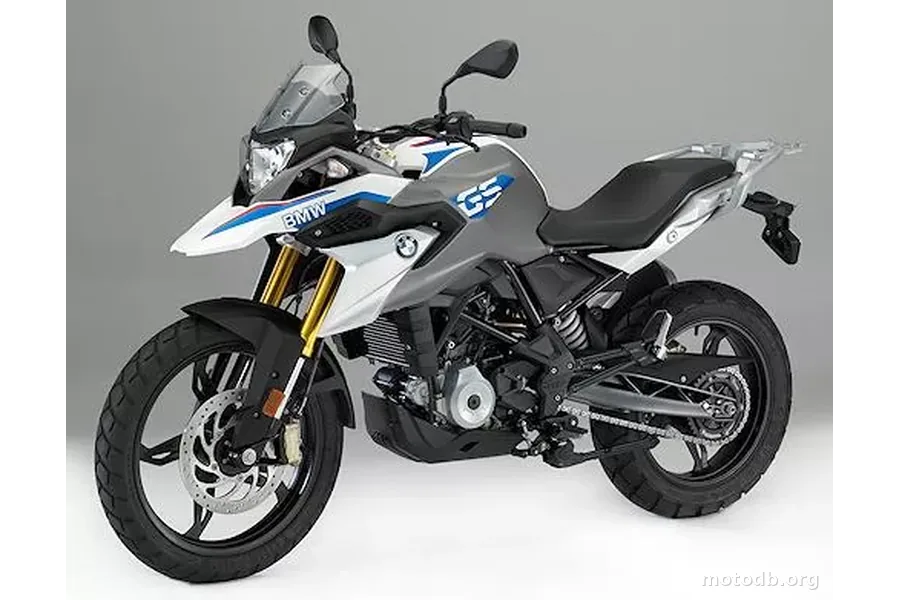
What a joy that mimicry is. This mini GS faithfully reproduces the personality of the maxi. Marked angles, adventurer profile, styling cues, and a high-set seat. But the appearance stops there. The 310 GS gives the impression that you could lift it with one hand; the R 1250 seems like a behemoth designed to smash through a wall. Of course, a 300 is more fluid, lighter, less seasoned for the trials of a larger displacement. Nevertheless, it doesn't do poorly. Simply, its belly doesn't bulge, as it is equally powered as the roadster.
It's a modest engine, but one that does honor to the history of trail bikes. This type of motorcycle has distinguished itself with singles, its typical engine configuration. The case is presented with the G 310 GS, equipped with a single piston. The entire set of technical solutions is classic, with liquid cooling, injection, 4 valves, double ACT, and a 6-speed gearbox. This single-cylinder engine stands out, however, with its inverted cylinder head, the intake being located at the front. This configuration has the advantage of moving the center of gravity down and closer to the front wheel. This offers more responsiveness to the machines of the G series. What will we have under our sleeves to carry the 169.5 kilos of this 310 GS? A respectable 34 horsepower, which the engine develops at 9,250 rpm. The torque is in line with the displacement, peaking at 3 mkg at 7,500 rpm. A power within the canons of the category, allowing for daily use, overflowing into a few weekend adventures. In perfect agreement with the needs of the targeted regions or the A2 license, but necessarily limited for the desires and needs of travelers from the old continent. Most wouldn't need more... But the desire yes. As for the maximum speed, don't ask it for more than a good 140 km/h.
As we have seen, the GS is built on the basis of the 310 R. But how did it manage to gain 11 kilos? A more protective headstock, specific bodywork, a luggage rack with integrated handles – it weighs. The trail takes the engine, and the essential part of the roadster's chassis. We find the steel tubular trellis frame, just retouched at the steering column level; the steering column angle is less open and the rake is greater. In the same spirit of stability, the swingarm has been extended by 46 mm, bringing the wheelbase to 1420 mm. The copy-paste also applies to the shock absorber and inverted fork. However, to stick to the trail use, the suspension travel has been increased. Plus 49 mm for the fork, for a 180 mm slide, and 40 mm more at the rear, harmonizing the stroke to 180 mm as well. This will allow the G 310 GS to overcome a few bumps, but at the expense of the seat: the seat height goes from 785 mm to 835 mm. 5 cm difference for a seat, you can feel it. Anyway, a trail is high-set. And it has a large wheel. The front wheel receives a 19-inch rim, a compromise between the road (17') and the offroad (21'). BMW retains a 17' at the rear, taking care to change the shoes for more versatile rubber. It's a shame that spoked wheels are not part of the package, not even as an option. There are no changes regarding the brakes. ABS supervises the crew, consisting of a 300 mm disc at the front with a radial 4-piston caliper signed Bybre (a Brembo sub-brand), and another disc at the rear, 240 mm this time with a double piston caliper.
Besides the noticeably different seat height, the G 310 GS highlights its riding position. A trail is one of the most decontracted machines to ride. Seated in a dominant position, you are ready to venture a little everywhere. The small windscreen and the shoulders will break up the force of the air better than the roadster. But it will remain limited, far from the performance of a large GS. Once mounted, the rider will feel more protected by the presence of the bodywork. The view of the cockpit will be the same as that of the 310 R. A window where everything is digital, from the speed to the bar graph, from the fuel gauge to the gear indicator, and trips, consumption calculations, clock, etc.
If the smallest of BMW's trails proudly bears the blue and white badge, it is because it was designed in Germany and draws without hesitation on the GS family under its most beautiful aspects. Under the engine, the motorcycle finds its origins in Indian factories. Like the roadster, it is manufactured by TVS Motor Company, in Bangalore. Therefore, it is impossible to claim the Made In Germany label. What a shame... KTM does well to have its small Dukes manufactured by Bajaj, Harley once its 500 and 750 Streets in India as well. Anyway, to conquer this market and offer a tight price, the economic logic imposes it.
What about the price? Important for this G 310 GS, and largely conditioning its implantation on the territory. Despite the multiplication of models in this displacement range, the sauce has always had difficulty taking hold. Nevertheless, there will be room to have fun gently among the trail bikes. The little court presents or presents this BMW, the Suzuki 250 V-Strom, the KTM 390 Adventure and the Kawasaki Versys-X 300. We could also talk about the Mash 400 Adventure and the Benelli 251 TRK. Briefly, things are moving, and they only ask to entertain our streets. Will the smallest of the GS also entertain roads, nuts, urban lanes, undergrowth and undertones?!!
M.B - Images constructeur
Standard equipment
- Assistance au freinage : ABS
Practical info
- Véhicule accessible au permis A2 ou bridable à 47.5ch / 35 Kw
- La moto est accessible aux permis : A, A2
- Pays de fabrication : Inde
Reviews & comments
No reviews yet. Be the first to share your opinion!