Key performance
Technical specifications
Engine
- Displacement
- 1198 cc
- Power
- 170.0 ch @ 9750 tr/min (125.0 kW)
- Torque
- 126.5 Nm @ 8000 tr/min
- Engine type
- Bicylindre en L à 90°, 4 temps
- Cooling
- liquide
- Compression ratio
- 12.7 : 1
- Bore × stroke
- 106 x 67.9 mm
- Valves/cylinder
- 4
- Camshafts
- 2 ACT
- Fuel system
- Injection
Chassis
- Frame
- treillis tubulaire en tube d'acier relié à des platines en alu
- Gearbox
- boîte à 6 rapports
- Final drive
- Chaîne
- Front suspension
- Fourche téléhydraulique inversée Ø 43 mm, déb : 120 mm
- Rear suspension
- Mono-amortisseur, déb : 120 mm
Brakes
- Front brakes
- Freinage
- Rear brakes
- Freinage 1 disque
- Front tyre
- 120/70-17
- Rear tyre
- 190/55-17
Dimensions
- Fuel capacity
- 18.00 L
- Weight
- 173.50 kg
- Dry weight
- 164.00 kg
- New price
- 26 990 €
Overview
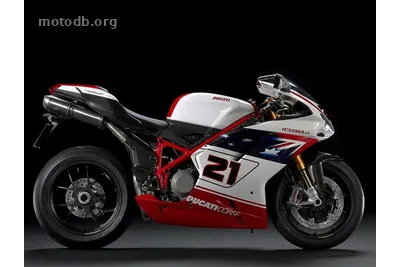
Rimini has never claimed to play in the same league as the major manufacturers. Bimota builds motorcycles the way certain craftsmen build watches: in small numbers, with an obsession for detail that barely justifies the prices charged. The DB8 SP, released in 2013 at €26,990, perfectly illustrates this philosophy taken to its extreme.
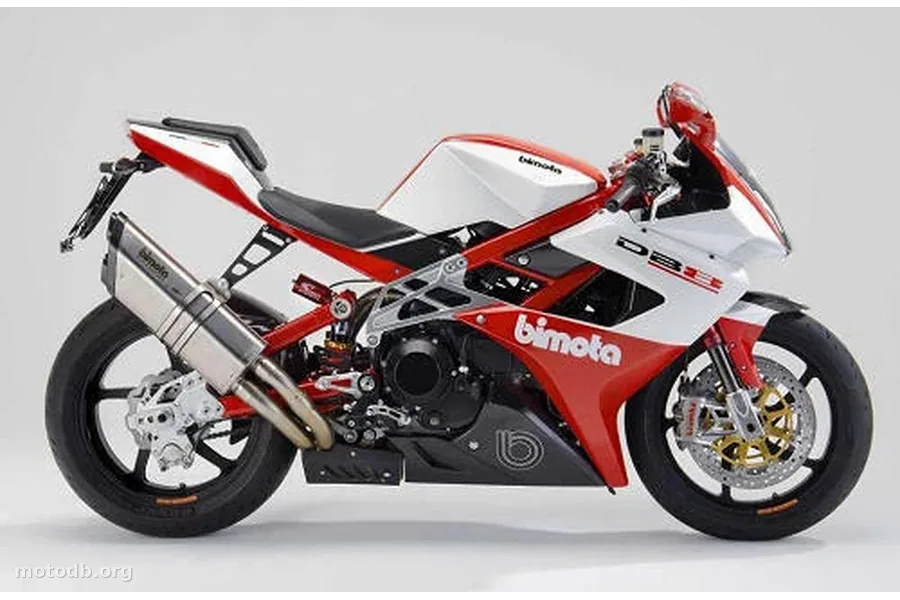
Beneath the carbon bodywork whose color scheme echoes the DB8's codes, the 90-degree L-twin displacing 1,198cc from Bologna beats at its heart. Same architecture as the Ducati 1198, same 170 horsepower at 9,750 rpm, same generous torque of 126.5 Nm at 8,000 rpm. But Bimota didn't simply transplant the engine as-is. The specific Walbro fuel injection refines the twin's character, and Zard developed a bespoke titanium exhaust that noticeably alters the acoustic signature and mid-range response. The figures on the spec sheet remain identical, but the way those horses deploy takes on an entirely different flavor. At 164 kg dry, the power-to-weight ratio places the DB8 SP in a category where few machines dare to venture.
What truly sets a Bimota apart from a Japanese sportbike or even a Ducati is the chassis. The steel tubular trellis frame, connected to billet aluminum plates machined from solid, has been the brand's DNA since the DB5 of 2005. This marriage of tubes and cut-out plates is not merely an aesthetic choice: it is a mechanical response to the challenge of dynamic behavior, a way of managing stiffness and flex where each is needed. The swingarm follows the same constructive logic, with the same immediately recognizable visual signature. One may debate the choice of a 43 mm Marzocchi inverted fork and an Extreme Tech shock absorber rather than the Öhlins one might expect at this price point, but these components do their job competently with 120 mm of travel at both ends.
The rest of the component list leaves little room for criticism. Brembo radial monobloc brakes, forged aluminum OZ Racing wheels, self-supporting carbon seat unit: the DB8 SP ticks every high-end box with a consistency that many manufacturers struggle to maintain across their limited-edition runs. The claimed top speed of 280 km/h and the 18-liter fuel tank complete a picture clearly not aimed at the Sunday tourer.
The target audience is narrow, and knows it. This is neither a track-day devotee chasing lap times nor an urban commuter seeking practicality. The DB8 SP speaks to a knowledgeable collector, one capable of appreciating the rarity of a machine produced in a few dozen examples and of accepting the compromises that positioning entails. Against a contemporary Ducati 1199 Panigale or a BMW S 1000 RR, the Bimota falls short on onboard electronics and accessibility at the limit. It gains on something less measurable: the absolute uniqueness of a motorcycle built by hand in the Rimini workshops, with a level of finish that transforms every detail into a reason for ownership. Some machines are ridden. This one, first and foremost, is admired.
Practical info
- La moto est accessible aux permis : A
Reviews & comments
No reviews yet. Be the first to share your opinion!