Key performance
Technical specifications
Engine
- Displacement
- 1198 cc
- Power
- 220.0 ch @ 11000 tr/min (161.8 kW)
- Torque
- 134.4 Nm @ 7750 tr/min
- Engine type
- Bicylindre en L à 90°, 4 temps
- Cooling
- liquide
- Compression ratio
- 12.8 : 1
- Bore × stroke
- 106 x 67.9 mm
- Valves/cylinder
- 4
- Camshafts
- 2 ACT
- Fuel system
- Injection Ø 50 mm
Chassis
- Frame
- treillis en tubes d\'acier
- Gearbox
- boîte à 6 rapports
- Final drive
- Chaîne
- Front suspension
- Fourche téléhydraulique inversée présurisée Öhlins TTX20 Ø 43 mm, déb : 120 mm
- Rear suspension
- Mono-amortisseur Öhlins TTX36, déb : 127 mm
Brakes
- Front brakes
- Freinage 2 disques Ø 320 mm, fixation radiale, étrier 4 pistons
- Rear brakes
- Freinage 1 disque Ø 218 mm, étrier 2 pistons
- Front tyre
- 120/75-17
- Rear tyre
- 190/65-17
Dimensions
- Fuel capacity
- 23.90 L
- Dry weight
- 168.00 kg
- New price
- 120 000 €
Overview
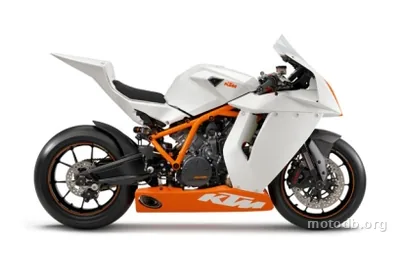
One hundred and twenty thousand euros. That figure alone sets the scene: this is not a road bike dressed up as a racer, but a competition machine homologated for the World Superbike Championship, born to bite the asphalt of racing circuits and make twice-as-complex Japanese four-cylinders suffer.
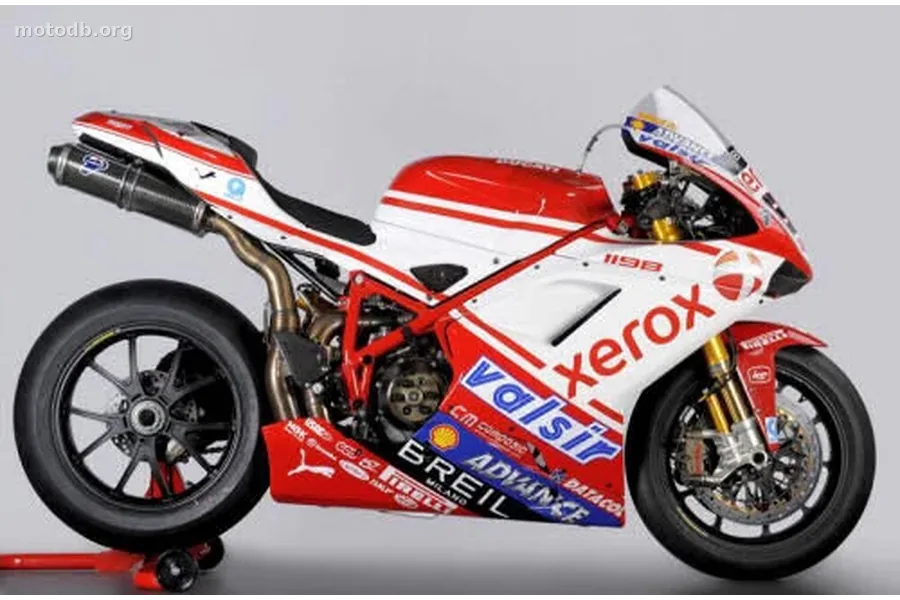
The 90° L-twin displacing 1198 cc is the backbone of an Italian philosophy that dates back to Borgo Panigale: do more with less. Fewer cylinders, but 220 horsepower wrung out at 11,000 rpm, and above all 134.4 Nm of torque in the mid-range. Faced with Japanese Superbikes and the BMW S1000RR beginning to make its presence felt, Ducati responds with this twin that impresses no one on the spec sheet, and crushes everyone on track. Bayliss knew it. So did Haga.
168 kilograms dry, a 23.9-liter tank sized for long sprint endurance races, a steel trellis frame that transmits every engine vibration like a direct line between rider and machine. The Öhlins TTX suspension front and rear is not there for show on the spec sheet: these are adjustable competition components, tunable to a tenth of a millimeter, the kind factory teams carry in their trucks. The 43 mm inverted fork with 120 mm of travel, the TTX36 monoshock at the rear — nothing here is standard in the conventional sense. Everything is designed to iron out the imperfections of the track, not the road.
310 km/h top speed, a compression ratio of 12.8:1 demanding quality fuel and rigorous maintenance: this F09 is not a machine you wheel out on a Sunday out of laziness. It demands, it consumes, it requires attention. That is the price of the contract made with the rider. In return, it offers surgical precision in direction changes, power that builds in a straight line without the hysteria of four-cylinders screaming through the rev range, and a sound that justifies the purchase on its own. The Ducati twin does not bark — it growls.
The target audience is obvious and singular: the rider competing in a Superbike or Superstock championship, backed by a professional team budget and a mechanic capable of preparing this machine between sessions. It is not a radical evolution over previous generations — Ducati acknowledges as much — but a millimetric refinement of an already highly developed package. In a market where the competition multiplies cylinders and electronic complexity, the 1198 F09 holds its ground with a simple argument: championship results. In competition, track records are read on podiums, not in brochures.
Reviews & comments
No reviews yet. Be the first to share your opinion!