Key performance
Technical specifications
Engine
- Displacement
- 898 cc
- Power
- 142.0 ch @ 11500 tr/min (104.4 kW)
- Torque
- 96.1 Nm @ 8500 tr/min
- Cooling
- liquide
- Compression ratio
- 11 : 1
- Bore × stroke
- 88 x 49.2 mm
- Valves/cylinder
- 4
- Camshafts
- 2 ACT
- Fuel system
- Injection
Chassis
- Frame
- treillis en tube d\'acier relié à des éléments de fonderie
- Gearbox
- boîte à 6 rapports
- Final drive
- Chaîne
- Front suspension
- Fourche téléhydraulique inversée Ø 50 mm, déb : 120 mm
- Rear suspension
- Mono-amortisseur Extreme Technology, déb : 115 mm
Brakes
- Front brakes
- Freinage 2 disques Ø 320 mm, fixation radiale, étrier 4 pistons
- Rear brakes
- Freinage 1 disque Ø 240 mm, étrier 2 pistons
- Front tyre
- 120/70-17
- Front tyre pressure
- 2.50 bar
- Rear tyre
- 190/50-17
- Rear tyre pressure
- 2.20 bar
Dimensions
- Seat height
- 810.00 mm
- Fuel capacity
- 22.00 L
- Weight
- 220.00 kg
- Dry weight
- 195.00 kg
- New price
- 20 461 €
Overview
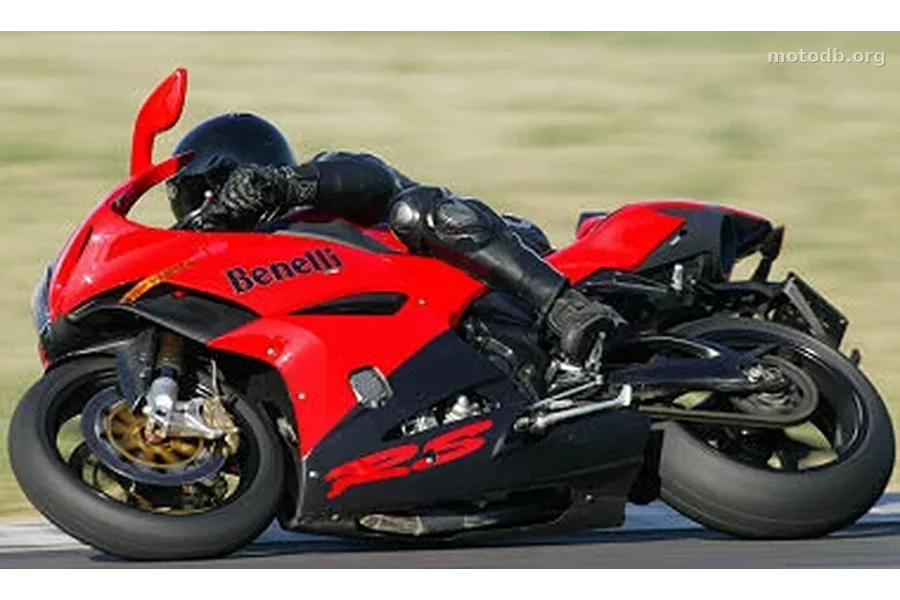
When Benelli launched the Tornado 900 in the early 2000s, nobody really expected Italy to step onto that turf. A 898 cc three-cylinder from Pesaro, going up against the GSX-Rs and CBRs of the era — it was almost a fool's bet. The 2004 RS pushes the provocation further: it fully owns its sporting vocation and makes no secret of it, starting with that red livery that clings like a warning.
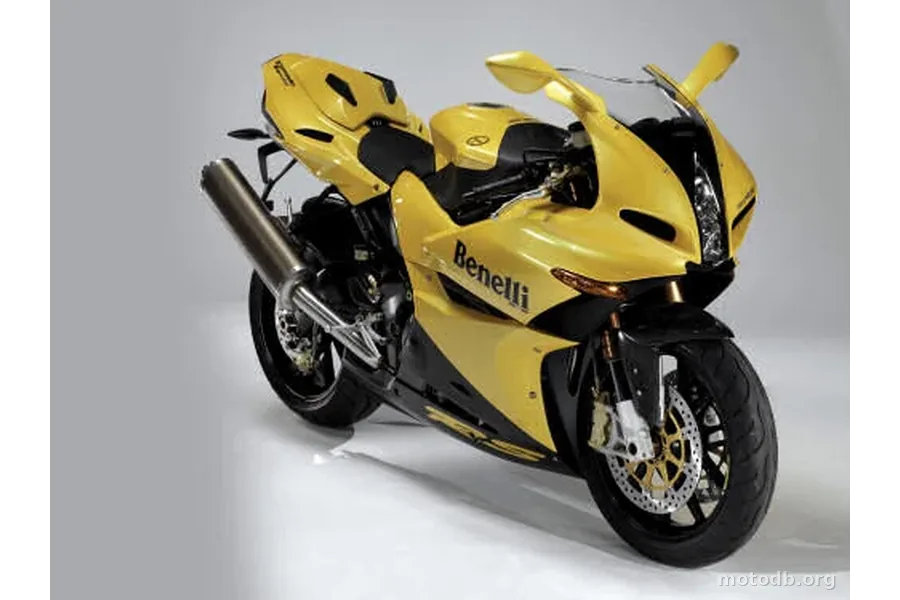
Under the fairing, work on the injection and intake systems extracted an additional 7 horsepower over the standard version. The result is 142 horsepower at 11,500 rpm, with 96.1 Nm of torque available at 8,500 rpm. This is not a motorcycle that hits hard at low revs; it needs to be pushed, warmed up, given its voice before it deigns to truly respond. To accompany this literal thermal power surge, an oil cooler makes its appearance to prevent overheating under intensive use. Benelli is thinking track, not just image.
The RS also sheds weight through a few well-chosen details: carbon fenders, forged wheels. Dry weight drops to 195 kg, or 220 kg fully fueled with the 22-liter tank. That's reasonable for a sportbike of this displacement, but still a long way from the lightness of an R6 or a Daytona 675 from the same era. The 50 mm inverted fork and the Extreme Technology monoshock gain in lightness and adjustment range, which makes a concrete difference on track.
The radially mounted front calipers on 320 mm discs deliver firm, honest bite, and the steering damper that appears on this version betrays the machine's clearly track-focused orientation. The clutch-side traction control becomes adjustable depending on use — road or track — which was still rare in 2004 on a motorcycle accessible to the general public. The seat height is 810 mm, and the clip-ons have been set back 15 mm compared to the standard version: the wrists take the punishment, as do the lower back. This is not a touring motorcycle, and it makes no claim to be.
At €20,461 at the time, the Tornado 900 RS positioned itself at the top end of the European sportbike segment without necessarily having the reputation or the service network to match. That is its historic Achilles' heel: up against Ducati or Aprilia in this segment, Benelli lacked commercial legitimacy. The machine itself lacked nothing on paper. An 11:1 compression ratio, an 88 mm bore with a 49.2 mm stroke, four valves per cylinder, and a claimed top speed of 260 km/h — the technical credentials were solid. What Benelli never truly managed was convincing buyers that those figures would translate reliably over the long term. The RS remains today an endearing curiosity, the kind of motorcycle you notice in a paddock because it sounds different, because it comes from somewhere else. For those who accept its singular character and its demands, it offers an experience that the major Japanese manufacturers simply cannot reproduce.
Practical info
- La moto est accessible aux permis : A
Indicators & positioning
Similar bikes
TDM 900 GT ABS
F 900 XR Aurelius
F 900 XR Sport Edition
Niken 900 GT
Reviews & comments
No reviews yet. Be the first to share your opinion!