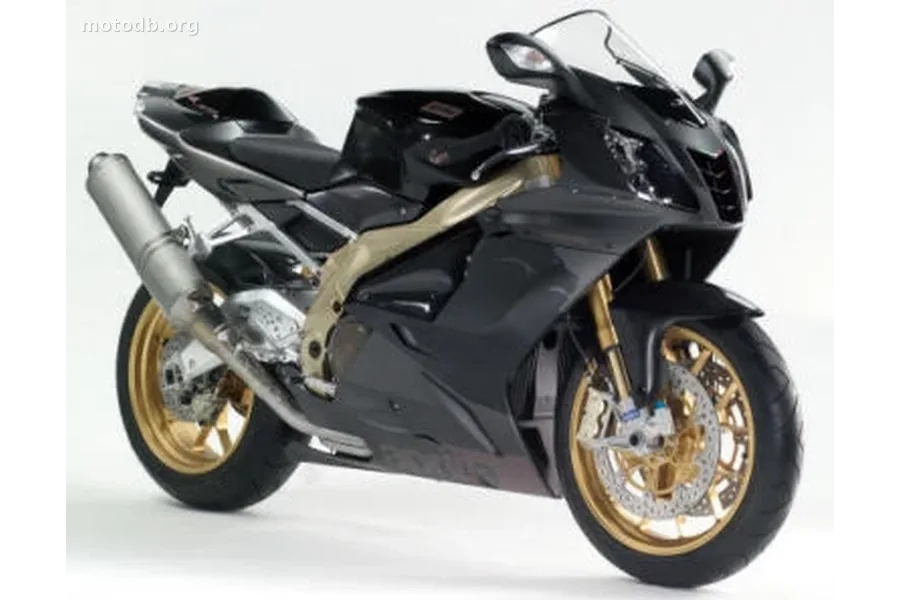
Key performance
Technical specifications
Engine
- Displacement
- 998 cc
- Power
- 143.0 ch @ 9500 tr/min (105.2 kW)
- Torque
- 101.0 Nm @ 8000 tr/min
- Engine type
- Bicylindre en V à 60°, 4 temps
- Cooling
- liquide
- Compression ratio
- 11.8:1
- Bore × stroke
- 97 x 67,5 mm
- Valves/cylinder
- 4
- Camshafts
- 2 ACT
- Fuel system
- Injection Ø 57 mm
Chassis
- Frame
- double poutre en alliage alu
- Gearbox
- boîte à 6 rapports
- Final drive
- Chaîne
- Front suspension
- Fourche téléhydraulique inversée öhlins Ø 43 mm, déb : 120 mm
- Rear suspension
- Mono-amortisseur Öhlins, déb : 133 mm
Brakes
- Front brakes
- Freinage 2 disques Ø 320 mm, fixation radiale, étrier 4 pistons
- Rear brakes
- Freinage 1 disque Ø 220 mm, étrier 2 pistons
- Front tyre
- 120/70-17
- Rear tyre
- 190/50-17
Dimensions
- Seat height
- 810.00 mm
- Fuel capacity
- 18.00 L
- Weight
- 211.00 kg
- Dry weight
- 185.00 kg
- New price
- 15 900 €
Overview
While Honda was refining its CBR1000RR and Yamaha consolidating the R1, Aprilia was taking a more radical direction with its 2006 RSV-R Factory. There's no question of compromise between daily use and the track here: this 997cc 60-degree V-twin, reworked with new electronic management and redesigned exhaust valves, now pushes 143 horsepower at 9,500 rpm with 101 Nm of torque at 8,000 rpm. Five more horsepower than the previous year — which may seem incidental on paper, but takes on real meaning in the context of a machine already operating at the limit.
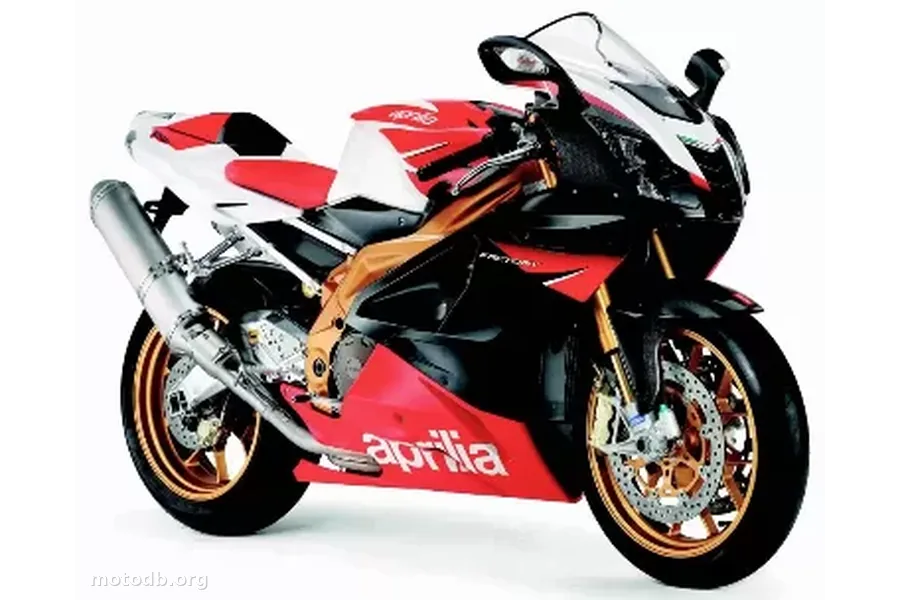
What truly distinguishes the Factory from the standard RSV-R is its equipment level. Öhlins Racing on both ends, without compromise: 43mm inverted fork up front, a rear monoshock adjustable for preload, compression and rebound, plus a twin-chamber steering damper from the same Swedish manufacturer. For comparison, many competitors of the era were still offering entry-level adjustable in-house suspension on their sport lines. Here, you're straight onto homologated racing-grade hardware. The aluminum twin-spar frame, painted in that characteristic gold that extends to the forged wheels, delivers a visual coherence rarely seen in the segment.
The forged aluminum wheels deserve a closer look: 25% lighter than conventional cast aluminum, they reduce unsprung mass and improve steering precision in a measurable, not theoretical, way. Combined with Pirelli SuperCorsa Pro tires mounted in 120/70-17 at the front and 190/50-17 at the rear, they give this machine an agility that its 211 kg fully fueled doesn't necessarily suggest. Dry, it drops to 185 kg — exactly the weight of the RSV 1000 SP, that Superbike homologation version that cost a fortune a few years prior. Technical progress has something satisfying about it when it materializes this way.
Carbon fiber makes an appearance on the front and rear fenders, the ventilation scoops, the fork brace deflectors, and the tank side panels. This isn't cosmetic carbon glued on for looks: each piece reduces weight where it's relevant. With a claimed top speed of 280 km/h and a compression ratio of 11.8:1, the Factory isn't aimed at the Sunday tourist. The 810mm seat height and the riding position imposed by this type of machine naturally filter the audience: it's aimed at experienced riders, equally at home on circuit and open road, who know how to exploit 143 horsepower without sophisticated electronic safety nets.
At €15,900 — nearly €2,000 less than the 2005 version — the 2006 Factory presents an interesting proposition. It doesn't try to compete with the Japanese supersports on value-for-money terms; it plays a different card: accessible exclusivity, racing DNA without the price tag of pure competition. For those who accept the strong character of the transalpine V-twin, its vibrations, its temperament, this RSV-R Factory remains one of the most honest offerings in its class. It doesn't pretend to be anything other than what it is.
Practical info
- La moto est accessible aux permis : A
Indicators & positioning
Similar bikes
CBR 1000 RR Fireblade Repsol Replica
1000 ZX-10R 30ème anniversaire
Reviews & comments
No reviews yet. Be the first to share your opinion!