Key performance
Technical specifications
Engine
- Displacement
- 998 cc
- Power
- 128.0 ch @ 9250 tr/min (94.1 kW)
- Torque
- 101.0 Nm @ 8000 tr/min
- Engine type
- Bicylindre en V à 60°, 4 temps
- Cooling
- liquide
- Compression ratio
- 11.4:1
- Bore × stroke
- 97 x 67,5 mm
- Valves/cylinder
- 4
- Camshafts
- 2 ACT
- Fuel system
- Injection Ø 51 mm
Chassis
- Frame
- double poutre en alliage alu
- Gearbox
- boîte à 6 rapports
- Final drive
- Chaîne
- Front suspension
- Fourche téléhydraulique inversée Ø 43 mm, déb : 120 mm
- Rear suspension
- Mono-amortisseur, déb : 135 mm
Brakes
- Front brakes
- Freinage 2 disques Ø 320 mm, étrier 4 pistons
- Rear brakes
- Freinage 1 disque Ø 220 mm, étrier 2 pistons
- Front tyre
- 120/70-17
- Rear tyre
- 190/50-17
Dimensions
- Seat height
- 820.00 mm
- Fuel capacity
- 18.00 L
- Weight
- 218.00 kg
- Dry weight
- 187.00 kg
- New price
- 12 855 €
Overview
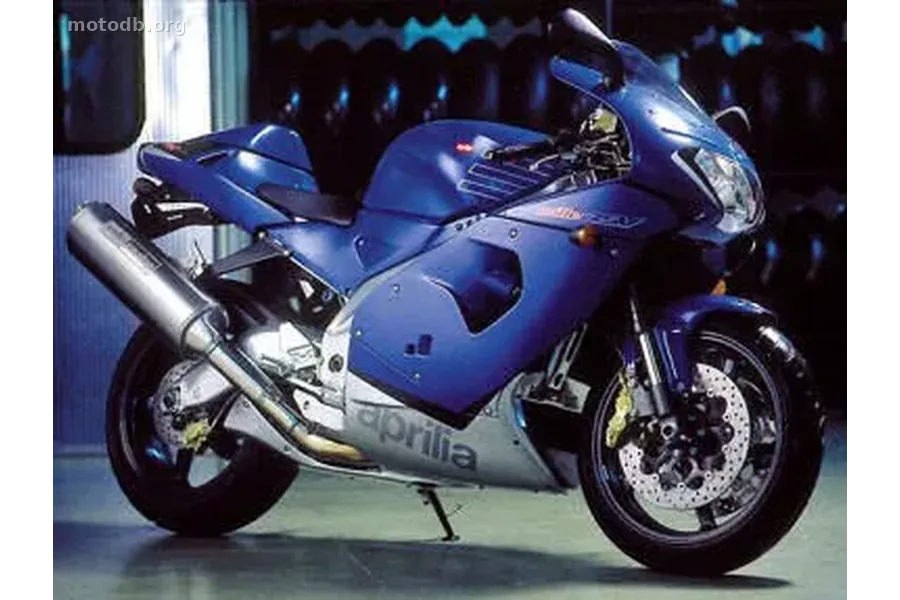
When Noale decided to play with the big boys, no one really knew what Aprilia would come up with from its workshops. The Italian brand, until then a specialist in small displacement engines and GP racing, surprised everyone with its RSV 1000, a sportbike built around a 60° V-twin engine that has nothing to envy from the best engines in the segment.
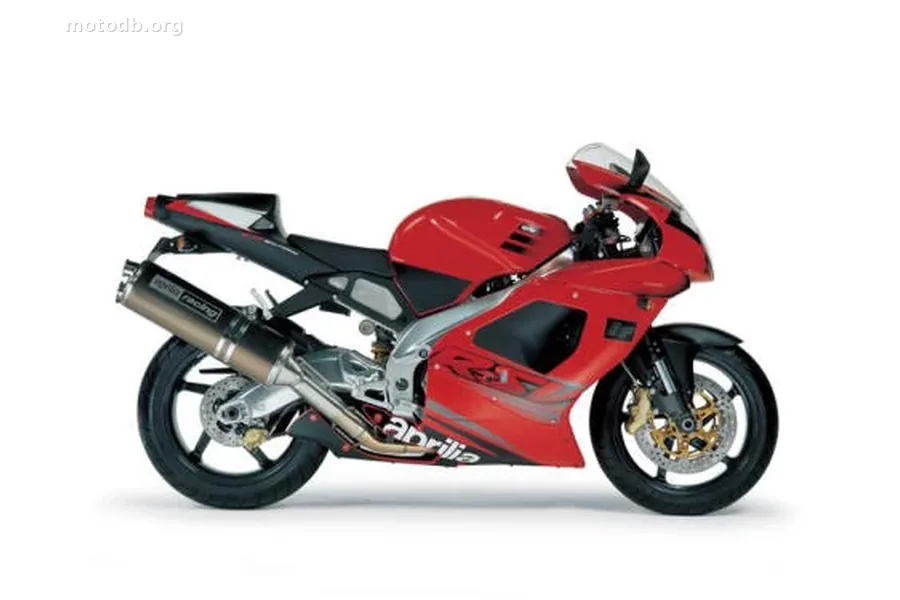
This engine is the heart of the matter. With 128 horsepower at 9250 rpm and 101 Nm of torque available from 8000 rpm, the twin developed for the Aprilia RSV 1000 stands out with a suppleness that its four-cylinder rivals can't always offer. Injection manages the mixture with precision, but it's the pneumatic clutch assist system during downshifts that makes the difference on special occasions: downshifting is done without jerks, with a fluidity that reassures both on the track and on exiting tight corners. All within an aluminum double beam frame that tacks the dry weight to 187 kg, or 218 kg fully fueled with the 18 liters of fuel on board. For a hypersportive of this power, the proposition is consistent.
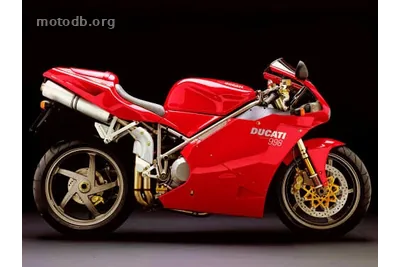
Faced with the Ducati 996 of the time, the comparison naturally imposes itself. The RSV chooses a different path: less exclusive, more accessible. The Bolognese V-twin imposes a riding rigor that not everyone can afford on a daily basis. The Aprilia RSV 1000 R, in its successive evolutions, has refined this philosophy of the versatile sportbike. Here, the front end communicates clearly, the 43 mm inverted fork with 120 mm of travel accompanies mass transfers faithfully, and the rider quickly learns to contribute physically to place the bike where he wants. It's not a passive machine, but it doesn't punish approximations with the brutality of a double-barrel Italian.
Two points deserve to be honestly noted. The rear shock absorber, with its 135 mm of travel, handles direction changes well but is approximate on small road imperfections, those ordinary road bumps that end up being tiring on a long journey. The brakes, with two 320 mm discs at the front and a 220 mm disc at the rear, do their job without shining; the bite lacks a bit of conviction during hard braking. Points that distinguish the 2002 version from what the Aprilia RSV 1000 Factory will become in its later, more radical versions.
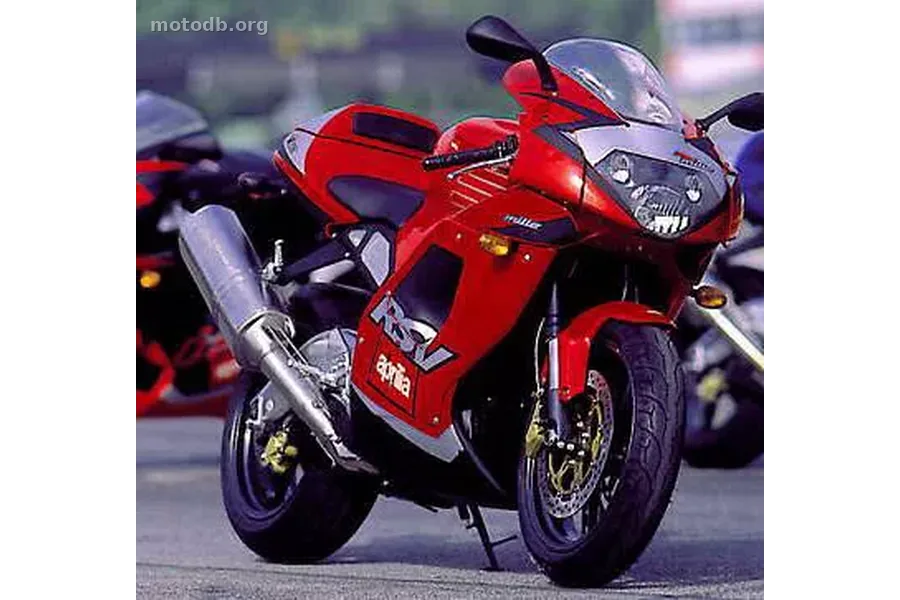
The 2002 version already benefits from the revisions introduced during the previous year: fork head deflectors, redesigned fairing, revised top end, two kilos less on the scale. These adjustments confirm that Aprilia listened to its customers and refined its product over the years, from the Aprilia RSV 1000 1999 to the R 2004 and 2005 versions that will push the formula even further. At 12,855 euros at its release, the Aprilia RSV 1000 price represented a serious investment, but justified by a real level of finish and technology. For an intermediate rider looking for a sportbike that can be tamed without being let loose, it remains today a particularly well-regarded Aprilia RSV 1000 used bike on the second-hand market.
Practical info
- La moto est accessible aux permis : A
Reviews & comments
No reviews yet. Be the first to share your opinion!