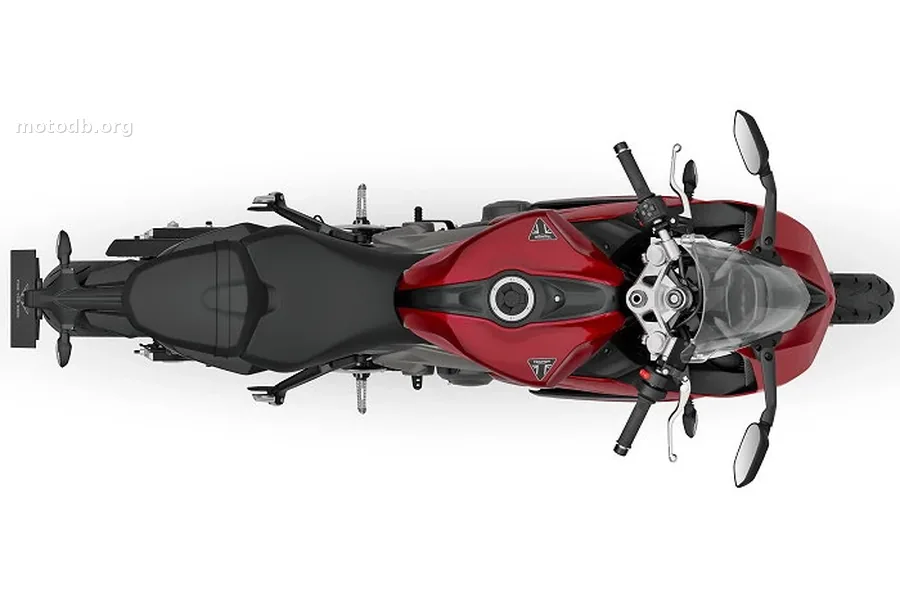
Key performance
Technical specifications
Engine
- Displacement
- 660 cc
- Power
- 95.0 ch @ 11250 tr/min (69.9 kW)
- Torque
- 69.6 Nm @ 8250 tr/min
- Cooling
- liquide
- Compression ratio
- 12.05 : 1
- Bore × stroke
- 74 x 51.1 mm
- Valves/cylinder
- 4
- Camshafts
- 2 ACT
- Fuel system
- Injection
Chassis
- Frame
- Structure en tubes d'acier
- Gearbox
- boîte à 6 rapports
- Final drive
- Chaîne
- Front suspension
- Fourche téléhydraulique inversée Ø 41 mm, déb : 110 mm
- Rear suspension
- Mono-amortisseur, déb : 130 mm
Brakes
- Front brakes
- Freinage 2 disques J.Juan Ø 310 mm, fixation radiale, étrier 4 pistons
- Rear brakes
- Freinage 1 disque J.Juan Ø 220 mm, étrier simple piston
- Front tyre
- 120/70-17
- Rear tyre
- 180/55-17
Dimensions
- Seat height
- 810.00 mm
- Fuel capacity
- 14.00 L
- Weight
- 201.00 kg
- New price
- 9 795 €
Overview
Since Triumph’s commitment to Moto2, everyone hoped for the return of the Daytona. Especially with the 765 cm3 engine and the chassis efficiency of the Street Triple RS—a fairing, a few adjustments, a dose of sportiness more, and the job would be done. A short follow-up had entertained some hope with the 765 Daytona in 2020. Then silence, without the public’s desire disappearing. Would Triumph have listened? Have the planets finally aligned for the Dayto’ to return, carving out trajectories?
Bring out the champagne but don’t fill the glasses just yet! Yes, the Daytona is back! Yes, it once again embodies sport. But a more restrained sport, far from the fury of its predecessor. The new Dayto’ is based on the 660 Trident roadster. But as we will see, Hinckley really worked to make it a much more appealing machine.
Just in terms of style, the English bike looks great. You vaguely guess the spirit of the 675 in filigree without really creating the connection. Less tense, less angry, the new Daytona wants to claim a certain affiliation without being able to achieve the aggressiveness of a true circuit machine. Between its eyes are placed a triangular air intake and a strange little parabolic recess under the nose. Compared to the Trident, the Dayto’ changes the tank, installs a double-layer seat, modifies the riding position with new footrest plates and a single-piece handlebar assembly, installs the necessary rear road equipment under the seat and gives the impression of a frame. Cosmetic parts give it the appearance of an aluminum longeron structure; but it is indeed steel tubes underneath.
Consequently, a true identity is offered to it. It will be able to compete without timidity with the machines of the segment of “gentle” mid-size sport bikes. A semi-militarized zone where the recipe is more or less the same to create a model. Whether it’s the GSX-8R, the CBR 650 or the Ninja 650, they all come from a roadster to which a fairing is grafted and a few elements are retouched. Basically, the suit changes for the same performance under a more refined look. Triumph goes much further. Already, its Daytona 660 will not frequent the same club of sports bikes. The little three-cylinder no longer has the same desires. A good stay with the engine specialists allows it to gain 17% of power and 9% of torque. Wowhw! That’s a lot!
For a little perspective, let’s look at the MT-07 and the R7. Whether you ride one or the other, it’s 73 horsepower. Let’s go to England, where the Trident proposes 81 horses. Change riders and it’s with 95 hp that you will open the ball. This good dose of watts is released completely at 11,250 rpm. Surprisingly, the redline is still far, at 12,650 rpm. Surely the 3-cylinder could still send us a few extra horses. But by staying at 95 horsepower, the Daytona maintains its A2 compatibility. With 69 Nm instead of 64 Nm, the maximum torque marks a less spectacular but also appreciable progress; with 80% of its force available after 3,125 rpm. To achieve this very significant increase in power, Triumph modified the crankshaft, camshafts, cylinder head and pistons and took the opportunity to retouch the gearbox. A new exhaust will also make the difference in the voice of this revitalized 3-cylinder. We find the Torque Assist clutch, to facilitate the effort on the lever and calm the rear wheel slides during strong decelerations.
In the Daytona, the engine does not show its growl right away. It follows the mood of the Trident’s block until the beginning of the mid-range then begins to want to emancipate itself around 6,500 rpm. But it is truly after 7,500 rpm that it shows its difference and takes off.
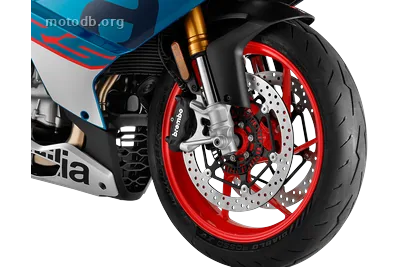
Aware that pilots will ask more of it and a more sustained pace, the Daytona also revises the front end. The Showa 41 mm inverted fork evolves from the SFF model to the BP-SFF with a large piston, while the brake calipers become radial and double the number of pistons in action. Look how Triumph has “cleaned” these 4-piston calipers to leave only its logo in evidence. The front brake discs have the same diameter (310 mm) while the rear one is reduced from 255 mm to 220 mm. The tubular steel perimeter frame does not receive any evolution, nor does the steel swingarm. This is where the Daytona loses some noble points compared to a pure sports bike; and could not proudly lift its chin in the face of the 675 dynasty. There are no beautiful aluminum parts, nor suspension settings at all levels (only rear preload), nor a top-of-the-line dashboard. Under such an iconic name, you expected a TFT screen like the Street Triple Moto2!?
Instead, you will get the combined unit of the 660 Tiger. A little LCD at the top, a dose of TFT at the bottom… The information is there but not the distinguished side. It will be difficult to ignore this vision regularly under the nose. Between the plastic and the data, the thumb will have the choice of the machine's character. The 660 Daytona features three Riding Modes, acting on the throttle response and the level of traction control. The “Rain” and “Road” Modes come from the Trident; to which is added the “Sport”, aptly for a motorcycle with such an equivocal name. The traction control is disconnectable as desired. The quickshifter has not been invited to resurrect. It will be necessary to go through the options to have it. Casino zone where the layman will also find the Triumph connectivity system to pilot his smartphone (and access music, turn-by-turn navigation, etc), heated grips, a USB socket, a tracker, tire pressure, a seat cover…
It’s clear and it’s a good thing: there is a world between the Trident and the Daytona. Those fearing a roadster dressed up will be reassured to discover a motorcycle much more sharpened than the roadster. Enough to start desires for brawls where the imagination sows vibrators on the road. It is, however, essential to remember certain data, such as the weight. The 2024 Daytona just goes above 200 kg, with just one unit more….. While the last generation in 675 cm3 only weighed 184; with 128 horsepower in the boiler. So, yes, it is important to show that there is also a gap between two chapters of Daytona. It has changed because the world changes, not as the purists would like.
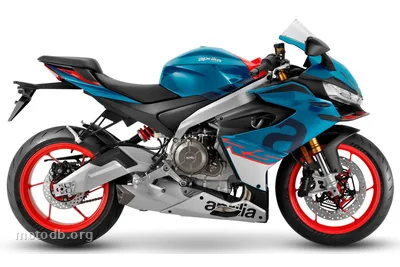
The new Daytona, unlike its 675 predecessor, is not a Supersport but a sports bike. Are these just words!? Much more and well weighed. The former sought pure performance and did not hesitate to tackle the R6 and 600 CBR; the one today does not think about the chronograph but bases its approach on the altar of sport. Its targets: Suzuki GSX-8R, Yamaha R7 and Aprilia RS 660. Or the Honda CBR 650 and the Kawasaki 650 Ninja. The contours of this new world are not traced by the chronograph but by the figures of the market.
M.B - Photos constructeur
Standard equipment
- Assistance au freinage : ABS
- Nombre de mode de conduite : 3
- Jantes aluminium
- Indicateur de vitesse engagée
- Contrôle de traction
- Embrayage anti-dribble
Practical info
- Véhicule accessible au permis A2 ou bridable à 47.5ch / 35 Kw
- La moto est accessible aux permis : A, A2
Reviews & comments
No reviews yet. Be the first to share your opinion!