Key performance
Technical specifications
Engine
- Displacement
- 599 cc
- Power
- 112.0 ch @ 12750 tr/min (80.3 kW)
- Torque
- 68.0 Nm @ 11000 tr/min
- Engine type
- In-line four, four-stroke
- Cooling
- Liquid
- Compression ratio
- 12.5:1
- Bore × stroke
- 68.0 x 41.3 mm (2.7 x 1.6 inches)
- Valves/cylinder
- 4
- Camshafts
- 2 ACT
- Fuel system
- Injection
- Valve timing
- Double Overhead Cams/Twin Cam (DOHC)
Chassis
- Frame
- périmétrique double poutre en alu
- Gearbox
- 6-speed
- Final drive
- Chaîne
- Front suspension
- Fourche téléhydraulique Ø 43 mm, déb : 120 mm
- Rear suspension
- mono-amortisseur
Brakes
- Front brakes
- Double disc
- Rear brakes
- Single disc
- Front tyre
- 120/70-ZR17
- Rear tyre
- 180/55-ZR17
Dimensions
- Seat height
- 815.00 mm
- Wheelbase
- 1390.00 mm
- Length
- 2050.00 mm
- Width
- 660.00 mm
- Height
- 1135.00 mm
- Fuel capacity
- 18.00 L
- Dry weight
- 165.00 kg
- New price
- 8 990 €
Overview
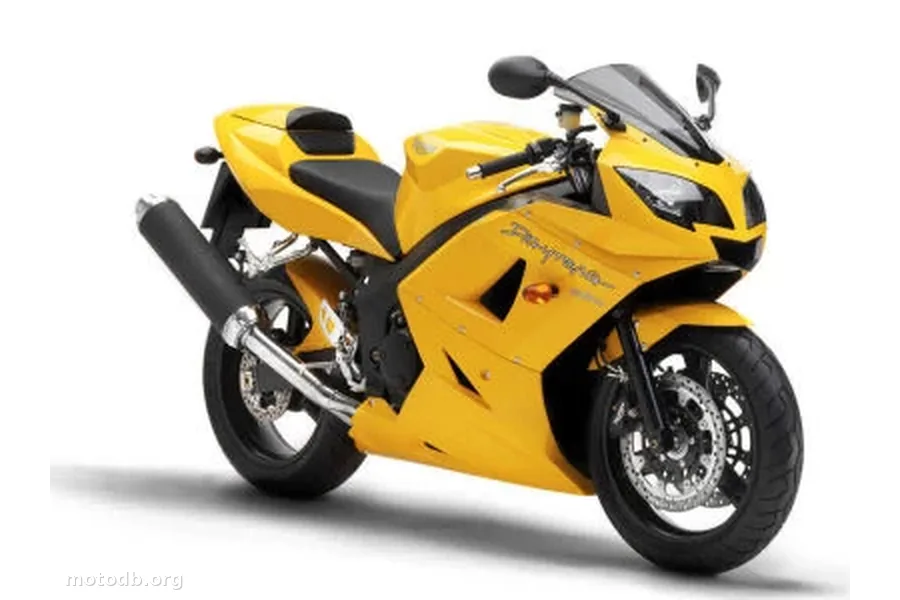
Remember that time, in 2003, when Japanese sport 600s had become precision weapons, cold and demanding. Triumph, with its resounding return, had suffered a setback with the TT600, a four-cylinder engine deemed too soft and too heavy. The answer is the 2004 Triumph Daytona 600, a machine that smells of effort and a desire to do well, but struggles to catch up. We are facing a transitional motorcycle, tasked with restoring a reputation.
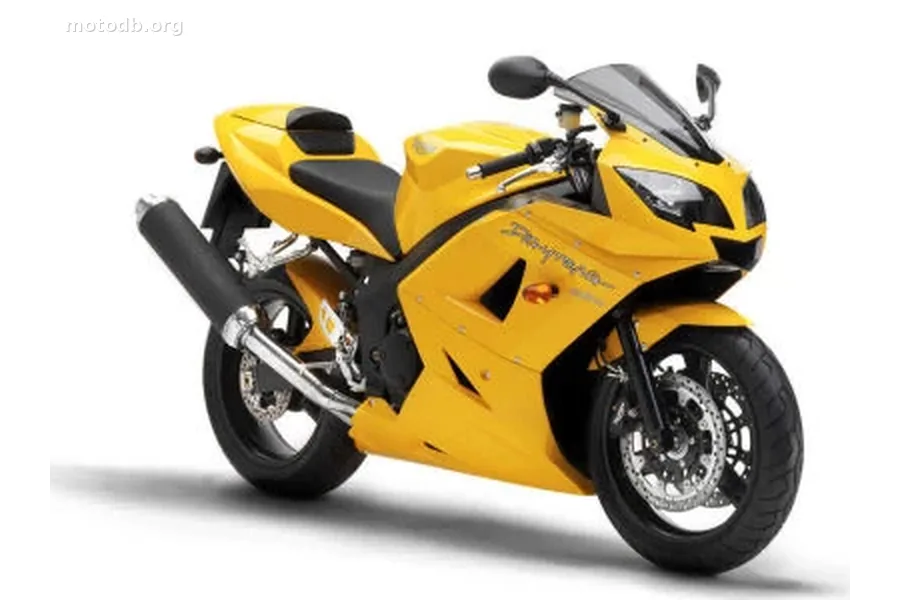
Under the redesigned, more angular fairing, the same 599 cm³ engine still beats. The figures are there: 112 horsepower at 12750 rpm, a torque of 68 Nm. On paper, this holds up against a Honda CBR600RR or a Yamaha YZF-R6. But on the asphalt, reality is less flattering. The engine suffers from an abysmal flat spot at low and mid-range. You have to torture it beyond 8000 rpm to feel a respectable surge, and the real life begins after 10000 rpm. This is a typical characteristic of the category at the time, but here it is exacerbated. The most frustrating thing? Triumph already possessed, with the Speed Four, a much more reactive and playful mapping on this same engine. Why didn’t they reuse it? This is the kind of question that haunts the enthusiast facing this 2004 Triumph Daytona 600, a missed opportunity to create a truly unique character.
The chassis, on the other hand, marks a real step forward. The perimeter aluminum frame and 43 mm fork offer serious, lively and stable handling. Braking is a strong point, effective and progressive. But once again, the comparison with the Japanese is cruel. The Daytona 600 behaves like a good sportbike from the previous generation, close to an older CBR600F, but lacks the ferocity and surgical precision of a ZX-6RR of the time. The gearbox, sometimes imprecise, recalls that there is still room for improvement. For those looking for a used Triumph Daytona 600 today, it is on these points that you will need to be vigilant; some childhood problems may persist.
And it is perhaps there that its true merit, and its audience, lie. Because if it is not the sharpest on the track, the Daytona 600 possesses an appreciable versatility. The riding position is less extreme than that of its competitors, the 815 mm seat is tolerable, and the suspensions offer relative comfort. It is easier to live with daily, on winding roads as in sporty riding. It is a sportbike that still smiles a little, where the others grimace. For a young license holder aiming for an A2 model after restriction, or for a touring rider looking for a sportbike without the associated torture, this English bike has arguments.
Ultimately, the Triumph Daytona 600, whether considered in its 2003 launch year, its 2005 or even 2006 version, remains an ambiguous object. It is an honest, well-built motorcycle that brought Triumph back into the ranks of the major players in the middle-cylinder sportbike class. But it is hampered by an engine that is too tame and dynamics that lack the last degree of Japanese madness. It pleases those who seek British charm and a certain ease, far from the dogma of all-out track performance. A beautiful machine, yes, but not a killer.
Practical info
- Moto bridable à 34 ch pour l'ancien permis A MTT1 - pas garanti pour le permis A2
- La moto est accessible aux permis : A, A (MTT1)
Indicators & positioning
Similar bikes
CBR 600 RR édition HANNspree Ten Kate
CBR 600 RR Replica MOVISTAR
Reviews & comments
No reviews yet. Be the first to share your opinion!