Key performance
Technical specifications
Engine
- Displacement
- 599 cc
- Power
- 112.0 ch @ 12750 tr/min (82.4 kW)
- Torque
- 66.7 Nm @ 11000 tr/min
- Engine type
- 4 cylindres en ligne, 4 temps
- Cooling
- liquide
- Compression ratio
- 12.5:1
- Bore × stroke
- 68 x 41.3 mm
- Valves/cylinder
- 4
- Camshafts
- 2 ACT
- Fuel system
- Injection Ø 38 mm
Chassis
- Frame
- périmétrique double poutre en alu
- Gearbox
- boîte à 6 rapports
- Final drive
- Chaîne
- Front suspension
- Fourche téléhydraulique Ø 43 mm, déb : 120 mm
- Rear suspension
- mono-amortisseur
Brakes
- Front brakes
- Freinage 2 disques Ø 308 mm, étrier 4 pistons
- Rear brakes
- Freinage 1 disque Ø 220 mm, étrier 2 pistons
- Front tyre
- 120/70-17
- Rear tyre
- 180/55-17
Dimensions
- Seat height
- 815.00 mm
- Fuel capacity
- 18.00 L
- Dry weight
- 165.00 kg
- New price
- 8 990 €
Overview
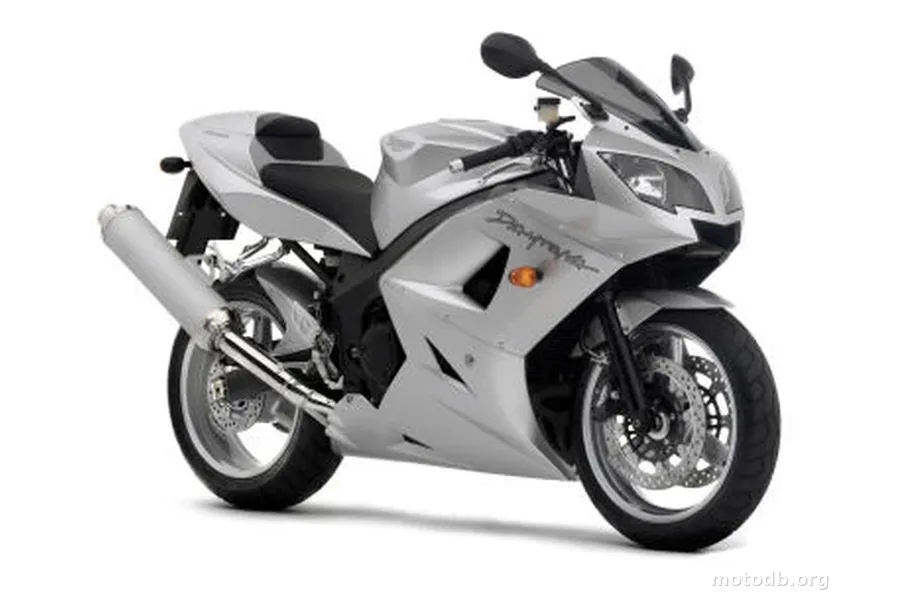
Remember the era. The early 2000s, when Japanese 600s reigned supreme in the sport segment. It was within this context that Triumph launched its Daytona 600, a serious attempt to bite into this ultra-competitive market. The objective was clear: to offer a British alternative to the CBR and ZX-6R, with its own character. The result is a motorcycle that still divides enthusiasts searching for a used Triumph Daytona 600.
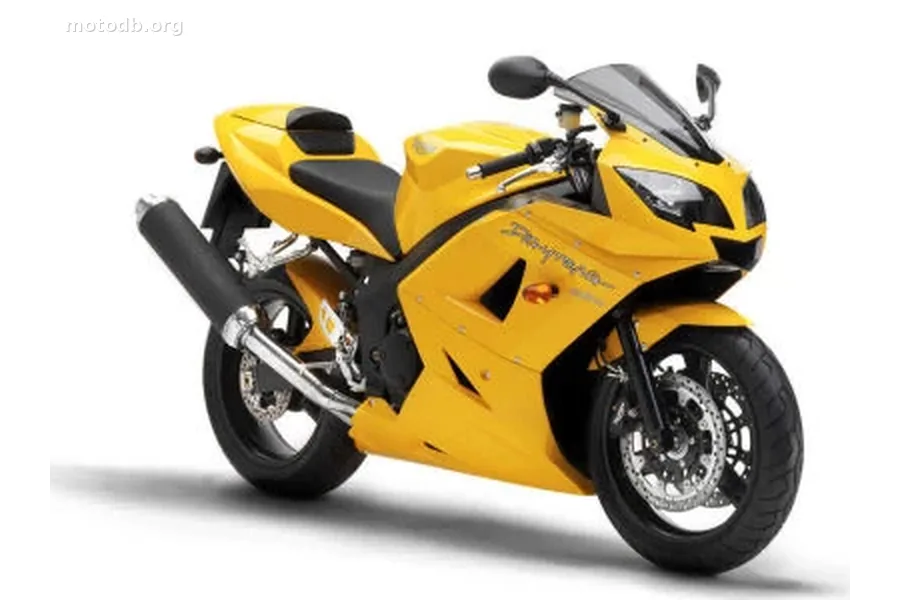
From the first glance, the 2003 Daytona 600 marks a clear break from the TT600 with its overly consensual design. The lines are sharper, the silhouette affirmed. Yet, compared to the Japanese rockets of the time, it retains a certain bulk, an almost massive presence. The real subject is its engine. This 599 cm3 inline four-cylinder delivers 112 horsepower at 12750 rpm, figures within the norm. But its character is its main drawback. Below 8000 rpm, it’s a desert, a flatness that contrasts with the immediate responsiveness of some competitors. You really have to torture it beyond 10000 rpm to extract its essence, a philosophy that recalls certain 600s of the time, but executed with less madness. That’s where the problem lies: why not inherit the more playful mapping of the Speed Four, which shared the same base? A question asked by everyone who studies the technical specifications of the Triumph Daytona 600.
Redemption occurs in the chassis. With a perimeter aluminum frame and a dry weight of 165 kg, the Daytona is agile and precise. The 43 mm fork and the dual 308 mm front disc braking system offer a feeling of solid control. On the track, it is lively and stable, even if it lacks the absolute ferocity of a ZX-6RR. It would be closer to an older CBR 600, reliable and effective without being exhilarating. Its greatest strength, ultimately, lies in its compromise. The riding position, with a seat at 815 mm, remains tolerable for road use, the suspensions correctly filter imperfections. It is a versatile sportbike, sacrificing a few tenths of a second per lap for a wider usage. A crucial point for a model often considered as a used Triumph Daytona 600 A2 after restriction.
So, for whom? The Triumph Daytona 600 will appeal to the sporty touring rider looking for an aggressive silhouette without the extreme drawbacks of a pure track machine, or the beginner track rider wanting to get started without breaking the bank. Its current used price makes it attractive. But you must accept its high-revving and sometimes ungrateful engine, as well as a finish that did not always match Japanese standards. It is a motorcycle with a personality, a flaw that becomes a quality for those who want to get off the beaten path. An imperfect, but charming, British proposition, whose 2004 to 2006 versions fundamentally did not change the recipe.
Practical info
- Moto bridable à 34 ch pour l'ancien permis A MTT1 - pas garanti pour le permis A2
- La moto est accessible aux permis : A, A (MTT1)
Indicators & positioning
Similar bikes
CBR 600 RR édition HANNspree Ten Kate
CBR 600 RR Replica MOVISTAR
Reviews & comments
No reviews yet. Be the first to share your opinion!