Key performance
Technical specifications
Engine
- Displacement
- 999 cc
- Power
- 152.0 ch @ 11000 tr/min (111.8 kW)
- Torque
- 104.0 Nm @ 9250 tr/min
- Engine type
- 4 cylindres en ligne, 4 temps
- Cooling
- liquide
- Compression ratio
- 12.2 : 1
- Bore × stroke
- 73.4 x 59 mm
- Valves/cylinder
- 4
- Camshafts
- 2 ACT
- Fuel system
- Injection Ø 44 mm
- Starter
- électrique
Chassis
- Frame
- périmétrique en aluminium
- Gearbox
- boîte à 6 rapports
- Final drive
- Chaîne
- Front suspension
- Fourche téléhydraulique inversée Ø 43 mm, déb : 120 mm
- Rear suspension
- Mono-amortisseur, déb : 63 mm
Brakes
- Front brakes
- Freinage 2 disques Brembo Ø 310 mm, fixation radiale, étrier 4 pistons
- Rear brakes
- Freinage 1 disque , étrier simple piston
- Front tyre
- 120/70-17
- Front tyre pressure
- 2.50 bar
- Rear tyre
- 190/50-17
- Rear tyre pressure
- 2.90 bar
Dimensions
- Seat height
- 825.00 mm
- Seat type
- Selle biplaces
- Fuel capacity
- 12.00 L
- Weight
- 215.00 kg
- New price
- 14 299 €
Overview
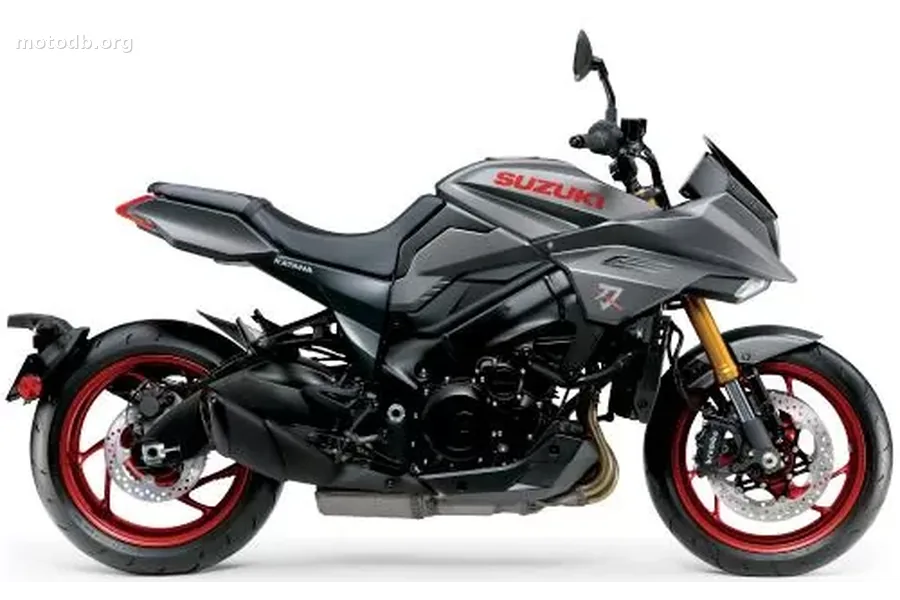
Appeared to the general public in the form of a prototype called ED-2 and presented at the Cologne show in 1979, the Suzuki Katana family enjoys a particular aura among motorcyclists and can boast a large lineage. Declined in 250, 400, 550, 650, 750, 1000, and 1100 cm3, depending on the eras and markets, it made its true debut in Europe at the 1980 Cologne show, where the Katana 650 and 1100 were unveiled.
With its sharp design, the fruit of the imagination of the prolific German designer Hans Muth, the Katana, whose name refers to the famous Japanese saber, aimed to break with a Suzuki range with unremarkable design. After experiencing success during the seventies with a beautiful range of two-stroke engine motorcycles – we remember the GT 380, GT 550, and GT 750 – Suzuki faltered with its GS models powered by inline four-stroke engines. Even though these were recognized as very good motorcycles, which the competition crowned with numerous successes, notably in the USA in the hands of Wes Cooley, the public encounter struggled to materialize.
Suzuki thus decided to create an electric shock and entrusted the design of a new motorcycle to the German Hans Muth, former design manager at BMW, the latter having been notably behind the very ambitious and futuristic project… Futuro. A concept that BMW ultimately did not follow through on but which demonstrated Hans Muth’s mastery of aerodynamics.
Thus, the Katana 1100, flagship of this family that continued to grow, made an impression with its angular style emphasized by its minimalist fork head and rectangular headlight. Nevertheless, the Katana 1100 ceased to be marketed in Europe as early as 1983, even though it and its derivatives continued their career on the Japanese market, primarily. A final edition model even appeared in the year 2000, its production definitively stopping the following year.
Seventeen years later, at the Eicma show in Milan, Suzuki resurrected the Katana in the form of a concept, the Hamamatsu firm having secured the services of the Italian designer Rodolfo Frascoli to bring back to life this mythical and terribly emblematic motorcycle of the 1980s. Faced with the public’s enthusiasm, Suzuki decided to launch production and unveiled the following year the all-new Katana 1000, a motorcycle with evocative design developed on the basis of the GSX-S 1000 roadster.
In 2022, Suzuki sharpened its blade by offering it a welcome update. The new model year receives a careful revision of its internals to comply with Euro5 standards: new valve springs, new intake and exhaust cams, new electronic throttle bodies, new radiator, new airbox, and new exhaust are on the menu. The 999cm3 inline four-cylinder borrowed from the GSX-R now develops 152 hp at 11,000 rpm against 150 hp in the previous version. This large four-cylinder with sporty genes also offers 10.6 kg of torque at 9,250 rpm. Enough to consider any stretch of tarmac in the most dynamic way possible. Especially since the chassis is the height of this vigorous mechanics, as the Katana benefits from a double aluminum truss frame and fully adjustable Kayaba suspension, including a 43mm inverted fork. All for a weight of 215 kg.
Above all, the Katana is equipped with a new ride-by-wire throttle, providing it with three riding modes influencing how power is delivered: normal, comfort, or sport. Already very effective, traction control also benefits from an upgrade and now offers five levels of adjustment, plus the possibility of disconnecting it completely. Suzuki also made the welcome choice of equipping the Katana as standard with a bidirectional quickshifter, meaning it works both up and down. On that subject, note that Miss Katana is equipped with the SCAS (Suzuki Clutch Assist System) clutch, which limits slippage to gently accompany rapid downshifts. Finally, a smaller attention less sporty but more focused on driving comfort, the 2022 model year receives rubber between the handlebar and the fork head to minimize vibrations felt.
The Katana stands out notably for a sublime matte dark blue hue and gold rims. A color scheme that suits it wonderfully!
Final note, to conclude: if the Katana 1000 has progressed in many aspects since 2022, we would really have appreciated that Suzuki decline it in a more accessible 750 cm3 version, or even in another even lower displacement, like 300 or 400 cm3, to bring back to life a complete Katana family, as was the case originally.
Michael Levivier - Photos constructeur
Standard equipment
- Assistance au freinage : ABS
- Nombre de mode de conduite : 3
- Taille de l'écran TFT couleur : 12,70 cm / 5 pouces
- Jantes aluminium
- Shifter
- Indicateur de vitesse engagée
- Aide au démarrage
- Aide à la manoeuvre
- Contrôle de traction
- Embrayage anti-dribble
Practical info
- La moto est accessible aux permis : A
- Pays de fabrication : Japon
Reviews & comments
No reviews yet. Be the first to share your opinion!