Key performance
Technical specifications
- Displacement
- 1340 cc → 1298 cc
- Power
- 198.0 ch @ 8500 tr/min (145.6 kW) → 175.0 ch @ 9800 tr/min (128.7 kW)
- Torque
- 152.0 Nm @ 4000 tr/min → 138.3 Nm @ 7000 tr/min
- Engine type
- In-line four, four-stroke → 4 cylindres en ligne, 4 temps
- Cooling
- Liquid → liquide
- Compression ratio
- 12.5:1 → —
- Bore × stroke
- 81.0 x 65.0 mm (3.2 x 2.6 inches) → 81 x 63 mm
- Fuel system
- Injection. Suzuki Fuel Injection → Injection
- Valve timing
- Double Overhead Cams/Twin Cam (DOHC) → —
- Lubrication
- Wet sump → —
- Ignition
- Electronic ignition (Transistorized) → —
- Starter
- Electric → —
- Frame
- Rigid twin-spar aluminum → double poutre alu
- Gearbox
- 6-speed → boîte à 6 rapports
- Final drive
- Chain (final drive) → Chaîne
- Front suspension
- Inverted telescopic, coil spring, oil damped → Fourche téléhydraulique inversée Ø 43 mm, déb : 120 mm
- Rear suspension
- Link type, coil spring, oil damped → Mono-amortisseur, déb : 140 mm
- Front brakes
- Double disc. ABS → Freinage 2 disques Ø 320 mm, étrier 6 pistons
- Rear brakes
- Single disc. ABS → Freinage 1 disque Ø 240 mm, étrier 2 pistons
- Front tyre
- 120/70-ZR17 → 120/70-17
- Rear tyre
- 190/50-ZR17 → 190/50-17
- Wheelbase
- 1480.00 mm → —
- Ground clearance
- 120.00 mm → —
- Length
- 2190.00 mm → —
- Width
- 735.00 mm → —
- Fuel capacity
- 20.82 L → 21.00 L
- Weight
- 266.00 kg → 250.00 kg
- Dry weight
- 266.00 kg → 217.00 kg
- New price
- 15 499 € → 13 299 €
Engine
- Displacement
- 1298 cc
- Power
- 175.0 ch @ 9800 tr/min (128.7 kW)
- Torque
- 138.3 Nm @ 7000 tr/min
- Engine type
- 4 cylindres en ligne, 4 temps
- Cooling
- liquide
- Bore × stroke
- 81 x 63 mm
- Valves/cylinder
- 4
- Camshafts
- 2 ACT
- Fuel system
- Injection
Chassis
- Frame
- double poutre alu
- Gearbox
- boîte à 6 rapports
- Final drive
- Chaîne
- Front suspension
- Fourche téléhydraulique inversée Ø 43 mm, déb : 120 mm
- Rear suspension
- Mono-amortisseur, déb : 140 mm
Brakes
- Front brakes
- Freinage 2 disques Ø 320 mm, étrier 6 pistons
- Rear brakes
- Freinage 1 disque Ø 240 mm, étrier 2 pistons
- Front tyre
- 120/70-17
- Front tyre pressure
- 2.90 bar
- Rear tyre
- 190/50-17
- Rear tyre pressure
- 2.90 bar
Dimensions
- Seat height
- 805.00 mm
- Fuel capacity
- 21.00 L
- Weight
- 250.00 kg
- Dry weight
- 217.00 kg
- New price
- 13 299 €
Overview
What does a motorcycle look like that, from its launch, becomes an absolute icon, a desirable object, and a legend? Suzuki answered that question in 1999 with the Hayabusa, an engine whose name, borrowed from the peregrine falcon, already announced the ambition: to be the fastest. And it was, clearly, with an official top speed of 317 km/h that earned it the crown, a position it held for a long time before speed limitation agreements intervened. This figure, more than a marketing argument, was a declaration of war against physical laws and competitors, like the Honda CBR1100XX Super Blackbird which had to bow down.
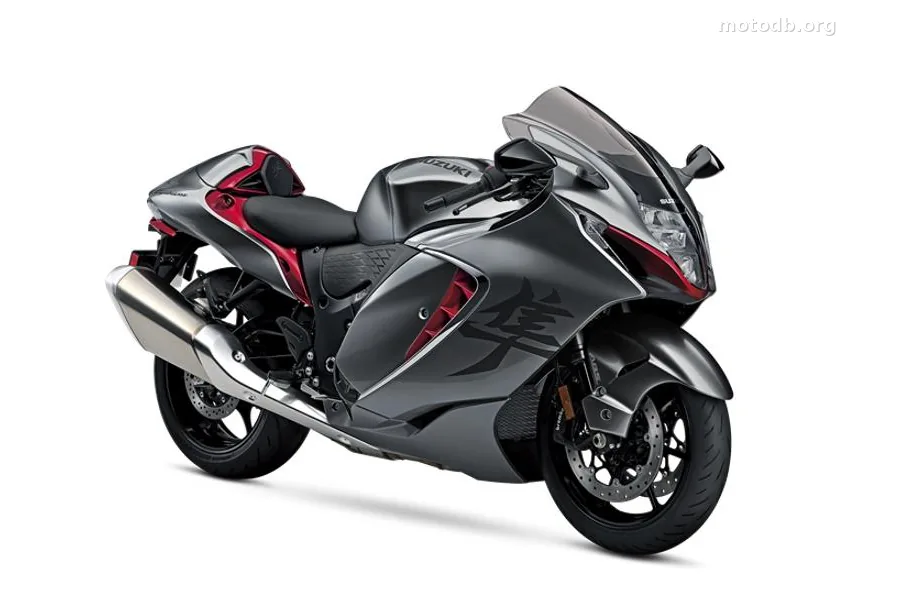
The heart of this madness is a 1300 cm3 inline four-cylinder engine, an engine that doesn’t just deliver impressive figures – 175 horsepower at 9800 rpm, 138 Nm of torque at 7000 rpm – but defines a new category of sensations. It is supple and civilized at low rpm, a true urban tractor, then gradually transforms into a demon beyond 8000 rpm. Acceleration then becomes an almost violent experience, a linear and relentless traction that pushes towards speeds where the world warps. Compared to the engines of the time, it was more expressive, more charismatic, with a deep sound and an unforgettable mechanical presence.
But a motorcycle capable of these performances cannot be just an engine on a frame. The Hayabusa’s chassis is a masterpiece of balance. With a dry weight of 217 kg, it is not a featherweight, but its aluminum double-beam frame and its suspension, a 43 mm inverted fork and a mono-shock, work so well that the weight seems to disappear from the first corners. It doesn’t have the nervous agility of a 600 sportbike, but it launches and straightens with a disconcerting ease for its size. The long wheelbase ensures royal stability at high speed, but requires a little more anticipation in tight cornering sequences. The braking, with two 320 mm discs at the front with six-piston calipers, is powerful but, on the early models, sometimes lacked initial bite, a point that Suzuki improved later.
Aerodynamics is the other secret to its speed. Its silhouette, controversial and immediately recognizable, is not a stylistic whim. It is the result of wind tunnel work to minimize drag and maximize stability. This integrated fairing allowed the rider to remain sheltered, but protection at very high speed was relative, with turbulence often appearing around 160 km/h. For long outings, a taller screen became almost an essential accessory. The riding position, less radical than on a GSX-R, offers an acceptable compromise between sporty control and relative comfort, with a seat height of 805 mm.
Who is the rider of a Hayabusa? It’s not a beginner, even if the motorcycle is surprisingly docile at low rpm. It is a touring rider looking for the ultimate machine for long distances and highways, a charismatic mechanical enthusiast, or a track rider seeking a unique base for pure speed. With a 21-liter tank, it also has a touring vocation. And today, finding a used Suzuki Hayabusa, perhaps on Le Bon Coin, is a way to access this legend at a price far lower than that of a new one. More recent models, the new Suzuki Hayabusa 2021 or the Suzuki Hayabusa 2023, have evolved with electronics and a revised design, but retain this essence of a powerful engine and a magic chassis. The new price of the Suzuki Hayabusa 2023 remains high, justified by this iconic position.
The original Hayabusa, the 1999 and 2000 model, remains therefore a motorcycle of excess. It is both a performance tool, a technical feat, and a symbol of an era when pure speed was the grail. It can be intimidating, demanding on winding roads, and its appetite for a second-gear license is real. But it offers an experience so unique, so charged with emotion and power, that it transcends its flaws. It’s a motorcycle that is not compared, it is lived. And for those who have ridden it, the word “Hayabusa” is never just a model, it is a memory that still makes wrists tingle.
Practical info
- La moto est accessible aux permis : A
Indicators & positioning
Similar bikes
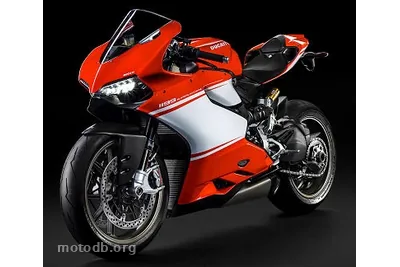
1299 Panigale Superleggera
Reviews & comments
No reviews yet. Be the first to share your opinion!