Key performance
Technical specifications
Engine
- Displacement
- 487 cc
- Power
- 48.0 ch @ 9200 tr/min (35.3 kW)
- Torque
- 40.2 Nm @ 7500 tr/min
- Engine type
- Twin, four-stroke
- Cooling
- Air
- Compression ratio
- 9.0:1
- Bore × stroke
- 74.0 x 56.6 mm (2.9 x 2.2 inches)
- Valves/cylinder
- 2
- Camshafts
- 1 ACT
- Fuel system
- Carburettor
- Valve timing
- Double Overhead Cams/Twin Cam (DOHC)
Chassis
- Frame
- Double berceau tubulaire en acier
- Gearbox
- 6-speed
- Final drive
- Chain (final drive)
- Front suspension
- Telescopic, oil damped
- Rear suspension
- Link type, 5-way adjustable preload
Brakes
- Front brakes
- Single disc
- Rear brakes
- Single disc
- Front tyre
- 110/70-17
- Front tyre pressure
- 2.25 bar
- Rear tyre
- 130/70-17
- Rear tyre pressure
- 2.50 bar
Dimensions
- Seat height
- 790.00 mm
- Wheelbase
- 1405.00 mm
- Length
- 2080.00 mm
- Width
- 820.00 mm
- Height
- 1250.00 mm
- Fuel capacity
- 20.00 L
- Weight
- 203.00 kg
- Dry weight
- 180.00 kg
- New price
- 4 999 €
Overview
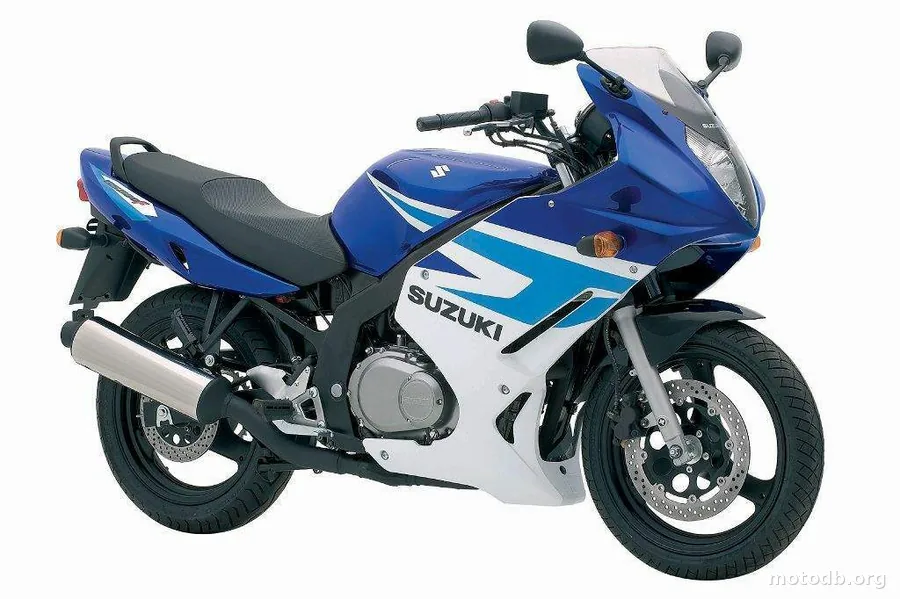
You remember those motorcycles that didn’t make a lot of noise but got the job done? The 2004 Suzuki GS 500 F is one of those. It never claimed to be a pure sportbike, but with its full fairing inspired by the GSX-R models, it managed to seduce a generation of young riders seeking a look without the prohibitive price. For around €5000 at the time, it offered a ticket into the world of affordable road bikes, a rare proposition in the French landscape.
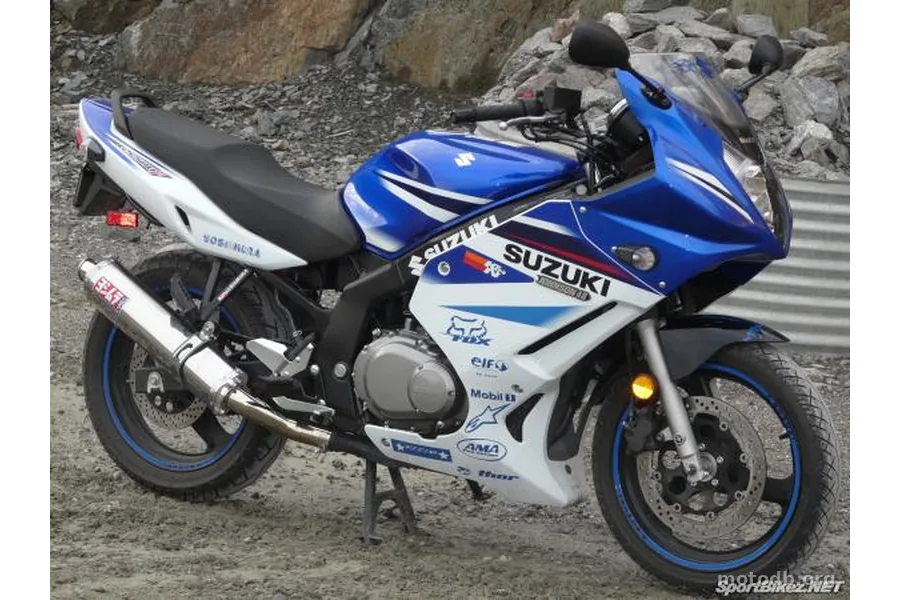
Technically, it remains faithful to its philosophy of simplicity. The 487 cc twin-cylinder engine, with its 48 horsepower and 40.2 Nm of torque, is a known and proven engine. It doesn’t shine with its liveliness, but with its regularity and economy. On the highway, it allowed you to maintain 150 km/h without forcing it, while its 20-liter tank promised nearly 350 km of range. This engine, often sought after for a used Suzuki GS 500 F for an A2 license, is the heart of an indestructible mechanical system. The adoption of a full fairing and a catalyzed exhaust to meet Euro 2 standards added 11 kg, bringing the weight to 203 kg fully fueled, but it also opened the door to long-distance travel.
In terms of handling, the GS 500 F cultivates a dual character. In the city, its relative lightness and 790 mm seat height make it a maneuverable and accessible tool. But as soon as the road unfolds, its limits appear. The telescopic fork and rear suspension, very soft, are designed for comfort, not for precision. The braking, with its two simple discs, is effective, but the fork dive under sustained use can spoil the feel. Straight-line stability is correct, but in windy areas like the Rhône Valley, lateral gusts required constant attention. It wasn’t dangerous, just a little annoying.
Compared to competitors like the Kawasaki 500 GPZ, the Suzuki GS 500 F perhaps had a little more visual appeal thanks to its fairing, but it shared this essence of a basic, easy-to-live-with motorcycle. Its audience? Mainly beginners, urban dwellers looking for a versatile mount, and economical touring riders. For those looking for a 2004 Suzuki GS 500 F or a model from the 2005 to 2008 years, the argument was clear: a reliable motorcycle, inexpensive to maintain, and capable of touring without drama.
Today, when examining a Suzuki GS 500 F specification sheet or reading Suzuki GS 500 F reviews, we find the same conclusion. It wasn’t exciting, but it was honest. It lacked engine character and rigorous handling, but it offered a coherent package for its price. For a beginner rider or someone looking for a simple motorcycle for daily use and short trips, it represented a safe choice. Its Suzuki GS 500 F battery, its tires, its Suzuki GS 500 F exhaust… everything was designed to last. In short, the GS 500 F wasn’t a star, but a faithful companion, and in a world where everything is becoming complex and expensive, that was its merit.
Practical info
- La moto est accessible aux permis : A
Reviews & comments
No reviews yet. Be the first to share your opinion!