Key performance
Technical specifications
No spec differences between these two model years.
Engine
- Displacement
- 1037 cc
- Power
- 101.0 ch @ 8000 tr/min (74.3 kW)
- Torque
- 101.0 Nm @ 4000 tr/min
- Engine type
- Bicylindre en L à 90°, 4 temps
- Cooling
- liquide
- Compression ratio
- 11.3 : 1
- Bore × stroke
- 100 x 66 mm
- Valves/cylinder
- 4
- Camshafts
- 2 ACT
- Fuel system
- Injection
Chassis
- Frame
- Double poutre en aluminium
- Gearbox
- boîte à 6 rapports
- Final drive
- Chaîne
- Front suspension
- Fourche téléhydraulique inversée Ø 43 mm, déb : 160 mm
- Rear suspension
- Mono-amortisseur, déb : 160 mm
Brakes
- Front brakes
- Freinage 2 disques Ø 310 mm, fixation radiale, étrier 4 pistons
- Rear brakes
- Freinage 1 disque Ø 260 mm, étrier simple piston
- Front tyre
- 110/80-19
- Front tyre pressure
- 2.50 bar
- Rear tyre
- 150/70-17
- Rear tyre pressure
- 2.90 bar
Dimensions
- Seat height
- 850.00 mm
- Fuel capacity
- 20.00 L
- Weight
- 232.00 kg
- New price
- 12 799 €
Overview
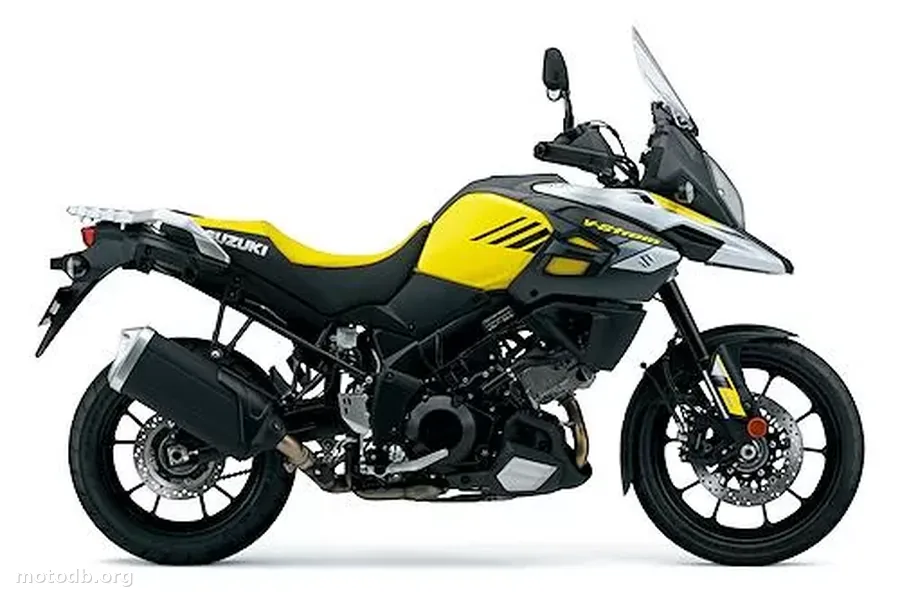
In the realm of large-trail motorcycles, Suzuki understood that attempting to displace the benchmark 1200 GS would be futile. Instead, the brand capitalized on its own policy, creating a machine that performs well everywhere, with a less aggressive price tag and a quirky design. A little upon its release in 2002; much more in its recent definition. After many miles of road and a few trails, the Hamamatsu maxi-trail benefited from a slight overhaul. 2017 brought almost nothing but improvements, providing what was needed to further assert its position.
Until recently, the V-Strom had a face that needed to be accepted. Well, no maxi-trail is truly sexy, except perhaps the Italian ones. But a bit more flexibility in the design would have been beneficial. That is now the case. Drawing inspiration from the DR 800 S "Big" and the DR-Z rally bike of the 1990s, the front fairing features a more square, yet friendlier face. The pyramidal shapes suit it much better than the insect-like appearance. Still cyclopean, the 1000 V-Strom allowed designers to rework its face but not the rest. The bodywork remains unchanged, and the only differences (besides the colors) are more prominent touches of black. The fork tubes, exhaust, and rear frame are finished in dark hues.
Subtle changes. Because, like many, the V-Strom needed to evolve; to meet Euro4 standards. While at it, it was decided to make a few adjustments. First, enrich the equipment. As standard, it now includes handguards and an engine guard. Next, the windscreen was redesigned for greater efficiency, while also growing by 49 mm. It still adjusts in three positions: standard, +7.5°, and +15° angle. Finally, borrow electronics from its siblings. The left handlebar switchgear incorporates a control button debuted on the GSX-S 1000, allowing navigation of the dashboard information and adjustment of traction control. Suzuki has also added a Bosch IMU inertial control unit with 5-axis sensors to optimize ABS performance in curves. The manufacturer calls this the Motion Track Brake System. Furthermore, braking is now linked. The large V-Strom also gains two goodies that are rapidly spreading throughout the entire range: Low RPM Assist, to facilitate take-off by raising the engine speed when releasing the clutch; and Easy Start – you press once, and the starter continues until the engine starts. Speaking of traction control, it is retained with its functions, with two intervention modes and the ability to be deactivated. Thus, without reaching the level of assistance found on a KTM or a BMW, the Suzuki trail quietly gains more equipment, without renouncing its simpler and more accessible nature than the competition. One point that disappoints us is the absence (as standard) of the luggage rack mounting system. It’s one thing that the 650 offers as an option; but when you know that the small 250 comes equipped with it as standard, you can twist the rictus at this type of economy.
Let's not forget the engine, one of the strong points of the 1000 V-Shtroumpf. If we insist on recalling that it originates from the TLS/TLR duo, it is because this twin is truly exhilarating. Full, responsive, always willing, this 1037 cm³ delivers great satisfaction with its 101 horsepower, and does not shy away from the more powerful engines in the segment. Revised to meet Euro4 standards, it does not lose power but must release 2 Nm of torque. Almost nothing, and it still has over 10 mkg of muscle to distribute. Technically, only the exhaust line changes with two catalysts instead of one, and the injection is re-parameterized.
The front is more flexible, the equipment more talkative, and under the hood, the technology has managed to maintain the confidence of the breeders. The perimeter frame and aluminum swingarm, the 43 mm fully adjustable inverted fork, the adjustable shock absorber via its large, practical knob, the 19 and 17 inch spoked wheels, the 310 mm brake discs with radial 4-piston calipers: they were all in the same class last year and are found again here. Dynamically, the V-Strom will offer the same playfulness as the previous generation. And that's a good thing. It's much more fun to ride than with other more serious and less lively productions.
Let's recap and return to the qualities. 1037 cm³ V-Twin adapted to Euro4 with a little less torque but the same gniak; retained lightweight, compact and playful chassis; tool-free adjustable windscreen, taller; 2 modes + OFF traction control; adaptive ABS of the latest generation; 12V socket on the dashboard; handguards and engine guard as standard; Suzuki easy start system and Low RPM assist; radial calipers and GSX-R old generation inverted fork; revised design with more flexibility. We would have just liked a little effort on the luggage side and a central stand as standard. The Suzuki 1000 V-Strom will know how to soften distractions with its pricing policy.
M.B - Photos manufacturer
Standard equipment
- Assistance au freinage : ABS de série
Practical info
- La moto est accessible aux permis : A
Reviews & comments
No reviews yet. Be the first to share your opinion!