Key performance
Technical specifications
Engine
- Displacement
- 124 cc
- Power
- 15.0 ch @ 9000 tr/min (11.0 kW)
- Engine type
- Monocylindre, 4 temps
- Cooling
- par air
- Valves/cylinder
- 4
- Camshafts
- 2 ACT
- Fuel system
- Injection
Chassis
- Frame
- Cadre tubulaire en acier
- Gearbox
- boîte à 6 rapports
- Final drive
- Chaîne
- Front suspension
- Fourche téléhydraulique Ø 37 mm
- Rear suspension
- 2 amortisseurs latéraux
Brakes
- Front brakes
- Freinage
- Rear brakes
- Freinage 1 disque
- Front tyre
- 110/70-17
- Front tyre pressure
- 1.60 bar
- Rear tyre
- 130/70-17
- Rear tyre pressure
- 2.00 bar
Dimensions
- Fuel capacity
- 14.00 L
- Weight
- 137.00 kg
- New price
- 3 799 €
Overview
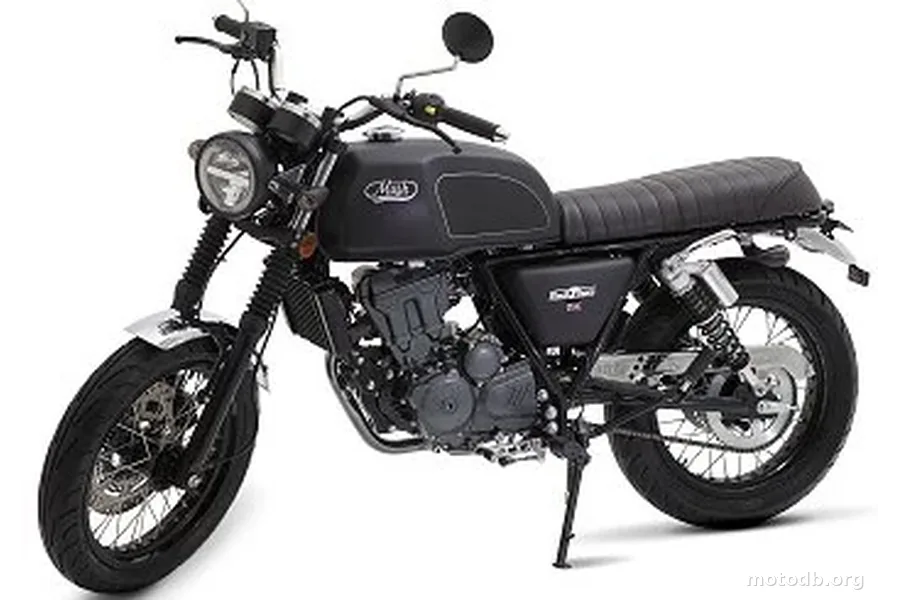
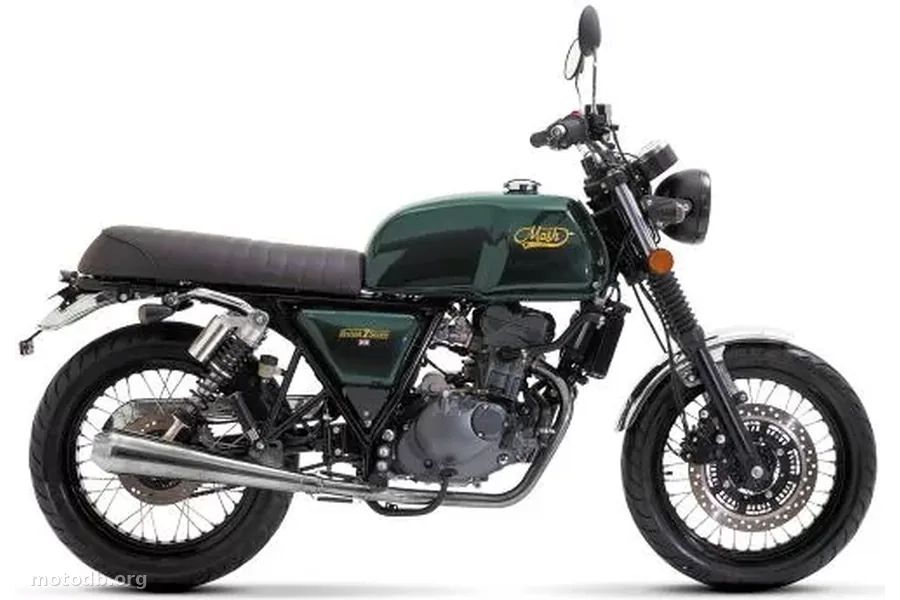
Two names, one motorcycle. Painted in black, it's called Black Seven. Dressed in green, it becomes British Seven. This game of mirrors sums up the Mash mindset: selling character before displacement, and creating the illusion of an English heritage on a machine born in China and powered by a Korean engine. Audacity or marketing talent? A bit of both, and that's precisely what makes this 125 endearing.
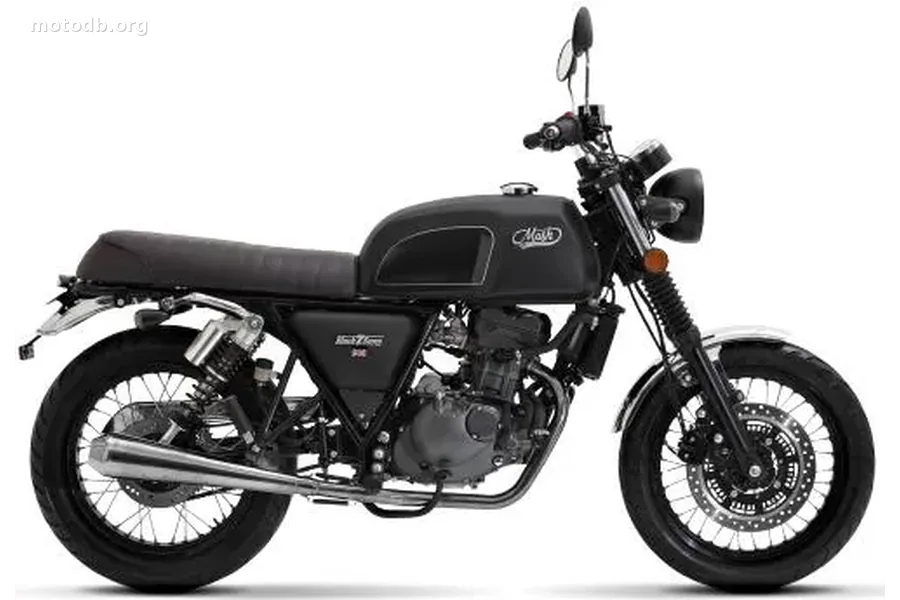
Aesthetically, the recipe works. Spoked wheels, conical silencer, metal front fender, long old-school textured seat, a few discreet touches of chrome: the Seven plays the Brit roadster card without overdoing it. The small Union Jack on the airbox cover sets the scene. All the trim adopts a uniform black treatment, fork stanchions, calipers, wheel rims, handlebar yoke, which gives a visual coherence that the Seventy, its range cousin, lacks. One inevitably thinks of the Orcal Astor in this niche, and the comparison doesn's necessarily favor Mash in terms of perceived finish. But the Seven holds its own, and the retro 125 segment has been sufficiently expanded in recent years for competition to be a daily reality.
What really changes the game is under the tank. Mash has turned its back on its former engine supplier to entrust the work to Hyosung. The result is unambiguous: liquid cooling, four valves per cylinder, six-speed gearbox. The Seventy is content with 11 horsepower with its aging block; the Seven delivers 15 horsepower at 9,000 rpm with this new engine, and the difference is felt in acceleration as well as general flexibility. Top speed announced at 110 km/h, which is honest for the size. The downside is real: 137 kilograms all full, this is the price of a modern engine and its auxiliaries. Not a dealbreaker, but worth noting for a less experienced user.
The braking follows the same upmarket logic. ABS now supervises the front two-piston caliper on a 300 mm disc, and the 220 mm rear disc. This is the minimum expected in 2022, but it is well present. The double analog dial dashboard has been revised, more refined, complemented by a small digital display and a gear indicator. These details count when you want to justify a ticket of entry at 3,799 euros. Standard center stand, removable stainless steel silencer, LED rear light, Fat Bar handlebar: the list of finishes speaks to an audience that wants more than just a rolling box.
It's here that the shoe pinches a little. The Seven targets an informed driver, sensitive to style and ready to spend, but it remains a 125 accessible to holders of the B license via mandatory training. This positioning between two waters can be confusing. The price increase exceeds 1,000 euros compared to the old version, and this deserves reflection in the face of a CB125R or a Royal Enfield Meteor 350 which, for a few hundred euros more, opens up much wider horizons. The Seven remains, however, the most accomplished proposition in the Mash range, the one that truly assumes its identity without stumbling on its own ambitions.
Standard equipment
- Assistance au freinage : Frenado combinado
Practical info
- La moto est accessible aux permis : A
Reviews & comments
No reviews yet. Be the first to share your opinion!