Key performance
Technical specifications
Engine
- Displacement
- 250 cc
- Power
- 45.0 ch (33.1 kW)
- Engine type
- Single cylinder, four-stroke
- Cooling
- Liquid
- Compression ratio
- 14.0:1
- Bore × stroke
- 78.0 x 52.3 mm (3.1 x 2.1 inches)
- Valves/cylinder
- 4
- Camshafts
- 2 ACT
- Fuel system
- Injection Ø 44 mm
- Valve timing
- Double Overhead Cams/Twin Cam (DOHC)
- Ignition
- Keihin EMS
- Starter
- Electric
Chassis
- Frame
- 25CrMo4 steel central-tube frame
- Gearbox
- 5-speed
- Final drive
- Chain (final drive)
- Clutch
- Wet multi-disc clutch / hydraulically operated
- Front suspension
- WP-USD, AER 48, Ø 48 mm
- Rear suspension
- WP shock absorber with linkage
- Front wheel travel
- 310 mm (12.2 inches)
- Rear wheel travel
- 300 mm (11.8 inches)
Brakes
- Front brakes
- Single disc. Brake calipers on floating bearings
- Rear brakes
- Single disc. Brake calipers on floating bearings
Dimensions
- Seat height
- 960.00 mm
- Wheelbase
- 1485.00 mm
- Ground clearance
- 370.00 mm
- Fuel capacity
- 7.00 L
- Dry weight
- 99.00 kg
- New price
- 9 300 €
Overview
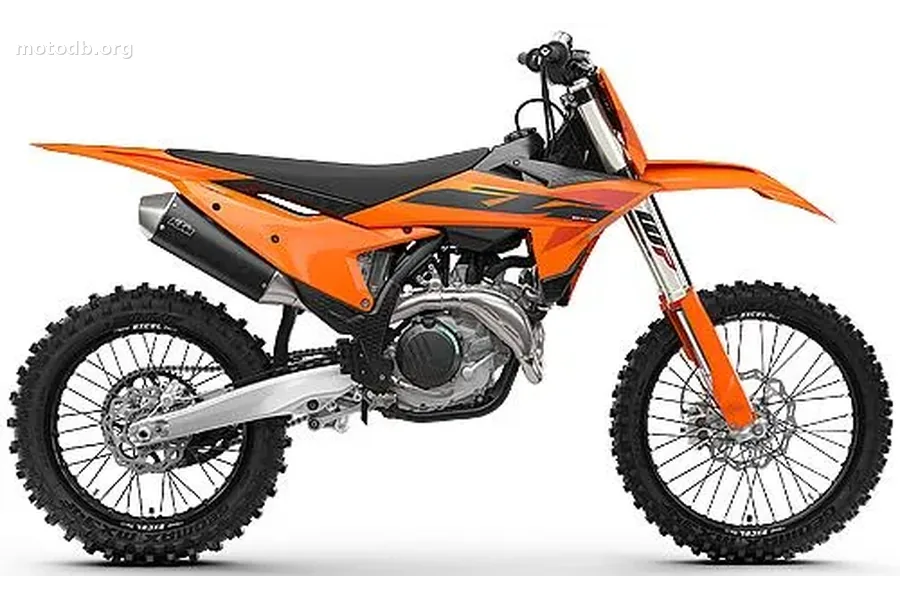
Ninety-nine kilograms dry, 45 horsepower extracted from a 249.9 cc single-cylinder that revs without hesitation to 14,000 rpm: the 2019 KTM 250 SX-F does not play in the same league as its Japanese competitors. Yamaha, Honda, and Husqvarna have been fighting on this segment for years, but the Austrian manufacturer has chosen a different philosophy — minimum weight combined with a power density that few four-stroke 250s can claim. The result comes in at €9,300, which remains the price of a pure competition machine, with no concessions for road use.
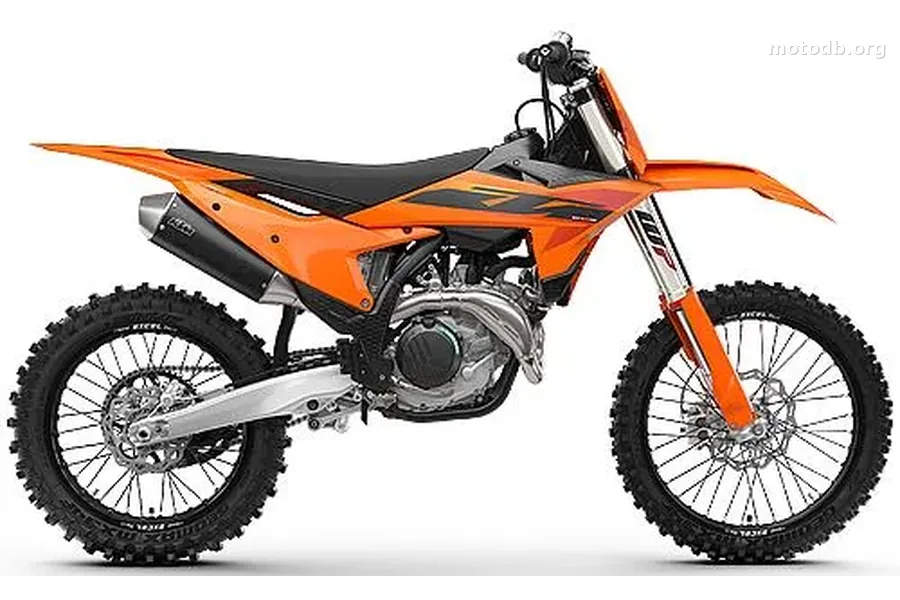
What sets this engine apart from the crowd is its construction around an extreme centralization of mass. The engine block weighs only 25.9 kg including the starter, a figure that reflects the care taken in high-pressure die-casting of the crankcases. The crankshaft has been stiffened by press-fitted bearings in the crankpin, a solution that extends maintenance intervals and allows these high rpm without mechanical stress. The 78 mm bore and 52.3 mm stroke favor a high-revving engine, responsive from the moment the throttle opens, with a 14:1 compression ratio that tolerates no low-grade fuel. The DOHC cylinder head receives titanium valves actuated by DLC-coated rocker arms, a race engine detail that reduces friction at extreme rpm.
The Keihin fuel injection with its 44 mm throttle body and ECU remapped for 2019 manages two maps accessible via a handlebar-mounted selector. Better still: this same selector controls traction control and launch control — two functions that would have seemed futuristic on a motocross bike ten years ago. Launch control now combines with traction control to limit wheelspin off the start, a tangible advantage on loose ground. The 48 mm WP AER 48 fork, with its air spring adjustable via a simple valve, paired with a linkage-mounted WP shock, delivers 370 mm of ground clearance. The geometry relies on a 1,485 mm wheelbase and a hydroformed 25CrMo4 chrome-molybdenum steel frame, whose rigidity has been tuned to better absorb rough tracks without sacrificing line precision. The radiators have been lowered by 12 mm compared to the previous model, contributing to a lower center of gravity that is immediately felt in weight transfers.
The used KTM 250 SX-F can be found today at attractive prices, and the 2019 and 2020 versions share a very similar mechanical base. Those looking for a 2021 KTM 250 SX-F or the 2021 KTM 250 SX-F Factory Edition will find incremental updates to the suspension and electronics, but the fundamental architecture remains the same. What changes little from one model year to the next is the clear positioning of this bike: it targets the competitive rider — high-level amateur or professional — capable of handling a 960 mm seat height and a power output that demands respect. This is not a machine for beginners, but for those who want to progress quickly and finish on the podium. The DS diaphragm-spring clutch with Brembo hydraulic actuation reduces left-hand effort at the end of a moto, a detail that matters when fatigue sets in. The Mitsuba starter fed by a 2 Ah lithium-ion battery definitively settles the question of restarts after a crash. In this segment, the competition still has work to do to reach this level of finish and technical integration.
Reviews & comments
No reviews yet. Be the first to share your opinion!