Key performance
Technical specifications
- Power
- 113.0 ch @ 10200 tr/min (81.2 kW) → 113.0 ch @ 10200 tr/min (82.5 kW)
- Camshafts
- 2 ACT → —
- Fuel system
- Injection → Injection. 34 mm x 4 Mikuni with dual throttle valves
- Valve timing
- Overhead Valves (OHV) → Double Overhead Cams/Twin Cam (DOHC)
- Gearbox
- boîte à 6 rapports → 6-speed
- Front brakes
- Double disc. Petal discs, dual opposed 4-piston → Double disc. Floating discs.
- Rear brakes
- Single disc. Petal disc, single-piston → Single disc. Single-piston caliper.
- Front tyre pressure
- 2.50 bar → —
- Rear tyre pressure
- 2.90 bar → —
- Weight
- 229.00 kg → 227.00 kg
- New price
- 8 899 € → —
Engine
- Displacement
- 806 cc
- Power
- 113.0 ch @ 10200 tr/min (82.5 kW)
- Torque
- 83.0 Nm @ 8500 tr/min
- Engine type
- In-line four, four-stroke
- Cooling
- Liquid
- Compression ratio
- 11.9:1
- Bore × stroke
- 71.0 x 50.9 mm (2.8 x 2.0 inches)
- Valves/cylinder
- 4
- Fuel system
- Injection. 34 mm x 4 Mikuni with dual throttle valves
- Valve timing
- Double Overhead Cams/Twin Cam (DOHC)
- Lubrication
- Forced lubrication, wet sump
- Ignition
- Digital
- Starter
- Electric
Chassis
- Frame
- Tubular backbone (with engine sub-frame), high-tensile steel
- Gearbox
- 6-speed
- Final drive
- Chain (final drive)
- Clutch
- Wet multi-disc, manual
- Front suspension
- 41 mm inverted fork with rebound damping and spring preload adjustability
- Rear suspension
- Bottom-Link Uni-Trak, gas-charged shock with piggyback reservoir and stepless rebound damping and preload adjustability
Brakes
- Front brakes
- Double disc. Floating discs.
- Rear brakes
- Single disc. Single-piston caliper.
- Front tyre
- 120/70-ZR17
- Rear tyre
- 180/55-ZR17
Dimensions
- Seat height
- 834.00 mm
- Wheelbase
- 1445.00 mm
- Ground clearance
- 150.00 mm
- Length
- 2100.00 mm
- Width
- 800.00 mm
- Height
- 1050.00 mm
- Fuel capacity
- 17.00 L
- Weight
- 227.00 kg
Overview
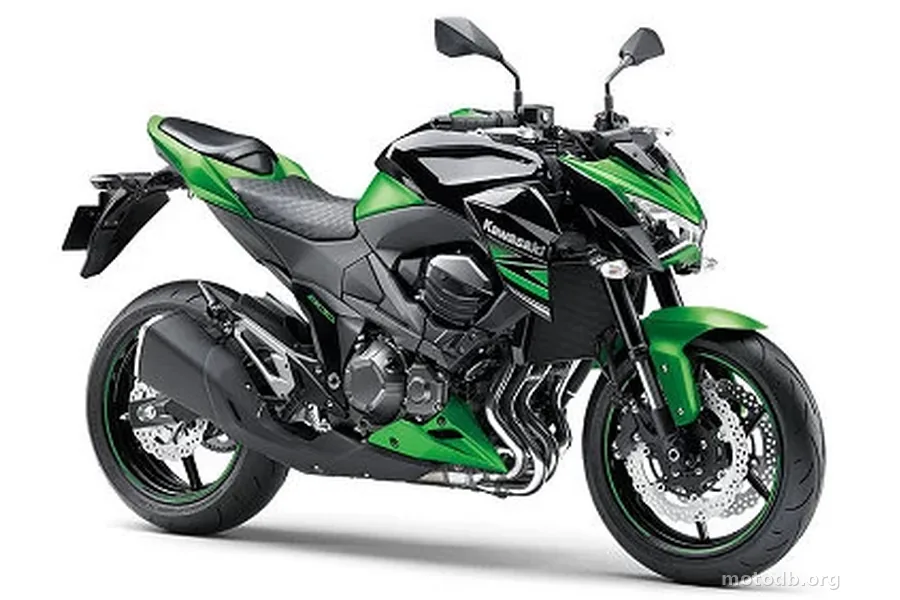
Ask any city dweller who’s been tinkering in garages since 2004: the Z 750 built its reputation not on impeccable technology, but on character. A brawler’s physique, direct handling, a street presence that turned heads. Kawasaki understood this, and when it was time to revamp the model in 2013, the Akashi brand didn’t seek to reinvent the wheel. It increased the engine displacement, beefed up the overall package, and changed the name. The Kawasaki Z800 was born, and it initially carried a somewhat raw ambition: to outperform the ancestor without betraying its soul.
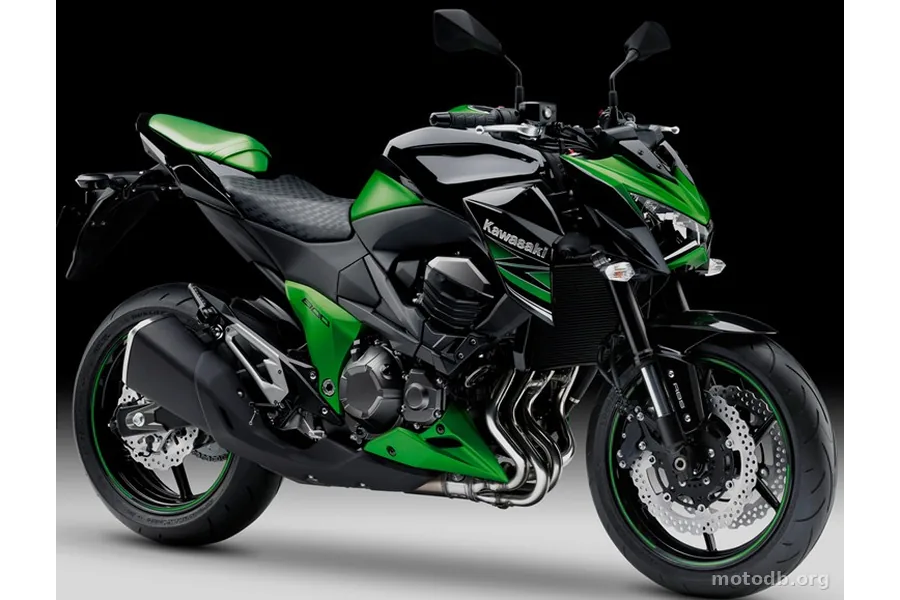
The work done on the four-cylinder engine deserves attention. The original 748 cc displacement gives way to 806 cc, achieved by increasing the bore from 68.4 to 71 mm. But Kawasaki didn’t just inflate the pistons: the injection bodies gain 2 mm to reach 34 mm, the intake and exhaust ports are redesigned, the intake funnels use two different lengths depending on their position, and the cylinder block switches to die-cast aluminum. The announced result on the Kawasaki Z800 technical specifications: 113 horsepower at 10,200 rpm, 83 Nm of torque at 8,500 rpm, and a curve designed to bite from the mid-range rather than reserving everything for the high end of the tachometer. The Kawasaki Z800 top speed is announced at 230 km/h, which places the machine in the upper-middle range of the segment without making it a disguised sportbike. The shorter final transmission accentuates the feeling of vigor, especially on corner exits.
The chassis, however, tells a more nuanced story. Kawasaki retained the tubular architecture of the Z 750 R, reinforced and slightly reworked, with a swingarm lengthened from 560 to 572 mm and a remote reservoir shock absorber. One might have expected the same fundamental work that the Z 1000 benefited from during its renewal, a real technical overhaul. That’s not what happened. The 41 mm inverted fork with rebound and preload adjustment, combined with the Uni-Trak rear suspension, represents a tangible improvement over the previous generation, but the frame itself remains a gentle evolution. The main drawback is the weight: 229 kg fully fueled, which is 46 kg more than a Triumph Street Triple 675, the technical benchmark of the segment. That’s considerable. The Kawasaki Z800 2016 confirms that Kawasaki embraces this bulk as a signature, even if purists of maneuverability turn to other addresses.
The design, on the other hand, doesn’t leave anyone indifferent. The front end stands out, the headlights slash through the air aggressively, and the rear lights in the shape of a Z constitute an immediate recognition sign. The Kawasaki Z800 declines its colors with conviction, whether it’s the Kawasaki Z800 black, the Kawasaki Z800 red, the Kawasaki Z800 orange, or the Kawasaki Z800 white: each version attracts its clientele, and accessory manufacturers have understood this, since the market for Kawasaki Z800 stickers, Kawasaki Z800 decals, and Kawasaki Z800 decals has developed rapidly. The triple digital window dashboard and the redesigned footrests complete the machine’s assertive character. One will regret the classic calipers where competitors now bet on the radial type, and a tendency towards plastic that is a little too present, but these points do not weigh heavily against the overall coherence.
The new Kawasaki Z800 price was set at 8,399 euros, a positioning consistent with the upper-middle range. The used Kawasaki Z800 price reflects a solid valuation today, a sign that the secondary market confirms what sales figures had already expressed. For candidates for the A2 license, the Kawasaki Z800 e version offers a power limited to 95 horsepower with revised rolling components, and is regularly found on Kawasaki Z800 A2 used listings at affordable prices. This motorcycle is primarily aimed at experienced riders seeking character and visual impact rather than a perfect technical record. It embraces its curves, its kilos, and its history. And that’s precisely why it sells.
Reviews & comments
No reviews yet. Be the first to share your opinion!