Key performance
Technical specifications
Engine
- Displacement
- 1043 cc
- Power
- 142.0 ch @ 10000 tr/min (104.4 kW)
- Torque
- 110.8 Nm @ 7300 tr/min
- Engine type
- 4 cylindres en ligne, 4 temps
- Cooling
- liquide
- Compression ratio
- 11.8 : 1
- Bore × stroke
- 77 x 56 mm
- Valves/cylinder
- 4
- Camshafts
- 2 ACT
- Fuel system
- Injection ø 38 mm
- Starter
- électrique
Chassis
- Frame
- Double poutre en aluminium
- Gearbox
- boîte à 6 rapports
- Final drive
- Chaîne
- Front suspension
- Fourche téléhydraulique inversée Ø 41 mm, déb : 120 mm
- Rear suspension
- Mono-amortisseur, déb : 135 mm
Brakes
- Front brakes
- Freinage 2 disques Ø 310 mm, fixation radiale, étrier 4 pistons
- Rear brakes
- Freinage 1 disque Ø 250 mm, étrier simple piston
- Front tyre
- 120/70-17
- Front tyre pressure
- 2.50 bar
- Rear tyre
- 190/50-17
- Rear tyre pressure
- 2.90 bar
Dimensions
- Seat height
- 815.00 mm
- Seat type
- Selle biplaces
- Fuel capacity
- 17.00 L
- Weight
- 221.00 kg
- New price
- 12 799 €
Overview
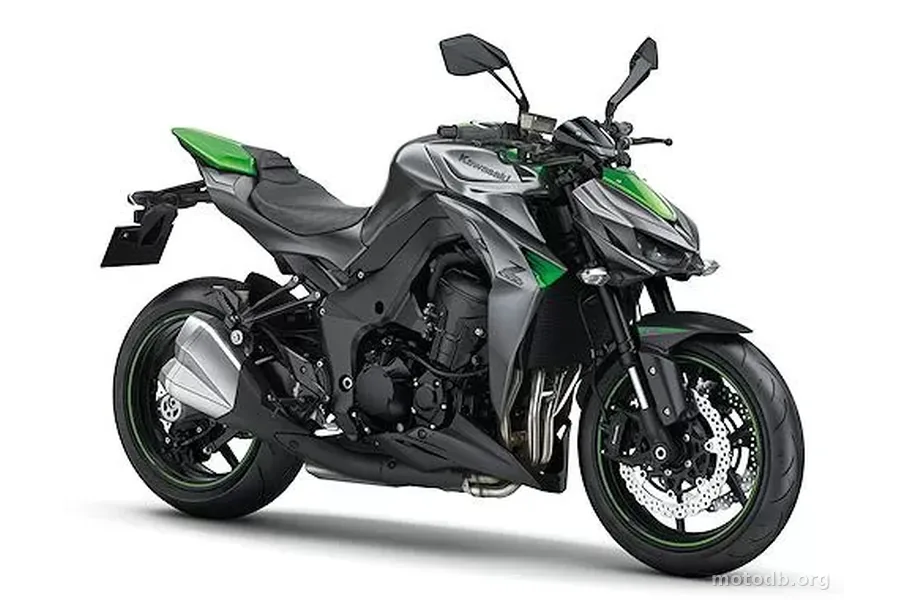
It’s been a while since there was a new color for the Z 1000 in 19, and that’s still the case in 2020. It hints at a mix of resilience and end-of-life for the Kawa big roadster. While the Z 1000 is far from obsolete, the machine is starting to show its age. Primarily on the technological front, as the competition offers a range of electronic assistance features that the big Z declines. For how long? It doesn’s care. The Z 1000 shook up the roadster world when it was released. That was over 15 years ago. And today, after several evolutions and a sector that has moved a lot, the big Z remains a somewhat out-of-place machine. In a world of power, smart chips, and digital copilots galore, the Akashi machine has become one of the few warrior motorcycles without a shield. No traction control, multi-axis inertial unit, or Riding Modes; only the rider's fury and management by the right hand.
The next Z 1000 will certainly be more "electronically advanced." In the meantime, a small evolution was necessary to comply with Euro4. To do this, the exhaust line incorporates modified catalysts and an evaporator to reduce polluting emissions. The injection mapping is revised for two missions: to also participate in the reduction of harmful gas emissions and to smooth out the delivery of power.
Complying with standards was not enough. Kawasaki focused on a few details, small or large. Like the suspension. The fork is tuned more softly to improve comfort and handling while preserving sensations. At the rear, a new linkage ratio increases the rear wheel travel by 13 mm (122 mm -> 135 mm) and softens the suspension’s work. The damping is more effective, and the rear end provides a better impression of grip. Note the new brake pads, an adjustable clutch lever with 5 positions, mirrors with a greater range of motion, and an enriched dashboard. The small digital display now shows the gear engaged, and the tachometer transforms into a shiflight, programmable for a flash from 4000 rpm. Finally, the fender is redesigned.
For enthusiasts of the Z seeking a higher level of efficiency, Kawa has the excellent idea of offering the Z 1000 R. And it delivers: Öhlins shock absorber and Brembo M50 brakes.
To recall the journey of the Z 1000 phase 4, let's find its mission and its evolutions: The Z 1000! A flagship model from Kawasaki. The one of resurrection, of rediscovered brutality, of disturbing and pleasant stylistics, of success among big roadsters. With a light breath, it carries you smoothly. One notch higher, and it growls menacingly in the cylinders. In episode 4, the big Z becomes the forbidden child of a Terminator and an Alien.
The design! It’s one of the big tactical points of the Z 1000. Perhaps more than on any other machine; the out-of-place and manga feel of the first opus forced a saving curiosity from the public. Even today, this machine whips the gaze, slaps the intrigue, takes us on a path of design that is both provocative and biomechanical. The Z 1000 phase 4 has lost its fork fairings, its angles, and its origami echoes. The contours and reliefs of its silhouette are drawn into the thickness of a worrying xenomorph. It all starts with this fork head, a veritable appendage of an exterminator robot. Its eyes hold 4 LED headlights, the central pair being used for daily use, the other being added for full beam. It all ends with a very sporty rear end, worthy of an R6 or Italian productions. Valuing, well-finished, chiadée, the Kawasaki commands respect, form, and detail. Seriousness seeps through the exuberance; we find the rear axle adjustment by eccentric; the seat is covered with a multitude of Z symbols, as on the 800; pay attention to the mirrors mounted on a double branch, to the translucent brake reservoir, to the polished double outlet silencers, to this new innovative dashboard. Almost entirely digital, it delegates the display of the engine speed to LEDs, but only from 4000 rpm; before that, it’s the LCD window that takes care of it. Unlike its predecessor, it is not adjustable in inclination. And, surprisingly for such a modern machine, the information cannot be controlled from the handlebars; only a warning and basic functions await you on the commodo. But what about the wheels!? Where are the tuning-style rims? Economy or change of style?
It’s a spectacular facelift for the Z 1000. Facelift? Isn't it a new machine? Well… On the face, the two generations have nothing to do. Technically, however, the Z 1000 "IV" retains the essentials of the Z 1000 "III." While still optimizing a lot of things, to mark the difference between the two beasts. First, the engine. You can imagine nothing other than a barrel of powder in such a pugnacious machine. Did Kawa add Red Bull to the 4-cylinder? Did the 1043 cm3 block spike itself with protein caffeine? Expectations are high, and Akashi’s response is in the plus, without tipping into the surreal, as KTM did with its Superduke 1290 R with 173 hp.
In the heart of the green monster, 4 additional horsepower were found, bringing the total to 142 units; a peak that must be sought 400 rpm higher, at 10,000 rpm. Torque increases from 11.2 to 11.3 mkg, at a reduced speed from 7,800 to 7,300 rpm. With revised ECU mappings, a different camshaft timing, oval intake pipes, and other improvements such as connected cylinders designed to reduce the pumping phenomenon, the Z 1000 now has more power in the low range without degrading its top-end. Already lively and prompt to distribute generous torque, it has something to respond with its more than well-watered musculature.
On this version, the front end is not only visually lightened but also optimized dynamically. The 43 mm inverted fork is a BPF with large pistons, all of whose settings can be performed from the top of the tubes. Each side has its role: preload on the left, compression and rebound on the right. Both more precise and more comfortable, this type of fork had already established its presence on some sportbikes before being invited to the Z. When it comes to braking, the emphasis has been placed on more power with larger discs, from 300 to 310 mm, new Tokico monoblock calipers borrowed from the SX sister, and a master cylinder with a 19 mm piston.
Relieved of too much plastic, with reinforced aggression and a devouring fury that tears its identity, the Z 1000 "IV" reaches a captivating stylistic bestiality level – Kawasaki transcends this idea with the designation "Sugomi." A veritable monster escaped from the universe of Stephen King or Ridley Scott, with sensitive mechanical evolutions to bite with its dynamism any portion of road that is a little playful. Facing it, machines such as the KTM Superduke 1290 R, the BMW S 1000 R, or the Aprilia Tuono V4R risk sending it into the ropes, at the price of exclusivity and a budget for the informed. On the Japanese side, it is certainly the most vindictive and most striking of the streetfighters. Relying on the success of previous generations and the technology of the 2010-2013 edition, this Z 1000 maintains the torch of the edgy, disruptive, and attractive roadster.
M.B - Photos manufacturer
Standard equipment
- Assistance au freinage : ABS de série
Practical info
- La moto est accessible aux permis : A
Indicators & positioning
Similar bikes
1050 SPEED TRIPLE Edition Speciale
Reviews & comments
No reviews yet. Be the first to share your opinion!