Key performance
Technical specifications
Engine
- Displacement
- 1099 cc
- Power
- 135.0 ch @ 9000 tr/min (99.3 kW)
- Torque
- 111.8 Nm @ 7600 tr/min
- Engine type
- 4 cylindres en ligne, 4 temps
- Cooling
- liquide
- Compression ratio
- 11,8 : 1
- Bore × stroke
- 77 x 59 mm
- Valves/cylinder
- 4
- Camshafts
- 2 ACT
- Fuel system
- Injection Ø 38 mm
- Starter
- électrique
Chassis
- Frame
- Double poutre en aluminium
- Gearbox
- boîte à 6 rapports
- Final drive
- Chaîne
- Front suspension
- Fourche téléhydraulique inversée Ø 43 mm, déb : 150 mm
- Rear suspension
- Mono-amortisseur, déb : 152 mm
Brakes
- Front brakes
- Freinage 2 disques Ø 310 mm, fixation radiale, étrier 4 pistons (monobloc)
- Rear brakes
- Freinage 1 disque Ø 260 mm, étrier simple piston
- Front tyre
- 120/70-17
- Front tyre pressure
- 2.50 bar
- Rear tyre
- 180/55-17
- Rear tyre pressure
- 2.90 bar
Dimensions
- Seat height
- 840.00 mm
- Seat type
- Selle biplaces
- Fuel capacity
- 21.00 L
- Weight
- 234.00 kg
- Dry weight
- 234.00 kg
- New price
- 15 490 €
Overview
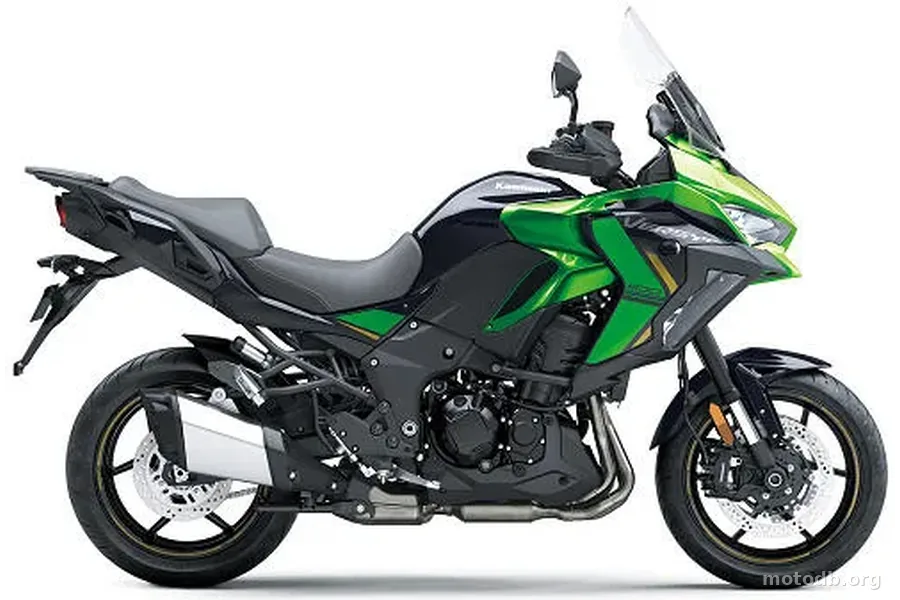
Kawasaki has never indulged in hyper-trail extravagance. Rather than offering high-powered "adventure" bikes or ultra-capable funambulists, the brand has long preferred a trail-GT with reasonable (but still ample) power, a confessed touring orientation, and a less punishing price tag.
However, the Versys has legitimately developed a desire for power, seeing machines with 150, 170, or even 200 horsepower across the river. Without trying to challenge or even tease them, it has demanded more watts! And it has received them. Becoming the 1100, Madame Versys strengthens herself without touching her fundamentals.
Let's announce this without further delay: the Versys IV now develops 135 horsepower. A very honorable value in absolute terms. This is a gain of 15 hp from the 1000. Without needing to rev higher than with the previous engine. Torque also performs well, with 1 mkg gained, for a total of 11.4 mkg. Good, breathy, vigorous, without veering into the unreasonable.
How did this surge come about? With some good work on the mechanics. First, revising the size of the ventricles. With an increase in stroke of 3 mm, the cylinder volume climbs from 1043 to 1099 cm3. But that doesn't explain everything. Torque availability was prioritized with narrower throttle bodies, optimized and differentiated intake ducts (the center ones are 45 mm longer, and a faster intake flow. The ECU has been revised accordingly. Additional junctions between the collector tubes also allow for improved performance. Kawa takes advantage of the engine overhaul to reduce vibrations with a second balancing shaft, increase engine inertia for a bit more smoothness, extend reliability with a second oil radiator, and reprogram the quickshifter to be active from 1500 rpm.
Those who like style changes will be disappointed. The 1100 has not changed face by even an inch. Apart from the new colors, the shape of the brake discs (they are no longer petal-shaped), the engine painted black, and the slight retouches to the exhaust line, nothing distinguishes the "ten" from the "11". Too bad for the "new look"; good for the wallet: no file at the design office, no new molds, fewer processes – this should help limit costs, and the final price.
The chassis follows the same trend. Everything, from the wheels to the rear light, comes from the previous version without modification. Except one: the rear brake disc grows by 10 mm. This large trail still benefits from a set derived from the old Z 1000 roadster and closely related to the Ninja 1000 / 1100 SX. The entire suite of electronic aids remains in the same location, with 4 Riding Modes, several power modes, traction control, KCMF cornering optimization, cruise control, intelligent ABS, and adaptive cornering headlights.
The 1100 Versys also incorporates (especially?) elements pleasant for everyday use or as needed, such as handguards, an adjustable screen, heated grips, Smartphone connectivity, a USB-C socket, discreet luggage rack anchors, a dashboard with a TFT screen and analog tachometer, a luggage rack, a center stand, well-proportioned saddles, and a remote-mounted adjustment dial for the rear damper.
Note that the base 1100 Versys is not planned for France. The Versys is marketed in S and SE versions; the second version being distinguished primarily by its semi-active Showa suspension.
M.B - media constructeur
Standard equipment
- Assistance au freinage : ABS
- Nombre de mode de conduite : 4
- ABS Cornering
- Shifter
- Béquille centrale
- Indicateur de vitesse engagée
- Régulateur de vitesse
- Bluetooth
- Prise USB
- Contrôle de traction
- Poignées chauffantes
- Pare brise réglable
- Embrayage anti-dribble
- Centrale inertielle
- Phares adaptatifs en virage
Practical info
- La moto est accessible aux permis : A
Indicators & positioning
Similar bikes
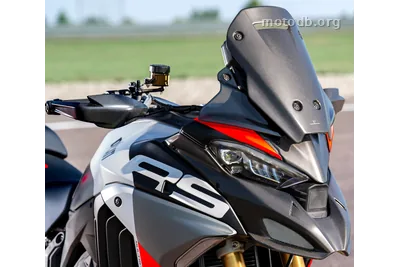
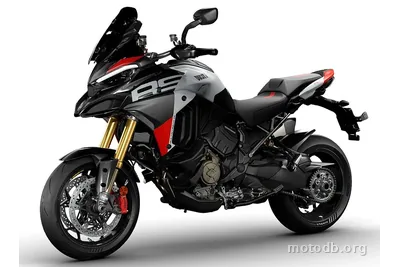
Multistrada V4 RS
Reviews & comments
No reviews yet. Be the first to share your opinion!