Key performance
Technical specifications
Engine
- Displacement
- 998 cc
- Power
- 228.0 ch @ 11500 tr/min (166.4 kW)
- Torque
- 141.7 Nm @ 11000 tr/min
- Engine type
- In-line four, four-stroke
- Cooling
- Liquid
- Compression ratio
- 8.5:1
- Bore × stroke
- 76.0 x 55.0 mm (3.0 x 2.2 inches)
- Valves/cylinder
- 4
- Fuel system
- Injection. DFI® with 50mm throttle bodies (4) with dual injection
- Valve timing
- Double Overhead Cams/Twin Cam (DOHC)
- Lubrication
- Forced lubrication, wet sump with oil cooler
- Ignition
- Digital
- Starter
- Electric
Chassis
- Frame
- Trellis, high-tensile steel with swingarm mounting plate
- Gearbox
- 6-speed
- Final drive
- Chain (final drive)
- Clutch
- Wet multi-disc, manual
- Front suspension
- 43 mm inverted fork with rebound and compression damping, spring preload adjustability and top-out springs
- Rear suspension
- Uni-Trak, Öhlins TTX36 gas-charged shock with piggyback reservoir, compression damping, rebound damping, preload adjustability and top-out spring
- Front wheel travel
- 119 mm (4.7 inches)
- Rear wheel travel
- 135 mm (5.3 inches)
Brakes
- Front brakes
- Double disc. Dual radial-mount, opposed 4-piston Brembo Stylema® calipers, dual semi-floating disc. ABS.
- Rear brakes
- Single disc. Opposed 2-piston calipers, single disc. ABS.
- Front tyre
- 120/70-ZR17
- Rear tyre
- 200/55-ZR17
Dimensions
- Seat height
- 825.00 mm
- Wheelbase
- 1455.00 mm
- Ground clearance
- 130.00 mm
- Length
- 2085.00 mm
- Width
- 770.00 mm
- Height
- 1125.00 mm
- Fuel capacity
- 17.00 L
- Weight
- 238.10 kg
Overview
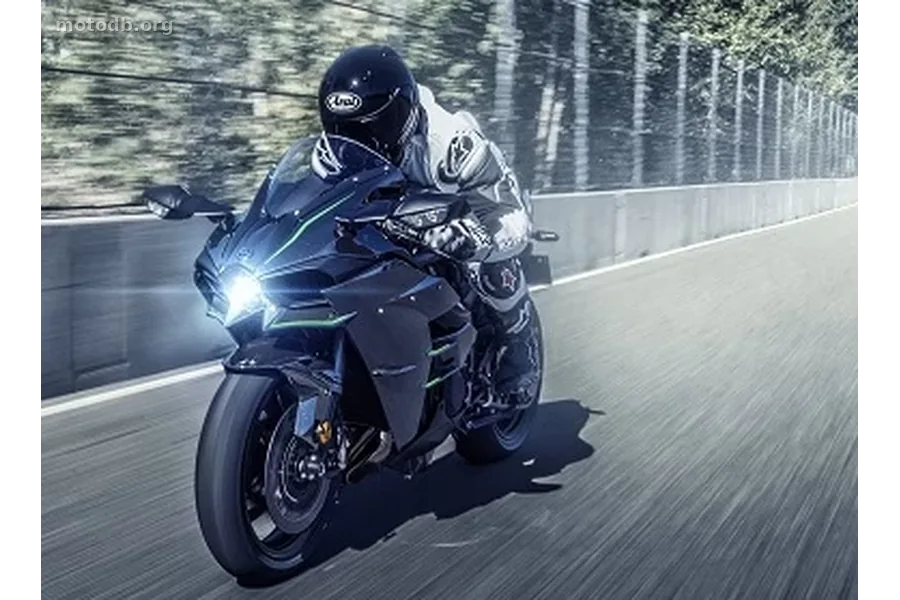
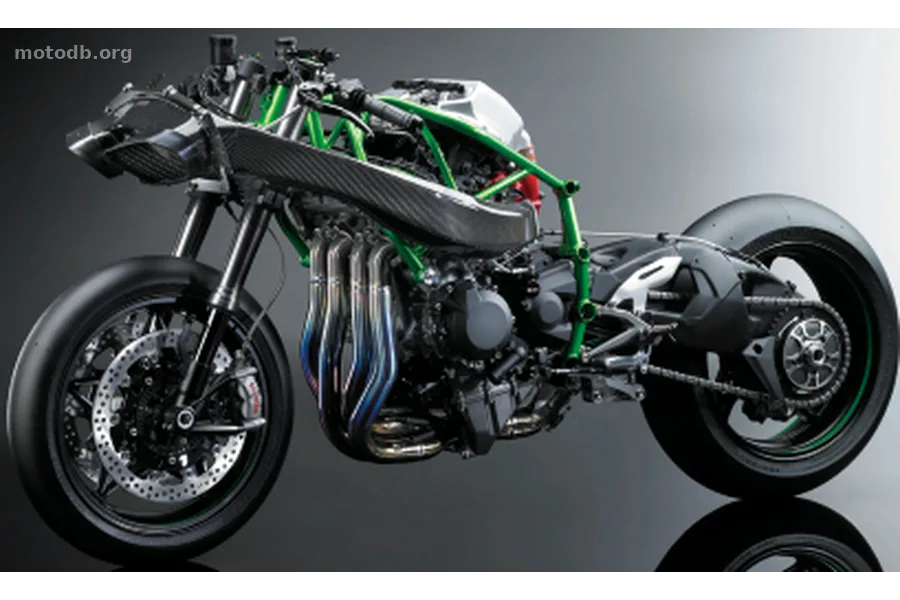
When Kawasaki released the H2R from its laboratories, few truly believed in it. A supercharged production motorcycle, developed in-house by the group's engineers, designed for the track without ever having to justify its existence on an open road. The civilian version, the Kawasaki Ninja H2, arrived to tame this madness, retaining the architecture, the high-strength steel trellis frame, and the centrifugal supercharger, but trimming the power to something barely reasonable. Two hundred horsepower was already a provocation. For 2020, it wasn’t enough anymore.
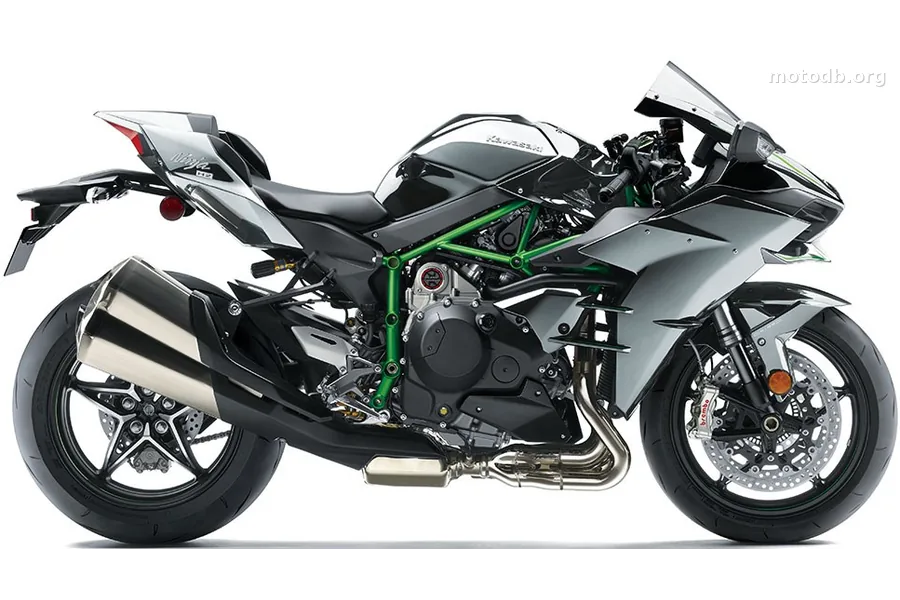
The Kawasaki Ninja H2 2020 now delivers 231 horsepower at 11,500 rpm, or 141.7 Nm of torque at 11,000 rpm, thanks to components borrowed directly from the Kawasaki Ninja H2 SX, the touring version of the same supercharged engine. ECU, intake chamber, spark plugs, airbox – everything has migrated from one version to the other to reach this new level. Including the ram air effect at full speed, the figure rises even further, to 242 units. Faced with a Suzuki GSX 1300R Hayabusa or the Kawasaki Ninja H2 R on the track, comparisons lose their usual meaning, as the difference in philosophy is abyssal. At €29,500, this machine is not a purchase proposition, it is a statement of intent.
What is more surprising is that Kawasaki announces a decrease in consumption despite the increase in engine speed. With 8.5 liters per 100 km and a 17-liter tank, range remains tight, but the progress is real. The rest of the technical specifications command respect without particular fanfare. The 43 mm inverted fork offers complete adjustments in rebound and compression, the Öhlins TTX36 rear shock with separate reservoir manages the ride height with surgical precision, the Brembo Stylema calipers at the front bite with the same decisiveness as on a Panigale V4. Bridgestone RS11 tires complete a package clearly oriented towards pure performance, even if the motorcycle weighs 238 kg when fully fueled, with a seat height of 825 mm. This is not the mount for Sunday morning family rides.
Kawasaki has also refined the details on this evolution. The "mirror" paint, already a signature of the range, gains a self-healing property for superficial micro-scratches. The color digital instrumentation, inherited from the Kawasaki Ninja H2 SX, replaces the old analog tachometer whose segments gradually lit up with engine speed, a particularity that owners of a Kawasaki Ninja H2 2019 or a Kawasaki Ninja H2 Carbon will undoubtedly miss. In return, Bluetooth connectivity allows you to consult fuel level, battery status, and telephone notifications on your smartphone. A debatable compromise, but in keeping with the times.
What truly distinguishes the Kawasaki Ninja H2 motorcycle from any conventional hypersport is the texture of its power. The supercharger does not deliver its horsepower like an atmospheric engine, with a linear rise towards the redline. It breathes, charges, then releases a progression that crushes usual benchmarks. Added to this is a complete electronic arsenal, with three-mode and nine-level traction control, launch control, cornering ABS, engine braking management, bidirectional quickshifter, and Öhlins steering damper that automatically stiffens according to speed. On the announced 300 km/h top speed, these assists are not a luxury, they are the condition for this motorcycle to remain manageable by humans. The target audience is not the beginner, not even the intermediate rider. It is the experienced rider who wants the most radical road-legal motorcycle, without going through a Kawasaki Ninja H2 R reserved for the track. A machine that continues to evolve intelligently, year after year, even if its oversized exhaust has yet to find someone to take care of it.
Reviews & comments
No reviews yet. Be the first to share your opinion!