Key performance
Technical specifications
Engine
- Displacement
- 998 cc
- Power
- 203.0 ch @ 13500 tr/min (149.3 kW)
- Torque
- 114.7 Nm @ 11200 tr/min
- Engine type
- 4 cylindres en ligne, 4 temps
- Cooling
- liquide
- Compression ratio
- 13 : 1
- Bore × stroke
- 76 x 55 mm
- Valves/cylinder
- 4
- Camshafts
- 2 ACT
- Fuel system
- Injection Ø 47 mm
Chassis
- Frame
- double poutre périmétrique en alu
- Gearbox
- boîte à 6 rapports
- Final drive
- Chaîne
- Front suspension
- Fourche téléhydraulique inversée BPF Ø 43 mm, déb : 120 mm
- Rear suspension
- Mono-amortisseur, déb : 114 mm
Brakes
- Front brakes
- Freinage 2 disques Ø 330 mm, fixation radiale, étrier 4 pistons
- Rear brakes
- Freinage 1 disque Ø 220 mm, étrier simple piston
- Front tyre
- 120/70-17
- Rear tyre
- 190/55-17
Dimensions
- Seat height
- 835.00 mm
- Fuel capacity
- 17.00 L
- Weight
- 208.00 kg
- New price
- 23 399 €
Overview
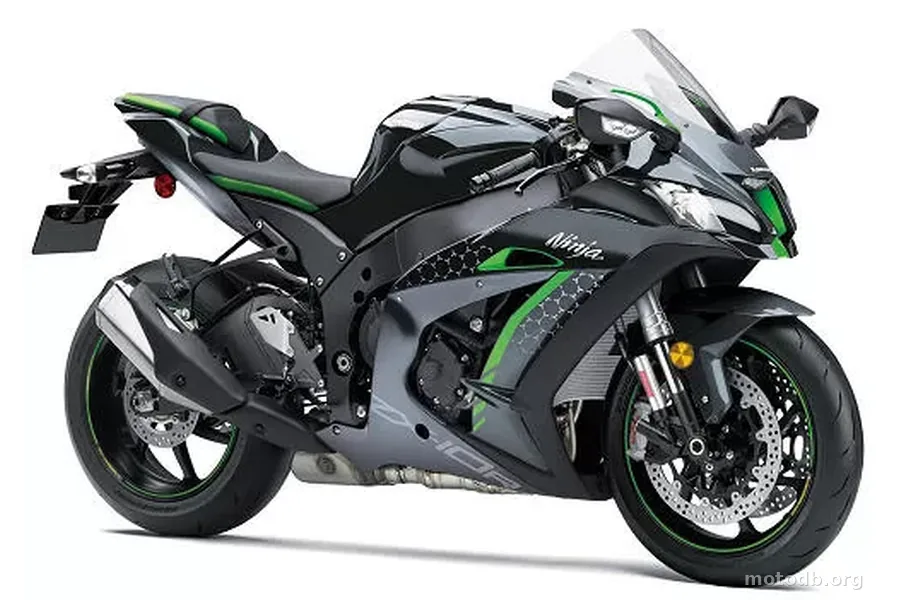
What sets a premium hypersport apart from a simple steroid-pumped sportbike? At Kawasaki, the answer comes down to two letters: SE. For the 2019 model year, the engineers in Akashi didn't just slap a gold badge on the ZX-10R. They redesigned the cylinder head of the 998 cc inline-four, adopting finger-follower valve actuation that allows higher revs. The result: 203 horsepower at 13,500 rpm and 114.7 Nm of torque at 11,200 rpm. Three horses more than the previous version, captured 500 rpm higher in the rev range. On paper, it seems modest. On track, where every tenth of a second counts, it's a measurable advantage. The compression ratio climbs to 13:1, a sign that Kawasaki sought maximum efficiency from that 76 mm bore and 55 mm stroke. And for those who want to push things even further, the new cylinder head now accepts camshafts from the racing kit.
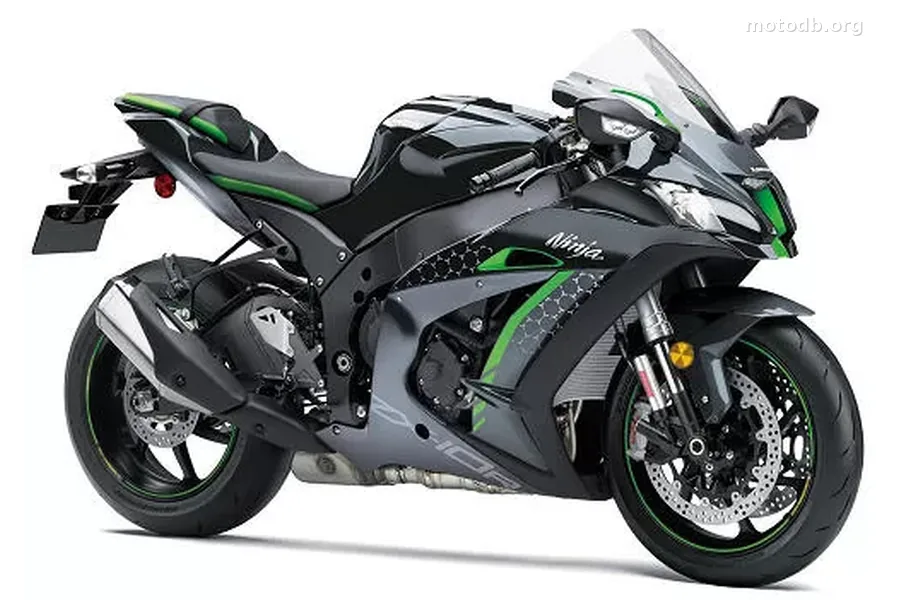
But the real showpiece of this SE is its semi-active suspension. Kawasaki debuts the KECS system here, developed in collaboration with Showa. The foundation remains solid: a 43 mm BPF inverted fork with 120 mm of travel up front, a single shock offering 114 mm at the rear. The difference is the intelligence layered on top. Sensors built into each suspension component measure compression and rebound speed every millisecond. The inertial measurement unit completes the picture every ten milliseconds with acceleration and vehicle dynamics data. Solenoid valves then adjust compression and rebound with a one-millisecond response time — ten times faster than stepper motor systems. Faster than a human reflex. In practice, the ZX-10R SE reads the road before your brain has time to register the bump.
Three modes are available to exploit this system. Road softens everything to absorb pavement imperfections. Track firms it all up for committed riding between the curbs. Manual lets the rider choose from 15 levels of compression and rebound adjustment, with the electronics then fine-tuning in real time according to conditions. Against the Yamaha R1M and its semi-active Öhlins suspension, or the Honda Fireblade SP, Kawasaki plays a different card: less prestige in the supplier's name, but a claimed superior responsiveness. The positioning is clear.
On the equipment side, the SE inherits the Marchesini forged aluminum wheels and the bidirectional quickshifter from the late ZX-10RR. The self-healing paint, borrowed from the H2, covers the 17-liter tank and the sub-panels. No miracles on deep scratches, but minor scuffs disappear on their own. All dressed in a discreet black-grey livery, accented with touches of Kawasaki green and an SE plate on the tank. On the scales, 208 kg wet, just two kilos more than the standard version. Negligible. The seat perched at 835 mm, radial-mount brakes with dual 330 mm discs, and 190/55-17 rear tires are reminders that this machine is aimed first and foremost at experienced riders capable of exploiting its 300 km/h top speed.
At €23,399, the ZX-10R SE commands roughly €5,000 more than the base KRT edition. That's the price of intelligent damping, forged wheels, and a full quickshifter. For the regular track rider tired of clicking adjustment knobs between sessions, or the demanding road rider who wants a hypersport capable of coping with unpredictable French tarmac, the bill is justified. The direct competition offers comparable pricing, sometimes higher. Within the Ninja 1000 lineup, the SE occupies the smart compromise slot: neither the raw brutality of the standard, nor the competition exclusivity of the RR, but a machine that thinks as fast as it accelerates.
Standard equipment
- Assistance au freinage : Sport ABS
Practical info
- La moto est accessible aux permis : A
Reviews & comments
No reviews yet. Be the first to share your opinion!