Key performance
Technical specifications
Engine
- Displacement
- 998 cc
- Power
- 210.0 ch (154.5 kW)
- Engine type
- 4 cylindres en ligne, 4 temps
- Cooling
- liquide
- Compression ratio
- 13 : 1
- Bore × stroke
- 79 x 50.9 mm
- Valves/cylinder
- 4
- Camshafts
- 2 ACT
- Fuel system
- Injection
Chassis
- Frame
- périmétrique Diamond en aluminium
- Gearbox
- boîte à 6 rapports
- Final drive
- Chaîne
- Front suspension
- Fourche téléhydraulique inversée Öhlins Ø 43 mm, déb : 120 mm
- Rear suspension
- Mono-amortisseur Öhlins, déb : 120 mm
Brakes
- Front brakes
- Freinage 2 disques Ø 320 mm, fixation radiale, étrier 4 pistons
- Rear brakes
- Freinage 1 disque Ø 220 mm, étrier simple piston
- Front tyre
- 120/70-17
- Rear tyre
- 200/55-17
Dimensions
- Fuel capacity
- 17.00 L
- Weight
- 190.00 kg
- New price
- 39 500 €
Overview
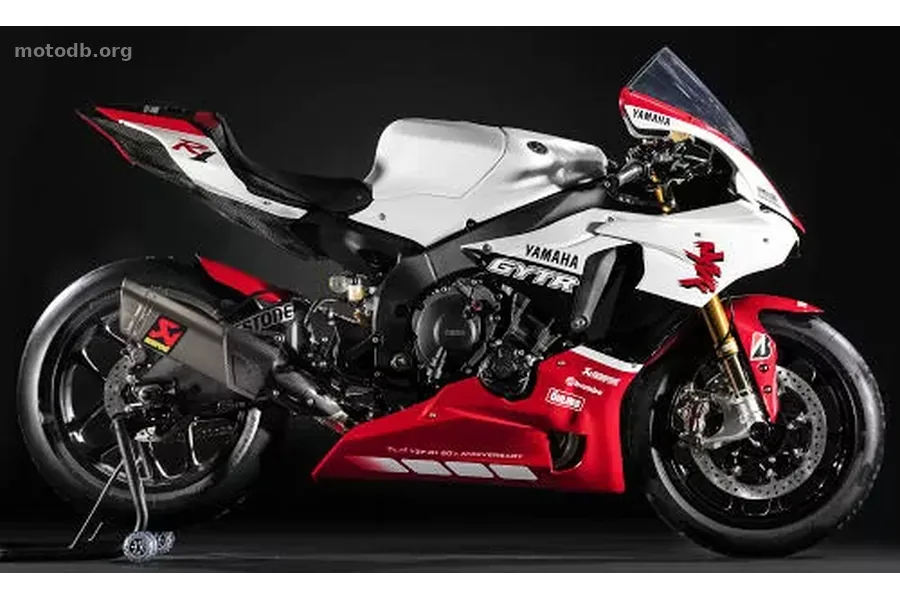
Twenty years of existence, twenty units produced. The calculation is symbolic, almost too beautiful to be coincidental. Yamaha does nothing at random with its GYTR division, and this 2019 R1 is the most radical proof: a competition motorcycle delivered ready to race by the manufacturer itself, without compromise or superfluous road equipment. It knows only the hot asphalt of the circuits, the heating blankets, and the scream of late braking.
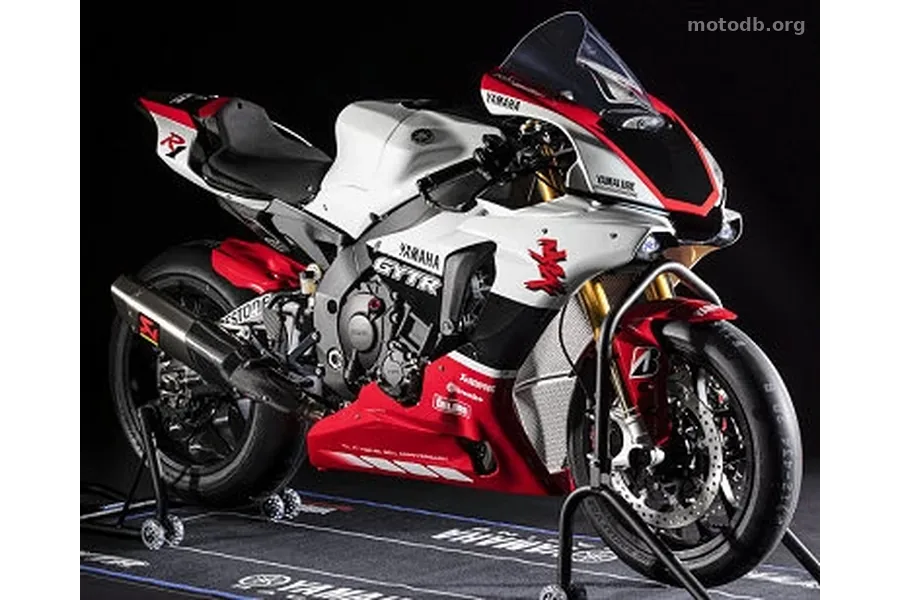
This segment of factory-prepared machines has become denser in recent years. Aprilia with its Factory Works division, BMW and its HP4 Race, Suzuki with the confidential GSX-R Ryuyo, without forgetting the MV Agusta F4 1000 Veltro Pista: each wanted to offer its most committed customers something more than a production sportbike. Yamaha responds to this call with a slightly different approach. The GYTR department, a merger of YEC and the former GYTR, did not seek to rebuild the engine from the ground up. The crossplane four-cylinder remains close to its standard configuration, which leaves a deliberately open margin for the buyer. Want more violence? The engine is your blank canvas.
What changes, however, is everything else. The integral carbon bodywork dresses the motorcycle in its original livery, the one worn by the official team during its victory at the 2018 Suzuka 8 Hours, itself inspired by the first YZF-R1 that appeared at the dawn of the 2000s. That first model redrew the standards of the sportbike; this GYTR celebrates the loop. The Öhlins suspensions do the serious work: 43 mm FGRT 219 fork, TTX36 GP rear shock, steering damper, all adjustable down to the last millimeter. The braking remains consistent with the R1’s technical specifications, with two 320 mm discs at the front and a single 220 mm disc at the rear, sufficient for well-managed track use. The Akrapovic Evolution 2 titanium exhaust releases the engine from its homologation constraints and pushes the estimated power towards 210 horsepower, all contained in 190 kilograms in running order. It is dense, concentrated, and very precisely within the range of customer Superbike machines.
The dashboard disappears in favor of a race electronic control unit, a dedicated CCU for communication control, and a short-stroke throttle. The clip-on handlebars bear their adjustment buttons like cockpit controls. The hollowed-out steering stem displays its serial number engraved in aluminum, a reminder that you hold in your hands a numbered piece in a strictly limited series. Gilles Tooling engine protectors complete the ensemble with the rigor expected of a tool designed to fall, get up, and start again.
Thirty-nine thousand five hundred euros. The price of entry into a very restricted club, accessible only via an online reservation that evaporated in a few hours, like an R1M on launch night. Those who were fast enough receive with their machine an invitation to the Yamaha Racing Experience, where technicians are waiting to help them fully exploit the potential of the machine. It’s not after-sales service; it’s competitor support. The GYTR is clearly not intended for the Sunday track rider looking for a beautiful mount for a few annual track days. It is aimed at those who already know their lap times, who have a mechanic in their entourage, and who consider the circuit as a workplace. For others, the R1M fulfills the role with far fewer constraints and a much more accessible price.
Standard equipment
- Assistance au freinage : ABS de série
Practical info
- La moto est accessible aux permis : A
Reviews & comments
No reviews yet. Be the first to share your opinion!