Key performance
Technical specifications
Engine
- Displacement
- 755 cc
- Power
- 92.0 ch @ 9500 tr/min (67.7 kW)
- Torque
- 75.0 Nm @ 7250 tr/min
- Engine type
- Bicylindre en ligne, 4 temps, calé à 270°
- Cooling
- liquide
- Compression ratio
- 11 : 1
- Bore × stroke
- 87 x 63,5 mm
- Valves/cylinder
- 4
- Camshafts
- 1 ACT
- Fuel system
- Injection Ø 46 mm
- Starter
- électrique
- Euro standard
- Euro 5+
Chassis
- Frame
- type Diamant en acier
- Gearbox
- boîte à 6 rapports
- Final drive
- Chaîne
- Clutch
- Wet multiplate, assisted slipper + Honda E-clutch
- Front suspension
- Fourche téléhydraulique inversée Ø 43 mm, déb : 200 mm
- Rear suspension
- Mono-amortisseur, déb : 190 mm
Brakes
- Front brakes
- Freinage 2 disques Nissin Ø 310 mm, étrier 2 pistons
- Rear brakes
- Freinage 1 disque Nissin Ø 256 mm, étrier simple piston
- Front tyre
- 90/90-21
- Rear tyre
- 150/70-18
Dimensions
- Seat height
- 850.00 mm
- Seat type
- Selle biplaces
- Wheelbase
- 1560.00 mm
- Ground clearance
- 210.00 mm
- Fuel capacity
- 16.90 L
- Weight
- 210.00 kg
- New price
- 10 800 €
Overview
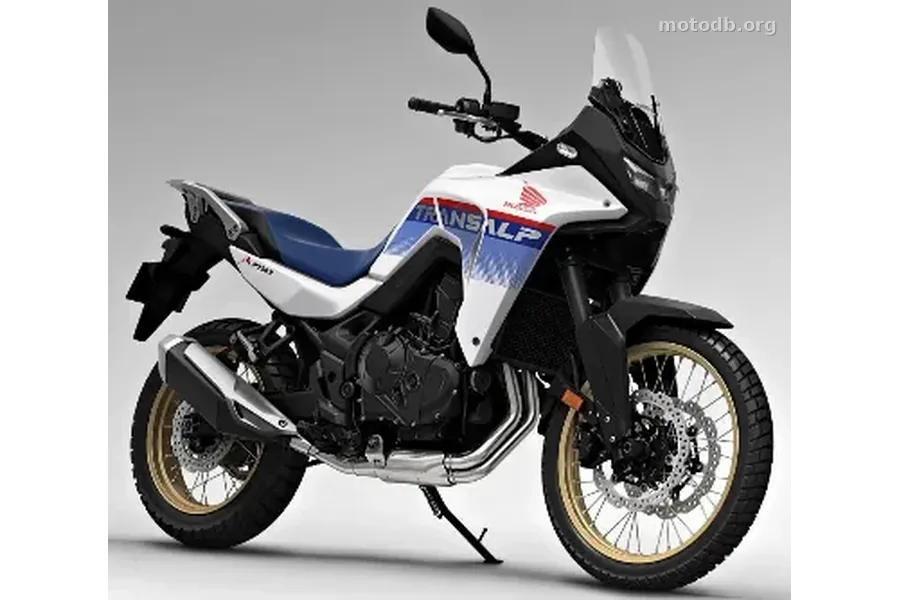
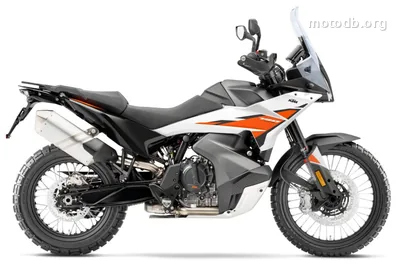
A true Swiss Army knife, the Transalp. Comfortable, efficient, and roadworthy, yet not shying away from venturing off-road, the Honda does justice to its name and lineage. The manufacturer closely monitors it and ensures regular updates. Revised for 2025, it also receives improvements in 2026.
First, adjustments to the suspension. As the Transalp is likely to change terrain during travel and/or as desired, the staff has the good idea to add compression and rebound adjustment to both the fork and the shock. As it was already possible to adjust preload, the bike is now adjustable everywhere.
A new skid plate better integrates with the machine's appearance. But the big bonus for 2026 is the optional arrival of E-Clutch, Honda’s robotic clutch. After debuting on the CB 650, the small electromechanical unit simplifies the Transalp’s operation. The clutch lever? No longer needed (unless you want a classic riding feel). With this technology, a twist of the throttle is all it takes. The E-clutch does a fantastic job of smoothing gear changes while being as fast as a quickshifter. I’ll provide a summary of all the interaction between the systems at the end of the article *. What remains is that clutch management adapts to the situation to be always efficient; even off-road where it can stabilize gear changes based on rear wheel jolts.
The E-Clutch also does the job when the rear wheel spins. As the rider no longer needs to touch the clutch during starts and stops (intentional or not), they can focus more on the situation. A real plus, especially for novices or in unexpected technical phases. The system also acts on the throttle butterflies according to the current Riding Mode. It doesn't just act on the clutch; it also manages the engine for optimum gear changes.
Two years after its release, the 750 Transalp had been revamped. Did it need it? Not really. But if you’re going to undergo some modifications following Euro5+, you might as well take the opportunity to tweak a few small things. A finer look, for example, or a vent in the new screen to improve airflow, as well as a new screen with the addition of the Honda RoadSync App for more functions. Mechanically, the twin meets standards without loss of power while a bit of firmness is added to the suspensions (which it will appreciate). Note also the arrival of a new backlit multi-function switch and an emergency braking warning light (the warning lights up on hard braking).
Briefly, the Transalp secures its future without upheaval. Its appetites, combined with the process of common platforms, have led it to a certain ideology of its engine. After 25 years of V-twin, the mechanics rely on a parallel twin. Less expensive to build, less bulky, lighter, this engine propels the trail towards a very promising peak. 92 horsepower! Mid-size Honda trail bikes hadn’t accustomed us to that. Everything is explained once you discover that this engine is shared with the 750 Hornet. A good dose of watts, allowing a nice appearance within the segment. The time of 50/60 horsepower to go wandering is now just a memory. The flat area now sweeps from 80 to 100 horsepower.
The 755 cm3 delivers 91.8 hp at 9500 rpm. The maximum torque value is a little lower, at 7250 rpm, where it reaches 7.7 mkg. Even if the internal webs are very square, Honda has worked to offer responsiveness at low and mid-speeds, i.e., the most frequently used ranges for this type of machine. As on the Hornet, the engine benefits from Unicam technology to obtain a compact cylinder head, an optimized valve train and a lightweight crankshaft.
Descent gear changes are controlled by ride-by-wire, adapting the engine speed to the rear wheel speed for even smoother gear changes.
The rider can select a “working feel” to adjust the intensity of the force required on the gear lever. Three settings are available: Hard, Medium and Soft, each of which can be selected independently for upshifts and downshifts. The system also invites the rider to downshift – via a symbol on the dashboard – if it detects that the bike is in a gear higher than a certain speed.
The clutch lever can be used normally at any time. After use, the Honda E-Clutch system reactivates in less than one second above a certain engine speed, and after 5 seconds at low speed. If the rider wants to disable the system for a particular trip, they can also do so via the switch on the left handlebar, once the vehicle is stopped and in neutral. Manual mode is indicated by the letter “M” on the dashboard.
The clutch itself is controlled by a two-motor actuator located inside the right engine cover.
The rider can select a “working feel” to adjust the intensity of the force required on the gear lever. Three settings are available: Hard, Medium and Soft, each of which can be selected independently for upshifts and downshifts. The system also invites the rider to downshift – via a symbol on the dashboard – if it detects that the bike is in a gear higher than a certain speed.
The clutch lever can be used normally at any time. After use, the Honda E-Clutch system reactivates in less than one second above a certain engine speed, and after 5 seconds at low speed. If the rider wants to disable the system for a particular trip, they can also do so via the switch on the left handlebar, once the vehicle is stopped and in neutral. Manual mode is indicated by the letter “M” on the dashboard.
The rider can select a “working feel” to adjust the intensity of the force required on the gear lever. Three settings are available: Hard, Medium and Soft, each of which can be selected independently for upshifts and downshifts. The system also invites the rider to downshift – via a symbol on the dashboard – if it detects that the bike is in a gear higher than a certain speed.
The clutch lever can be used normally at any time. After use, the Honda E-Clutch system reactivates in less than one second above a certain engine speed, and after 5 seconds at low speed. If the rider wants to disable the system for a particular trip, they can also do so via the switch on the left handlebar, once the vehicle is stopped and in neutral. Manual mode is indicated by the letter “M” on the dashboard.
The rider can select a “working feel” to adjust the intensity of the force required on the gear lever. Three settings are available: Hard, Medium and Soft, each of which can be selected independently for upshifts and downshifts. The system also invites the rider to downshift – via a symbol on the dashboard – if it detects that the bike is in a gear higher than a certain speed.
The clutch lever can be used normally at any time. After use, the Honda E-Clutch system reactivates in less than one second above a certain engine speed, and after 5 seconds at low speed. If the rider wants to disable the system for a particular trip, they can also do so via the switch on the left handlebar, once the vehicle is stopped and in neutral. Manual mode is indicated by the letter “M” on the dashboard.
The rider can select a “working feel” to adjust the intensity of the force required on the gear lever. Three settings are available: Hard, Medium and Soft, each of which can be selected independently for upshifts and downshifts. The system also invites the rider to downshift – via a symbol on the dashboard – if it detects that the bike is in a gear higher than a certain speed.
The clutch lever can be used normally at any time. After use, the Honda E-Clutch system reactivates in less than one second above a certain engine speed, and after 5 seconds at low speed. If the rider wants to disable the system for a particular trip, they can also do so via the switch on the left handlebar, once the vehicle is stopped and in neutral. Manual mode is indicated by the letter “M” on the dashboard.
The rider can select a “working feel” to adjust the intensity of the force required on the gear lever. Three settings are available: Hard, Medium and Soft, each of which can be selected independently for upshifts and downshifts. The system also invites the rider to downshift – via a symbol on the dashboard – if it detects that the bike is in a gear higher than a certain speed.
The clutch lever can be used normally at any time. After use, the Honda E-Clutch system reactivates in less than one second above a certain engine speed, and after 5 seconds at low speed. If the rider wants to disable the system for a particular trip, they can also do so via the switch on the left handlebar, once the vehicle is stopped and in neutral. Manual mode is indicated by the letter “M” on the dashboard.
The rider can select a “working feel” to adjust the intensity of the force required on the gear lever. Three settings are available: Hard, Medium and Soft, each of which can be selected independently for upshifts and downshifts. The system also invites the rider to downshift – via a symbol on the dashboard – if it detects that the bike is in a gear higher than a certain speed.
The clutch lever can be used normally at any time. After use, the Honda E-Clutch system reactivates in less than one second above a certain engine speed, and after 5 seconds at low speed. If the rider wants to disable the system for a particular trip
Standard equipment
- Assistance au freinage : ABS
- Nombre de mode de conduite : 6
- Taille de l'écran TFT couleur : 12,70 cm / 5 pouces
- Jantes à rayon
- Indicateur de vitesse engagée
- Bluetooth
- Prise USB
- Contrôle de couple
- Embrayage anti-dribble
- Commodes rétro-éclairés
- Contrôle du frein moteur
Practical info
- Véhicule accessible au permis A2 ou bridable à 47.5ch / 35 Kw
- La moto est accessible aux permis : A, A2
Reviews & comments
No reviews yet. Be the first to share your opinion!