Key performance
Technical specifications
Engine
- Displacement
- 1832 cc
- Power
- 118.0 ch @ 5500 tr/min (86.8 kW)
- Torque
- 166.7 Nm @ 4000 tr/min
- Cooling
- liquide
- Compression ratio
- 9.8:1
- Bore × stroke
- 74 x 71 mm
- Valves/cylinder
- 2
- Camshafts
- 2 ACT
- Fuel system
- Injection PGM-FI
Chassis
- Frame
- Double poutre alu, type Diamant
- Gearbox
- boîte à 5 rapports
- Final drive
- Cardan
- Front suspension
- Fourche téléhydraulique Ø 45 mm, déb : 140 mm
- Rear suspension
- monobras Pro-Arm mono-amortisseur Pro-link, déb : 105 mm
Brakes
- Front brakes
- Freinage 2 disques Ø 296 mm, étrier 3 pistons
- Rear brakes
- Freinage 1 disque Ø 316 mm, étrier 3 pistons
- Front tyre
- 130/70-18
- Front tyre pressure
- 2.50 bar
- Rear tyre
- 180/60-17
- Rear tyre pressure
- 2.80 bar
Dimensions
- Seat height
- 740.00 mm
- Fuel capacity
- 25.00 L
- Weight
- 417.00 kg
- Dry weight
- 363.00 kg
- New price
- 31 990 €
Overview
Remember 2007. While the competition was fine-tuning its semi-active suspensions and fledgling inertial measurement units, Honda came out of the woods with an idea nobody had dared carry through to the assembly line: fitting an airbag on a production motorcycle. Not a trade show prototype, not a mock-up for journalists, a genuine production model. And the mount chosen to carry this technological slab is no accident, it's the GL 1800 Goldwing, the flagship of the catalog, the one that swallows miles the way others rack up club memberships.
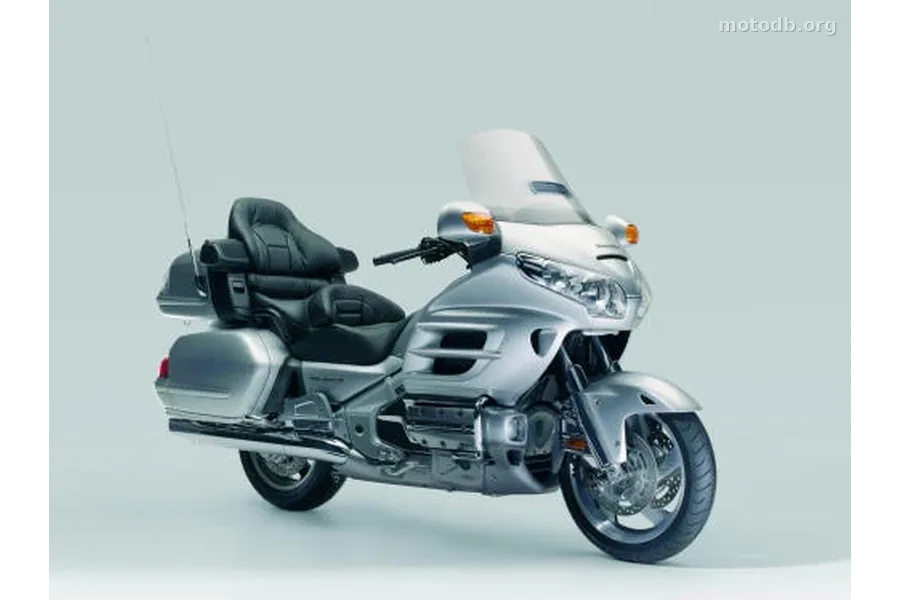
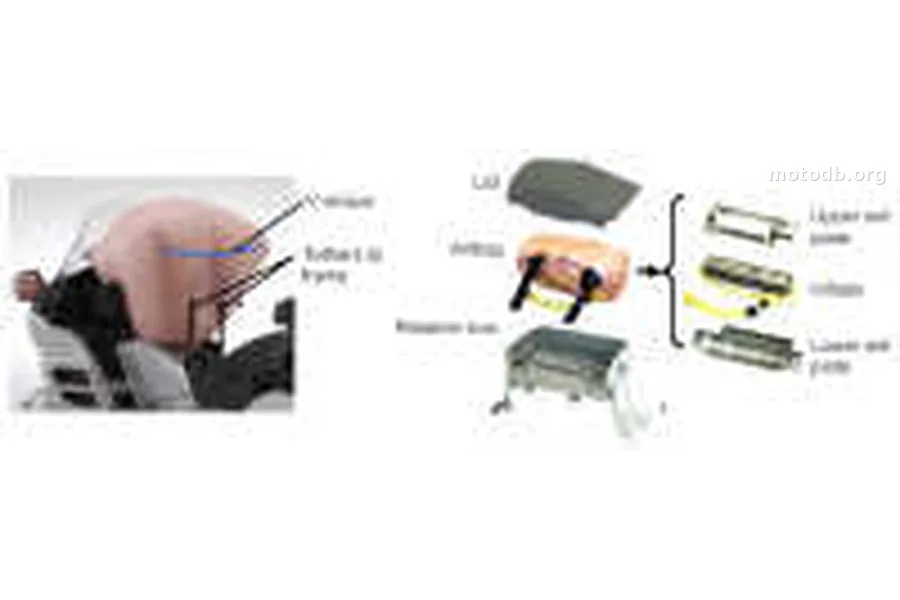
The project wasn't born of a marketing whim. Tokyo's engineers had spent a decade poring over accident statistics, and the verdict always landed in the same spot: frontal collision remains the most frequent scenario, and the deadliest. An initial prototype ran on a Goldwing 1500 in the late 90s, another on the Silverwing scooter in 2004, before the system finally reached series production on the GL 1800. The specification is rustic in principle, diabolical in execution: four sensors doubled up on the 45 mm fork tubes, a control unit that constantly compares signals against a reference table, and a cushion housed in the top of the tank that deploys in 0.15 second via a pressurized gas canister. Two straps hold it in place, its shape prevents the rider from slipping sideways, and the rest is pure physics, absorbing kinetic energy before the body meets the tarmac or the obstacle.
Mechanically, nothing revolutionary beneath the bodywork, but there's plenty to work with. The 1832 cc flat-six delivers 118 horsepower at 5500 rpm and above all 166.7 Nm of torque from 4000 revs, enough to haul the 417 kg wet weight out of any situation without making the five-speed gearbox break a sweat. The shaft drive does the job without drama, the aluminum twin-spar Diamond-type frame holds everything together, and the 740 mm seat remains accessible despite the heft. Facing a BMW K 1600 GTL or a Harley Electra Glide of the era, the Honda bets everything on velvet smoothness and on that safety argument nobody else can wield. Top speed of 200 km/h, 25-liter tank, long-haul range, the GL ticks every box for extended travel.
That leaves the question of the entry ticket. 31,990 euros in 2011, roughly 12 percent more than a standard Goldwing, the airbag comes at a real cost. On a motorcycle priced above 30,000 euros, the surcharge argument carries less weight than on a mid-range tourer, and Honda knows it full well. The target isn't the track rider or the urban commuter, still less the beginner who would shy away from such a monolith. We're talking here about the couple of fifty-somethings crossing Europe every summer, the graying road warrior stringing together 600-kilometer stages, in short the one for whom passive safety isn't a gadget but an investment.
With fifteen years of hindsight, the GL 1800 Airbag retains its status as a historical curiosity. Systems integrated into riding gear have since made the technology less exclusive, but Honda keeps the swagger of the pioneer, the one who dared when the others were looking elsewhere. Exclusivity, safety, technological lead, the invoice justifies itself according to each rider's sensibility. For a flagship designed to last 200,000 kilometers, it may not have been the worst of bets.
Standard equipment
- Assistance au freinage : Dual-CBS et ABS
Practical info
- La moto est accessible aux permis : A
Indicators & positioning
Similar bikes
1830 Challenger Venum
1830 Roadmaster Limited / Dark Horse
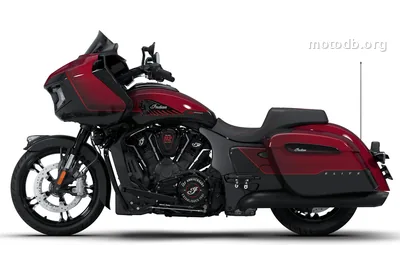
1830 Challenger 125th Anniversary Edition
Reviews & comments
No reviews yet. Be the first to share your opinion!