Key performance
Technical specifications
- Power
- 85.8 ch @ 7000 tr/min (62.6 kW) → 88.4 ch @ 7000 tr/min (65.0 kW)
- Torque
- 98.0 Nm @ 4750 tr/min → 98.1 Nm @ 4750 tr/min
- Engine type
- Twin, four-stroke → Bicylindre parallèle, 4 temps, calé à 270°
- Cooling
- Liquid → liquide
- Compression ratio
- 10.1:1 → 10.5 : 1
- Bore × stroke
- 91.0 x 81.5 mm (3.6 x 3.2 inches) → 92 x 81.5 mm
- Camshafts
- — → 1 ACT
- Fuel system
- Injection. PGM-FI with 34mm throttle bodies → Injection
- Valve timing
- Single Overhead Cams (SOHC) → —
- Ignition
- Computer-controlled digital transistorized with electronic advance → —
- Starter
- Electric → électrique
- Frame
- — → double berceau tubulaire en acier
- Gearbox
- 6-speed → boîte à 6 rapports
- Final drive
- Chain (final drive) → Chaîne
- Clutch
- Wet multiplate Hydraulic → —
- Front suspension
- 43mm telescopic fork → Fourche téléhydraulique Ø 43 mm
- Rear suspension
- Showa with pro-link system → 2 amortisseurs latéraux
- Front brakes
- Double disc → Freinage 1 disque Ø 330 mm, fixation radiale, étrier 4 pistons
- Rear brakes
- Single disc → Freinage 1 disque Ø 256 mm, étrier simple piston
- Front tyre
- 130/70-18 → 130/70-18
- Front tyre pressure
- — → 2.30 bar
- Rear tyre
- 180/65-16 → 180/65-16
- Rear tyre pressure
- — → 2.30 bar
- Seat height
- 700.00 mm → 710.00 mm
- Seat type
- — → Selle biplaces
- Wheelbase
- 1520.00 mm → —
- Ground clearance
- 120.00 mm → —
- Length
- 2240.00 mm → —
- Width
- 834.00 mm → —
- Height
- 1115.00 mm → —
- Weight
- 233.00 kg → 236.00 kg
- New price
- — → 12 099 €
Engine
- Displacement
- 1084 cc
- Power
- 88.4 ch @ 7000 tr/min (65.0 kW)
- Torque
- 98.1 Nm @ 4750 tr/min
- Engine type
- Bicylindre parallèle, 4 temps, calé à 270°
- Cooling
- liquide
- Compression ratio
- 10.5 : 1
- Bore × stroke
- 92 x 81.5 mm
- Valves/cylinder
- 4
- Camshafts
- 1 ACT
- Fuel system
- Injection
- Starter
- électrique
Chassis
- Frame
- double berceau tubulaire en acier
- Gearbox
- boîte à 6 rapports
- Final drive
- Chaîne
- Front suspension
- Fourche téléhydraulique Ø 43 mm
- Rear suspension
- 2 amortisseurs latéraux
Brakes
- Front brakes
- Freinage 1 disque Ø 330 mm, fixation radiale, étrier 4 pistons
- Rear brakes
- Freinage 1 disque Ø 256 mm, étrier simple piston
- Front tyre
- 130/70-18
- Front tyre pressure
- 2.30 bar
- Rear tyre
- 180/65-16
- Rear tyre pressure
- 2.30 bar
Dimensions
- Seat height
- 710.00 mm
- Seat type
- Selle biplaces
- Fuel capacity
- 13.60 L
- Weight
- 236.00 kg
- New price
- 12 099 €
Overview
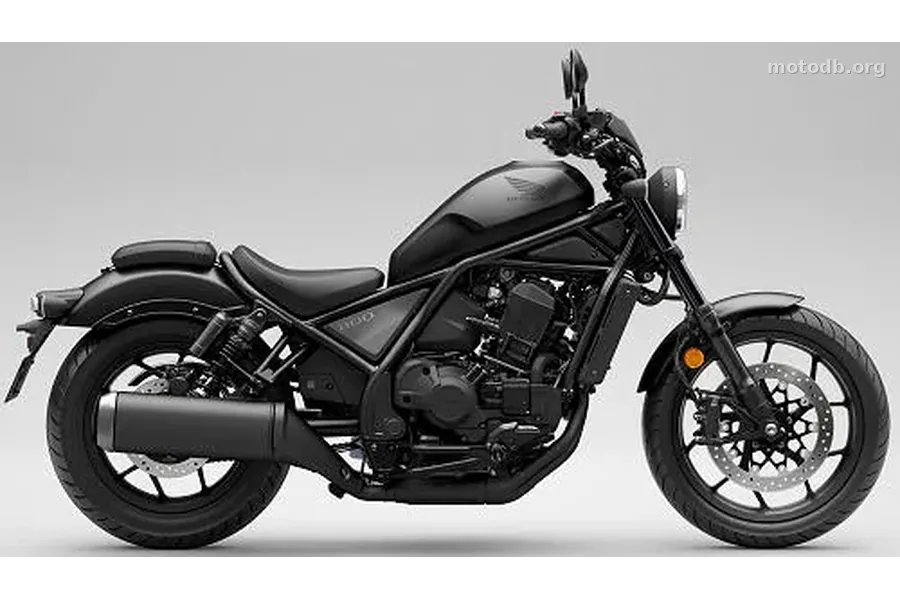
The big CMX may look Classic, with its bobber-like styling, but it remains attentive to the lures of technology. It now features a 5-inch color TFT dashboard. A screen poised to conquer much of the Honda lineup. The screen offers 3 display types (bar/circle/simple), essential data, and the ability to pilot your smartphone with the "RoadSync" app (music, notifications, calls, simplified navigation).
As it must comply with the E5+ standard, it leaves the technical staff to deal with its engine. Excellent idea: with a new sensor in the exhaust, adapted electronic management, and an increased compression ratio, the big Rebel gains 1.4 horsepower but, above all, a torque that is more present at low RPM. The DCT gearbox improves in smoothness at startup. Comfort is also part of the evolution plan. A 10 mm thicker seat with a new type of foam, a handlebar raised (12 mm) and brought closer (28 mm) to the rider, and footpegs advanced by 10 cm aim to provide a more relaxed riding position.
This shows that Honda has no intention of discontinuing the 1100 Rebel anytime soon. So much the better, because the machine is sufficiently atypical and appealing to warrant interest. A machine that goes against the grain of its segment. A big Rebel that has understood that it is no longer useful to imitate a Harley and dives into the spirit raised by the CMX 500.
Or by the 650 Vulcan S. A custom with a parallel-twin, a style that is not at all traditional and with a certain audacity. This time, Honda is forcefully playing with an 1100 twin to mark its presence as a difference...
…Its difference compared to classic customs! Because between the 500 and the 1100, it’s pure cloning. From the frame to the tank, from the seat to the face, from the quad-lens headlight to the single brake disc, it’s really the same suit. Just resized in XL. But you quickly realize that the man is of a different breed. The blackened fork looks more robust; the radiator occupies more space; and in the belly, you can guess a pulsating heart with a journey in the coronaries.
This engine has forged a good reputation… in a completely different area. If I tell you about a 1084 cm3 twin cylinder with Unicam technology for ACT (from the CRF motocross models), with a growling rumble and mud in the crankcases?! Jackpot! It’s the engine of the Africa Twin. Except to power a custom, you must greatly change the behavior. This is done with a 32% heavier crankshaft, a modified valve timing, adapted valve lift profiles, and recalibrated electronics. The result is undeniable: power values change significantly.
The 1100 announces 88.4 horsepower – 13.6 less than the big trail bike. But what interests us is when the watts are available. The maximum reaches 7500 rpm on the Africa Twin, while the Rebel reaches it 500 revolutions earlier. This is especially noticeable in terms of torque, a value more appreciated on a custom. With 10 mkg at 4750 rpm, we lose only 0.7 mkg while it takes 1500 rpm less to wring out all the grease from the pistons. Certainly, it’s not as generous as an H-D Softail 114 – but the American benefits from a much larger displacement. We repeat: the Japanese does not want to play in the same register.
By placing the Africa Twin engine, Honda has not only installed a modern and compact mechanical unit. It can also graft all the technology that goes with it. Especially its favorite weapon for comfort and transmission: the DCT. The CMX 1100 Rebel is thus the first custom in the world to receive a robotic gearbox, a double-clutch one at that. A boon for all those who want to cruise without asking questions. The left foot can rest comfortably. The rider simply selects the mode that suits them best: manual, using the switches on the left handlebar for changing gears – or fully automatic, simply by turning the throttle and letting the machine do the rest. According to 4 riding laws: - Standard: this favors higher gears when riding cool and plays on the first when teasing the throttle. - Rain: mainly high gears to prevent power from taking over. - Sport: the electronics allow the engine to rev higher and dynamically manage gears. - User: the rider chooses their own settings.
The DCT gearbox is now standard. Its cost in terms of price and weight (+ 10 kilos) is not insignificant, but usage can convince. Still in the electronics, the CMX 1100 is not stingy. It offers a speed regulator, a USB-C socket under the seat, HSTC traction control (revised in 2025), four riding Modes, and an anti-wheelie system. Uh… is that really useful on a custom? It’s not the 1520 mm wheelbase or the shape or function of the machine that will make you want to wheelie. Anyway. It’s true that with 233 kilos, the big Rebel is not very heavy in its category. Would that really be a motivation to scrape its metal fenders? No, more a criterion apt to reassure the concerned. Another appreciable point is the seat height, very accessible at 700 mm.
Well, let’s move away from the electronics, then. Let’s go back to the riding Modes, whose names are identical to those of the robotic gearbox. Each sets certain parameters to a determined level: - Standard: intermediate level for power, engine braking, traction control, and anti-wheelie. - Rain: low power and engine braking, high level of traction control and anti-wheelie. - Sport: dynamic engine behavior, normal engine braking, low level of intervention of traction control and anti-wheelie. - User: allows the rider to define custom settings. Once determined, the choices are automatically memorized.
On the meter, the CMX seems to go for simplicity with a round module, just like on the 500. Once lit, it’s a higher level. With the same LCD technology but a larger screen and smaller "pixels," the instrumentation gains in graphic quality and information displayed.
But what holds the engine and the wheels together is not all this silicon. It’s a frame, a decidedly non-traditional steel tube frame. If its scheme is identical to that of the 500, the 1100’s braces are tubes of a larger diameter (35 mm). With its long wheelbase, its wide 130/180 mm tires, and a fork angle of 30°, the machine clearly aims for stability and not too much agility. The manufacturer specifies that it can take 35° of lean angle on each side. What does that correspond to??? Well, the average of the sector; it scrapes well before a roadster.
The Big Rebel’s fork is indeed of a better make. Wider with its 43 mm, it also benefits from preload adjustment – like the two rear shock absorbers. At its feet, the braking system is far from making a splash: the 330 mm disc is pinched by a radial 4-piston caliper. ABS watches over it, as well as the single-piston jaw coupled to the 256 mm rear disc.
The time of the Shadow is long gone, very long. Japanese and Europeans have understood that it is useless to imitate Harley or Indian to conquer the custom market in our territory. Unlike the States where the offer is plentiful. Honda abandoned the big custom 10 years ago after the 1300 Fury (let’s not talk about the 1300 CTX episode). It returns with an Africa Twin heart in a bobber body and an exceptional level of technology for a custom. The CMX 1100 Rebel can receive various accessories, in the Street category to make it a scamp – or Tour to transform it into a bagger fluet. It is also possible to crack directly for the pseudo-road version, called Touring.
M.B - Photos manufacturer
Standard equipment
- Assistance au freinage : ABS
- Nombre de mode de conduite : 4
- Taille de l'écran TFT couleur : 12,70 cm / 5 pouces
- Régulateur de vitesse
- Boîte automatique
- Bluetooth
- Prise USB
- Contrôle de couple
- Contrôle anti wheeling
Practical info
- La moto est accessible aux permis : A
Reviews & comments
No reviews yet. Be the first to share your opinion!