Key performance
Technical specifications
Engine
- Displacement
- 999 cc
- Power
- 149.7 ch @ 11000 tr/min (110.1 kW)
- Torque
- 102.0 Nm @ 8750 tr/min
- Engine type
- 4 cylindres en ligne, 4 temps
- Cooling
- liquide
- Compression ratio
- 11.7 : 1
- Bore × stroke
- 76 x 55,1 mm
- Valves/cylinder
- 4
- Camshafts
- 2 ACT
- Fuel system
- Injection Ø 44 mm
- Lubrication
- Wet sump
- Ignition
- Computer controlled digital transistorized
- Starter
- électrique
- Euro standard
- Euro 5+
Chassis
- Frame
- type diamant en acier
- Gearbox
- boîte à 6 rapports
- Final drive
- Chaîne
- Clutch
- Wet, multiplate, assisted slipper clutch
- Front suspension
- Fourche téléhydraulique inversée Ø 41 mm EERA, déb : 130 mm
- Rear suspension
- Mono-amortisseur EERA, déb : 144 mm
Brakes
- Front brakes
- Freinage 2 disques Nissin Ø 310 mm, fixation radiale, étrier 4 pistons
- Rear brakes
- Freinage 1 disque Nissin Ø 240 mm, étrier simple piston
- Front tyre
- 120/70-17
- Rear tyre
- 180/55-17
Dimensions
- Seat height
- 825.00 mm
- Seat type
- Selle biplaces
- Wheelbase
- 1465.00 mm
- Ground clearance
- 135.00 mm
- Fuel capacity
- 21.00 L
- Weight
- 241.50 kg
- New price
- 13 999 €
Overview
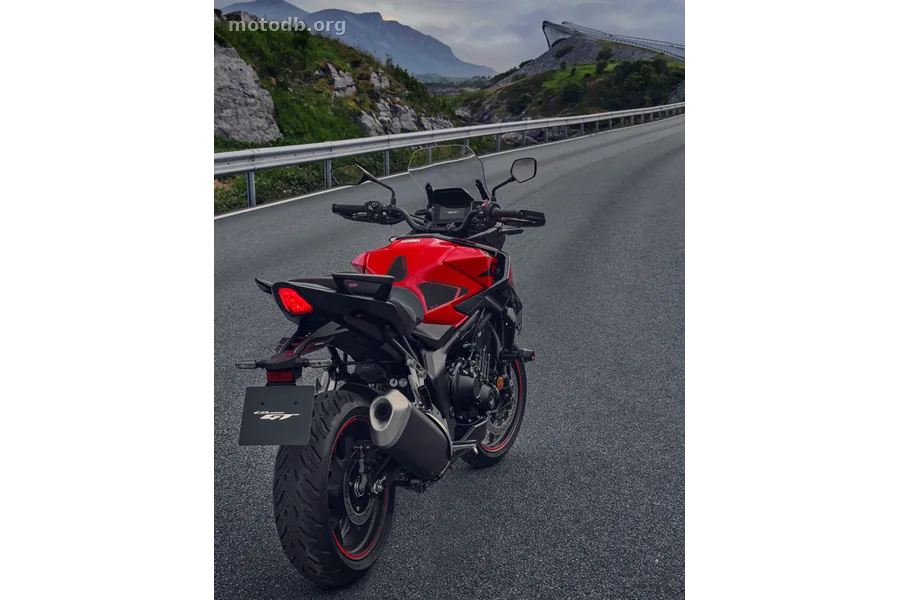
The Honda CB 1000 GT is opening a new domain for Honda: the sport-touring-GT trail. The competition has clearly understood the interest in this segment, where hooliganism wants to mix with touring with a false adventurer look. Here, it smells of gravel, the highway, and footpeg scraping. More like surprising comfort.
Honda’s touring expertise, we know and master it: the luxury and grandeur of the Gold Wing, the pragmatism of the NT 1100 – now the incisive CB 1000 GT. Although derived from the 1000 Hornet, the GT exudes its own personality… and what a personality! With flint on the cheeks, the headlamp cowl is surprisingly expressive for a Honda. Bellicose even. Although its eyes are the same as those of the Hornet, the fairing around them doesn’t hesitate to remind us of the CBR range. It’s taut, bulging, provocative – it wants to assert itself from the start as a threat.
Mounting up. The cockpit volumes announce a protection level more than correct. The adjustable bubble, the prominent tank shoulders, and small deflectors around the radiator will spare your torso from external meanders.
However, the handguards are only there to provoke a crossover style. Enough to divert air from a phalanx and little more. Extensions are planned in the accessories corner.
The higher handlebars and more substantial seat (+ 15 mm) are much more welcoming than on the Hornet. It’s mainly the passenger who will feel the difference: the rear reserves a real seat, much wider, larger, and more padded by almost 4 cm, with large handles and much lower footrests. Here, the duo is not an option but is part of the specifications.
Buzzing in the category, the machine is quickly identifiable as a derivative of the large Hornet. A healthy, muscular, and convincing base, of which this 3rd derivative significantly expands the scope of action. The chassis evolves judiciously in this direction, with a lengthened rear frame to give more space for the crew, and reinforcement to support cases on the sides.
It is also endowed with stability, with a longer swingarm of 16 mm. The technical data informs us of a little more drag, a steering angle maintained at 25° and a wheelbase increased; it is clear, this Hornet-GT clearly aims for a calmed road behavior but sufficiently taut to darken the gaze when curves appear at aperitif time.
A good dose of watts with the engine? The 4-cylinder has it in the pistons. Retuned in its electronic management for more smoothness and power at mid-range, it delivers barely less horsepower than in the Hornet. 150 instead of 152, that is negligible and will both allow you to maintain a sustained pace even when fully loaded, to unleash the powder if necessary, and to never lack breath. The torque also drops slightly, with 102 Nm, or 2 less, but who will feel it?!
The gearbox is also reworked, its 2nd, 3rd, 4th and 5th gears being readjusted to the engine power while the sixth is calibrated for highway pretension. An overdrive, in fact. Added to this is, for greater comfort, an Up&Down shifter and an anti-dribble clutch, for less effort on the left lever and a digestion of the torque return to the rear wheel.
It is a domain where the CB 1000 GT will score big points: equipment! As standard, the equipment surprises and delights us with its generosity for a "roadster" with fairing:
There is not much to add.
As the price follows the same policy as for the Hornet, i.e. surprising and aggressive, this GT could upset the cards of the sport-touring roadster and crossover sector.
PGM-FI injection, Up&Down shifter, ride-by-wire... the beginning of the electronic trim of this CB1000GT. The same as the 1000 Hornet from which it is derived; even a little more. Like the neo-retro CB1000F, it gains an IMU 6-axis inertial unit (which the Hornet lacks and will lack until its first evo). A little gadget that gives a lot of information to the traction control... pardon, HSTC to make it more effective at the angle, just like the ABS which becomes cornering.
The active safety and character of the GT are also supervised by 5 Riding Modes (Standard / Sport / Rain / Tour / User, customizable), the power level and the engine braking management. They like the HSTC are adjustable on 3 levels each.
With the GT label on the flanks, you have to be prepared to do some miles. Predisposition, a lot; being accommodating, great preference. A more important autonomy is customary, which will be made possible by the 4 liters of extra in the tank, with 21 liters of thirst.
Let's add to the loading of the semi-active suspensions. Faithful to the Showa house (of which Honda owns a part), the winged manufacturer installs an inverted 41 mm fork and an EERA technology shock absorber. The system adjusts compression and rebound based on instructions sent by the IMU, the engine ECU, and the front fork travel sensor. It can also adjust the rear preload spring but for the front, you have to take out the tools.
EERA offers 5 suspension modes, to be manipulated according to desires. "Standard" for not messing around and suitable for all uses; "Rain" when it's slippery or delicate, with very softened damping; "Sport" calibrates the suspensions to the maximum of stability; "Tour" concretizes the journey with the firmest setting; and finally "User" lets you parameterize your own salad of settings.
For the brakes, and given its vocation, the GT has not retained the Brembo Stylema from the Hornet SP but the more common Nissin 4-piston from the standard model. Less violent, less sporty, they better suit the label of this machine. There is already enough to do good work, the action of the Japanese calipers and 310 mm discs being serious in their action. They will have to stop or calm 229 kilos of carcass; 18 more than the Hornet, or the weight of a Brittany spaniel. Let's be a little more precise: 229 kilos full + 12.5 kilos of cases, which brings the balance to 241.5 kilos.
Honda needed a crossover to fight in the nervous supertrail-GT segment. The manufacturer had already tried it by transforming the VFR 1200 into a Crosstourer in the 2010s, with mixed success. Some may see this as the return of the CBF 1000 F; but this distant descendant is of a whole different caliber.
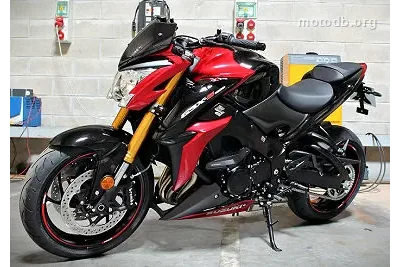
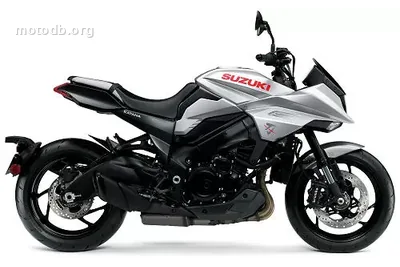
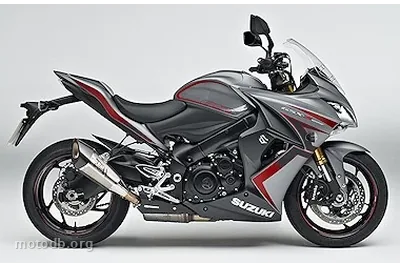
This time, the arguments are more impactful, bringing to the market a rival for the S 1000 XR and GSX-S 1000 GX, a little more reasonable and with a large dose of equipment. Somewhere, the CB 1000 GT presents itself as the Tracer 10 that Yamaha never created; that some, many, have hoped for.
M.B. - Photos manufacturer
The USER mode allows the driver to choose between the settings for each parameter and save the parameter for later use.
Standard equipment
- Assistance au freinage : ABS
- Nombre de mode de conduite : 5
- Volume de rangement : 65 litres
- Taille de l'écran TFT couleur : 12,70 cm / 5 pouces
- Jantes aluminium
- Indicateur de vitesse engagée
- Bluetooth
- Prise USB
- Contrôle de couple
- Contrôle anti wheeling
- Embrayage anti-dribble
- Contrôle du frein moteur
- ABS Cornering
- Shifter
- Régulateur de vitesse
- Poignées chauffantes
- Centrale inertielle
- Pare brise réglable
- Béquille centrale
- Valises
- Démarrage sans clé
Practical info
- La moto est accessible aux permis : A
Reviews & comments
No reviews yet. Be the first to share your opinion!