Key performance
Technical specifications
Engine
- Displacement
- 999 cc
- Power
- 123.7 ch @ 9000 tr/min (91.0 kW)
- Torque
- 103.0 Nm @ 8000 tr/min
- Engine type
- 4 cylindres en ligne, 4 temps
- Cooling
- liquide
- Compression ratio
- 11.7 : 1
- Bore × stroke
- 76 x 55,1 mm
- Valves/cylinder
- 4
- Camshafts
- 2 ACT
- Fuel system
- Injection Ø 36 mm
- Lubrication
- Wet sump
- Ignition
- Computer controlled digital transistorized
- Starter
- électrique
- Euro standard
- Euro 5+
Chassis
- Frame
- type diamant en acier
- Gearbox
- boîte à 6 rapports
- Final drive
- Chaîne
- Clutch
- Wet, multiplate, assisted slipper clutch
- Front suspension
- Fourche téléhydraulique inversée Ø 41 mm, déb : 130 mm
- Rear suspension
- Mono-amortisseur, déb : 140 mm
Brakes
- Front brakes
- Freinage 2 disques Nissin Ø 310 mm, fixation radiale, étrier 4 pistons
- Rear brakes
- Freinage 1 disque Nissin Ø 240 mm, étrier simple piston
- Front tyre
- 120/70-17
- Rear tyre
- 180/55-17
Dimensions
- Seat height
- 795.00 mm
- Seat type
- Selle biplaces
- Wheelbase
- 1455.00 mm
- Ground clearance
- 135.00 mm
- Fuel capacity
- 16.00 L
- Weight
- 214.00 kg
- New price
- 12 099 €
Overview
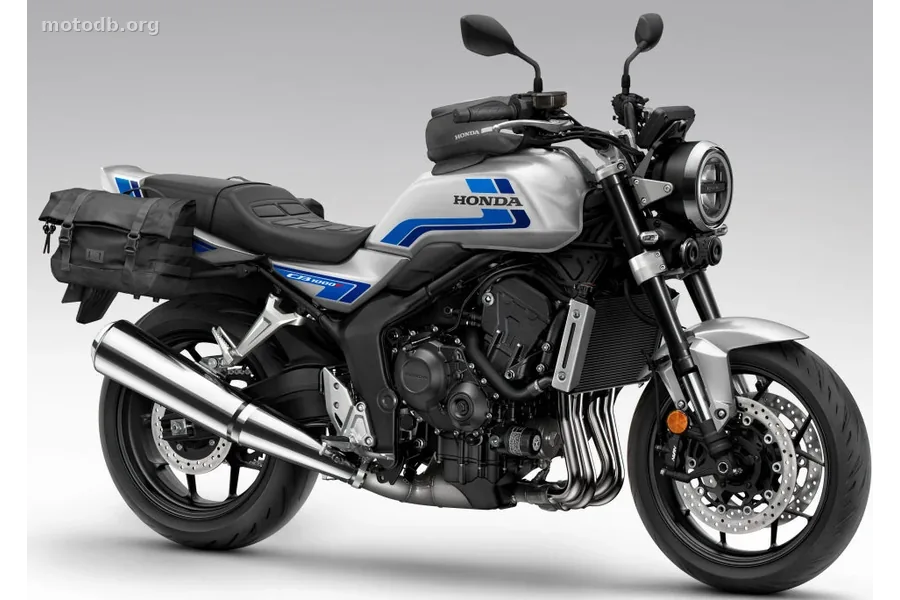
Each brand has its iconic model, the one associated with it forever. For Triumph, it’s the Bonneville; for Ducati, the strongest image is the 916; for Suzuki, the GSX-R; for Moto-Guzzi, the V7; etc., etc. For Honda, the memory instinctively turns to the 1969 CB 750 Four. But when creating its new neo-retro, it wasn’s this model that served as inspiration. Designers delve a decade later, to refresh the CB 750 F / CB 900 F from the 1980s and propose the CB 1000 F of 2026.
It matches that large CB well. With its round headlight, its soft lines typical of another era, its vintage décor, the two horns neatly aligned under the headlight, its megaphone exhaust pipe much more stylish than the Hornet’s bowl, and its faux appearance of an old roadster, today’s CB 1000 F can proudly pose in the family photo with its grandmothers. The lineage will be evident, the nod emphasized, and nostalgia sprinkled.
Then, very quickly, the technical power grabs attention and brings you back to the 21st century. There’s no question of using an air-cooled engine to lock in the retro atmosphere as the Bonneville family or the Ducati Scrambler know how to do so well. Here, modernity speaks: a recent 4-cylinder water-cooled engine, a color TFT screen, radial braking, a steel diamond frame. Oh oh, it smells strongly of the 1000 Hornet underneath.
This reassures us on several points. The large Hornet laid down new foundations, with big-bore power for a reasonable price without having a downgraded motorcycle. This cousin CB 1000 F should therefore be attractive, both for a 1000 and for its segment. Next, the motorcycle is well born, which will naturally result in the neo-retro. However, it won’t behave the same way.
Already by the riding position. With a higher and more rearward handlebar, a long-span seat, and a real place for the passenger, the CB revival promises to be more comfortable and less bellicose. Then by its mechanics!
If the F and the Hornet share the same 4-cylinder borrowed from the CBR 1000 RR of 2017, the engine specialists wanted to give it a character more in line with the spirit and silhouette of the retro. To do this, many small modifications have been made: revision of the camshafts, lengthened intake duct by 50 mm to 140 mm, 36 mm injection instead of 42 mm, different conduit sections on the right and left, modified airbox, retouched gearbox with the two first gears shortened – This work allows to give more torque and character at low and mid-range.
After all that, the block is brought back to 123.7 horsepower at 9,000 rpm. The torque loses only 1 Nm, with a maximum at 103 Nm. The loss of 28 horsepower compared to the 1000 Hornet is perfectly assumed: this motorcycle does not seek the frenetic riding of a streetfighter and does not intend to deliver its power like it, with that desire to express the best of itself at high rpm. The maximum power of the CB 1000 F, as well as the torque, are obtained well before hysteria: 2,000 rpm earlier for the watts and 1,000 rpm less for its 10.5 mkg. Here, muscle wants to express itself lower, with more consistency.
The machine benefits from technical consanguinity to recover the electronics of the Hornet... and even a little more. An inertial unit makes its appearance, while the big hornet is not equipped with it. This allows for cornering ABS and makes the HST torque control sensitive to the angle.
The CB 1000 F therefore incorporates a set of driving aids that is provided but not excessive, consisting of 3 levels of power, 3 also for the engine braking, still 3 for the torque control (disconnectable), anti-wheelie and stoppies, and 5 Riding Modes* to top it all off. Modes proven in the range, with three pre-set selections in the factory that are Standard, Sport, and Rain; plus two customizable maps by the pilot to make his own Modes.
Economies of scale are good for the wallet but not necessarily for the look in some areas. Although.... there is room for reflection. Take, for example, the wheels. Spoked wheels always make a great effect on a neo-retro. But the CB 1000 F is not entitled to them. If that were the case, the price would have taken another slap. Also, the speedometer. It’s a shame to recover the color TFT screen of all recent Hondas. Some would have appreciated a nice set of needle gauges, like the CB 1300 from Japan, the Kawa Z 900 RS, these models with a sweet scent of the last century... It moves better in terms of nostalgia. But really a shame? Because with the 5-inch modern and tech’ screen, the pilot has access to three types of display, can connect the smartphone and manage his calls, listen to music, use the RoadSync app add-ons, and navigate the menus to parameterize the character of the motorcycle by tickling the backlit left joystick. Which launches the debate of which is better?
Ah, no need to take out the key, the F is equipped with a Keyless system.
As you might guess, if there’s the engine and electronics of the 1000 Hornet, there’s also its chassis. That’s not a problem seen as it does a very good job. Same wheelbase, same steering head angle, almost the same weight (214 kg or 3 more), same tire size, same frame, same braking: the assembly line will not see differences. Except for the suspensions, which benefit from settings adapted to its prerogatives; and where the shock absorber is anchored to the Pro-link with a specific linkage. Above, the rear cradle is modified to offer more space for the duo.
So, everything else is the same? Yes, the steel tube frame, the Nissin brakes with 310 mm discs and radial 4-piston calipers, the Showa SFF-BP inverted fork adjustable everywhere, hoses not necessarily well placed, aluminum swingarm, 17-inch wheels. But at first glance, it’s not so obvious. Oops, I almost forgot a detail: the brake hose expansion rates have been revised.
At the beginning of the neo-retro craze, Honda did try to ride the wave but without really seizing it. The CB 1100 R and EX were excellent machines but did not find their audience. Today, the sauce takes much better with the CL 500 and its interesting GB 350 S. With the CB 1000 F, the level of performance is much higher, which could trigger a more significant success. Moreover, the price plays the game, contenting itself with a reasonable inflation compared to the Hornet. Better placed from the start than the Z 900 RS (which has disappeared from the catalog), much better than the Z 900 RS SE, well below a Triumph 1200 Bonneville or Speed Twin. There will be the XSR 900 to tickle its behind but with a very different engine architecture and character. Start of the match in March 2026, date when the CB1000F will be available.
M.B. - Photos manufacturer
Standard equipment
- Assistance au freinage : ABS
- Nombre de mode de conduite : 5
- Taille de l'écran TFT couleur : 12,70 cm / 5 pouces
- Jantes aluminium
- Indicateur de vitesse engagée
- Bluetooth
- Contrôle de couple
- Contrôle anti wheeling
- Embrayage anti-dribble
- Contrôle du frein moteur
- ABS Cornering
- Démarrage sans clé
- Centrale inertielle
- Contrôle anti stoopi
Practical info
- La moto est accessible aux permis : A
- Pays de fabrication : Japon
Reviews & comments
No reviews yet. Be the first to share your opinion!