Key performance
Technical specifications
Engine
- Displacement
- 999 cc
- Power
- 152.0 ch @ 11000 tr/min (111.8 kW)
- Torque
- 104.0 Nm @ 9000 tr/min
- Engine type
- 4 cylindres en ligne, 4 temps
- Cooling
- liquide
- Compression ratio
- 11.7 : 1
- Bore × stroke
- 76 x 55,1 mm
- Valves/cylinder
- 4
- Camshafts
- 2 ACT
- Fuel system
- Injection Ø 44 mm
- Starter
- électrique
- Euro standard
- Euro 5+
Chassis
- Frame
- Double poutre en acier
- Gearbox
- boîte à 6 rapports
- Final drive
- Chaîne
- Front suspension
- Fourche téléhydraulique inversée Ø 41 mm, déb : 118 mm
- Rear suspension
- Mono-amortisseur, déb : 138 mm
Brakes
- Front brakes
- Freinage 2 disques Nissin Ø 310 mm, fixation radiale, étrier 4 pistons
- Rear brakes
- Freinage 1 disque Nissin Ø 240 mm, étrier simple piston
- Front tyre
- 120/70-17
- Rear tyre
- 180/55-17
Dimensions
- Seat height
- 809.00 mm
- Seat type
- Selle biplaces
- Fuel capacity
- 17.00 L
- Weight
- 211.00 kg
- New price
- 10 599 €
Overview
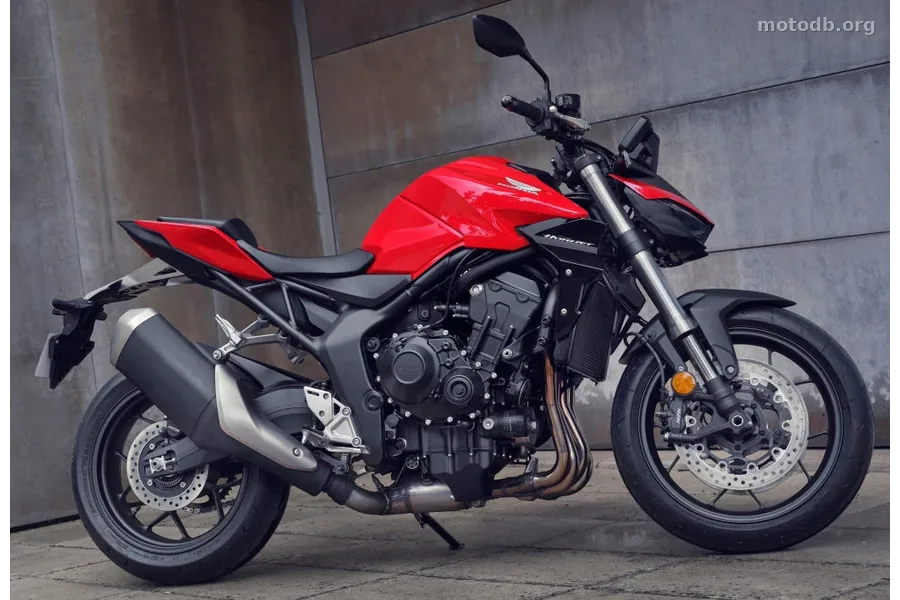
Honda has struck hard with its 1000 Hornet! As in the early 3000s, the manufacturer's goal is to capitalize on the popularity of the Hornet name. Sadly for the world's number one manufacturer, the 900 Hornet had not enjoyed success, due to a reputation for a wandering front end.
Today, the market for large roadsters has become elitist, following the same technical foundations as superbikes; motorcycles have become expensive and are becoming rare on our roads. The renewed interest of buyers in adventure bikes is not entirely unrelated to the lack of interest in these streetfighters. Because it is within this category that the new Hornet 1000 fits, let's see why.
A heart of thunder… 2017 version
To offer the most powerful Hornet ever produced to date, Honda has grafted the 4-cylinder in-line engine from the impressive CBR1000RR Fireblade into a new steel double-beam frame.
But it’s not the latest generation Fireblade that serves as the engine donor. Honda has taken the basics of the 2017 model. It is a 16-valve, double overhead camshaft 1000 cc 4-cylinder engine claiming 111.6 kW (152 hp) at 11,000 rpm and 104 Nm at 9,000 rpm. A powerful engine already, but more reasonable than the demagogic fire pumps – competition it doesn’s aim to compete with. Honda more often plays pragmatism than madness.
However, Honda specifies that engineers have revised the engine’s character to offer more flexibility and low-end torque at intermediate revs. The transmission has also been modified (probably shortened) so that the 2nd, 2nd, 3rd, 4th and 5th gears prioritize acceleration (according to the press release), while the 6th gear sprocket has been sized for cruising on the highway. You will note that to unleash the engine, Honda did not deem it appropriate to retain a standard quick shifter… probably to limit the price. The gearbox is supported by a slipper clutch that will prevent rear wheel lock-up during downshifts at high revs. Ultimately, this engine claims a consumption of 5.9 l/100 km (WMTC), or an autonomy of approximately 290 km with the 17 l contained in the tank.
State-of-the-art electronics, Honda’s specialty
This Hornet 1000 features: - 3 default riding modes, 2 user-programmable modes - 3 levels of power and engine braking - 4 levels of torque control (HSTC) and anti-wheelie Thanks to an electronic throttle TBW (Throttle By Wire), Honda offers 3 pre-defined riding modes (Standard / Rain / Sport) each offering specific combinations between power, engine braking and torque control / anti-wheeling, plus 2 USER modes that allow the owner to create 2 completely personalized modes. Selection between modes is performed from the left handlebar command and the TFT screen.
In detail, it is possible to enjoy 3 levels of power (P) and engine braking (EB), as well as 4 levels for the HSTC torque control system, which can be disconnected; for possible track use? STANDARD for everyday use This mode responds to most situations with an intermediate level for power, engine braking and torque control. Power is softened on the first two gears, while performance is slightly attenuated compared to SPORT mode, with torque reduced when the throttle is partially or fully open.
SPORT Performance is delivered without limitation, engine braking and torque control are at their minimum to fully enjoy the power and torque on the 6 gears, regardless of the throttle opening.
RAIN The power setting is at its minimum for the least aggressive engine behavior possible. Engine braking is at the intermediate level while torque control intervention is maximum. Power and torque limitation is concentrated on the first 3 gears.
Optimized chassis, farewell monobras
While Honda has created a new chassis and has not simply taken over the cycle part of the CB1000R "neo-sport-cafe" (its predecessor in the 1000 cc range), we already regret that Honda has not retained what has often been the signature of the winged brand: a monobras. Instead, there is a traditional aluminum swingarm, with a length of 619.1 mm. With its double-beam architecture designed to integrate the engine, the torsional rigidity of this frame is increased by 70% compared to that of the CB1000R 2023. Another important detail, the engine mounts at the rear are designed to limit vibrations and promote feedback to the rider. The rake and trail are respectively 25° and 98 mm with a wheelbase of 1,455 mm. To increase the agility of the motorcycle and avoid dead weight in corners, Honda specifies that it has reflected on maximizing the position of the rear damper, battery and engine relative to the frame. This arrangement leads the airbox to be located above the cylinder head rather than behind it. Ultimately, the mass distribution is 51.2% on the front and 48.8% on the rear, with a total curb weight of 211 kg. The Showa Separate Function Fork Big Piston (SFF-BP) inverted fork with a ø 41 mm is fully adjustable (preload, compression and rebound). The Showa shock is no exception and offers adjustments for preload and rebound.
Braking is provided, at the front, by a radial master cylinder that controls 2 Nissin 4-piston calipers with a radial mounting. The discs are floating, 310 mm in diameter. At the rear, the CB1000 Hornet relies on a single-piston Nissin caliper that bites a 240 mm disc. Equipped with ABS, of course, the 1000 Hornet also has an automatic emergency brake light. The wheels are 5 Y-spoke aluminum cast, they receive tires of 120/70-ZR17 at the front and 180/55-ZR17 at the rear.
A style that fits the hornet
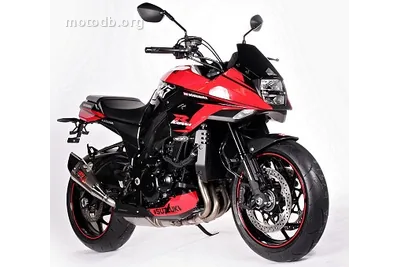
The design of this new 1000 Hornet quite matches the spirit of the small insect that forged the reputation of the 600 roadsters (then 750 at Honda). This time, we even have the impression that the design office set themselves the challenge of mimicking the hornet as closely as possible. The front is made up of a generous head and the body is well in two parts, consisting of the tank / engine block and then the rear fairing. The optical unit is a mask positioned quite low and equipped with two LED fauxs. Some may be annoyed by a certain resemblance to the front of the old Kawasaki Z 1000, but one cannot deny its appreciable aggressiveness. The tank seems well hollowed out at the level of the thighs / knees to be part of the motorcycle.
On the fork head, we find a 5-inch color TFT screen that seems very exposed. The display is configurable between the "bar", "circle" or "simple" modes while the Honda RoadSync application (free) allows you to use the functionality of a phone as for navigation, listening to music or making calls using a Bluetooth intercom. The screen functions are accessible from a new backlit 4-axis command located on the left handlebar.
To personalize their motorcycle, future owners will be able to choose from the option catalog or equip their motorcycle with one of the packs provided by Honda: Style, Sport and Comfort.
Style Pack: - Alcantara rider seat - Oil filler cap - Handlebar risers - Radiator grille - Rider footrests - Rim stickers
Sport Pack: - Quickshifter up and down - Windscreen - Engine belly pan - Passenger seat cover - Tank protection
Comfort Pack: - Heated grips - Tank bag - Saddlebag
Behind its sporty appearance, the new Hornet 1000 will undoubtedly not be the most exclusive roadster on the market. If it looks like it, its target is clearly not a Ducati Streetfighter with which it cannot compete either in power or in lightness. Honda is undoubtedly more likely to overshadow the GSX-S1000 and Streetfighter V2, while positioning itself as the ideal compromise between mid-size (Street Triple, MT-09, Z 900, etc.) and stratospheric performance hyperfighters. The manufacturer has launched a formidable offensive with a floor price: the 1000 Hornet requires only 10,559 euros. An absolutely crazy and incredibly accessible price for a motorcycle of this caliber. A success or a tidal wave for the big hornet?!
The CB1000 Hornet will be available in the following colors: Red, Matte Gray or White. A SP version accompanies it, with Brembo Stylema brakes, an Öhlins shock, a shifter and 5 extra horsepower.
Vincent Beaucousin - Photos manufacturer
Standard equipment
- Assistance au freinage : ABS
- Nombre de mode de conduite : 5
- Taille de l'écran TFT couleur : 12,70 cm / 5 pouces
- Jantes aluminium
- Indicateur de vitesse engagée
- Bluetooth
- Prise USB
- Contrôle de couple
- Contrôle anti wheeling
- Embrayage anti-dribble
- Contrôle du frein moteur
Practical info
- La moto est accessible aux permis : A
- Pays de fabrication : Japon
Reviews & comments
No reviews yet. Be the first to share your opinion!