Key performance
Technical specifications
Engine
- Displacement
- 1690 cc
- Power
- 78.0 ch @ 5250 tr/min (57.4 kW)
- Torque
- 131.4 Nm @ 3250 tr/min
- Engine type
- Bicylindre en V à 45°, 4 temps
- Cooling
- par air
- Compression ratio
- 9.6 : 1
- Bore × stroke
- 98.4 x 111.1 mm
- Valves/cylinder
- 2
- Fuel system
- Injection
Chassis
- Frame
- Double berceau tubulaire en acier
- Gearbox
- boîte à 6 rapports
- Final drive
- Courroie
- Front suspension
- Fourche telescopique Ø 41 mm, déb : 129 mm
- Rear suspension
- 2 amortisseurs sous le moteur, déb : 103 mm
Brakes
- Front brakes
- Freinage 1 disque Ø 300 mm, étrier 4 pistons
- Rear brakes
- Freinage 1 disque Ø 292 mm, étrier 2 pistons
- Front tyre
- 140/75-17
- Front tyre pressure
- 2.48 bar
- Rear tyre
- 200/55-17
- Rear tyre pressure
- 2.90 bar
Dimensions
- Seat height
- 690.00 mm
- Fuel capacity
- 18.90 L
- Weight
- 331.00 kg
- Dry weight
- 318.00 kg
- New price
- 21 090 €
Overview
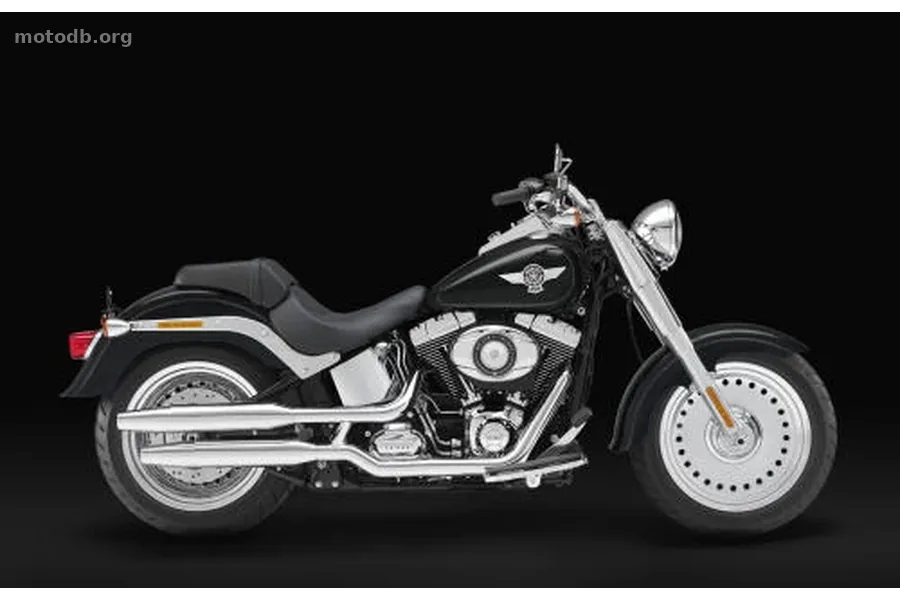
Does a motorcycle embody a myth on its own? With the Softail Fat Boy, Harley-Davidson answered yes more than twenty years ago, and hammered that point home on film in the hands of a certain Terminator. Today, in 2015, it remains the archetype of the American custom, a two-wheeled statement that speaks louder than its 78 horsepower. Because yes, with a large 1690 cm3 twin cylinder engine, one would expect staggering power. But at Harley, grandeur is measured in Newton-meters, not horsepower. And there, with its 131.4 Nm of torque available from 3250 rpm, the Fat Boy pins you in the back with the authority of a locomotive.
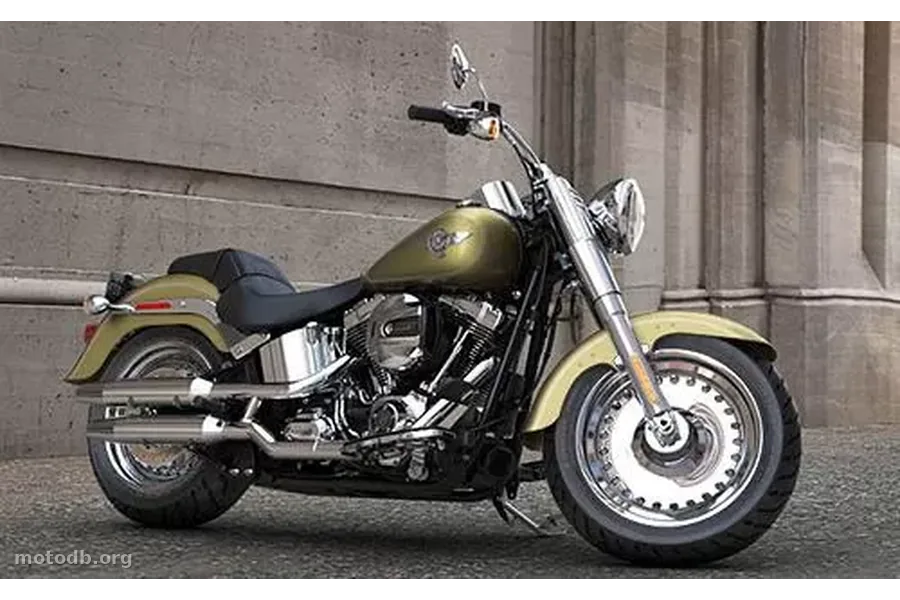
This sensation of mass in motion, you feel it before you even start. Seated 69 cm from the ground, arms stretched out on a wide handlebar, you dominate a minimalist dashboard and chromed cylinder heads. The silhouette is timeless, with its full wheels and 200 mm rear tire that gives the impression that the motorcycle is carved from a block of steel. The secret of the Softail, this faux rigid frame that hides the shock absorbers, still works just as well for the eye, even if, at 331 kg fully fueled, we no longer talk about agility. It's a barge, an ocean liner of the boulevards that dictates its tempo. Tight turns are to be avoided, under penalty of scraping the wide footpegs like surfboards, but in a straight line, it exudes absolute serenity.
The major evolution comes from the Twin Cam 103 engine, which replaced the old 1450. It’s not a power revolution, but a maturation. The torque is more present, the vibrations better contained by a balancer, and the motorcycle seems to breathe with greater ease. The real progress, and it was necessary, is at the level of braking. Harley has finally taken the bull by the horns: front disc increased to 300 mm, revised caliper, and above all a master cylinder that reduces lever effort by nearly half. The standard ABS finally becomes a credible ally to calm these 300 kilos of inertia. It’s far from the precision of a radial Japanese braking system, but it’s a giant step for Milwaukee.
Who is this machine for? Certainly not the hurried track rider or the intimidated beginner. At 21,000 euros, the Fat Boy is an object of passion, purchased by those who seek the posture, the raw sensation, and the deep sound, much more than pure performance. It’s a motorcycle that is lived more than it is ridden, a mechanical sculpture that rolls. It is heavy, slow compared to its more lively Japanese custom competitors, and its 19-liter tank imposes frequent stops. But it possesses what others will never have: that aura, that weight of history, and that goofy smile you will wear while making its V-Twin rumble in a tunnel. It’s illogical, imperfect, and totally irresistible.
Standard equipment
- Assistance au freinage : ABS de série
Practical info
- Véhicule accessible au permis A2 ou bridable à 47.5ch / 35 Kw
- La moto est accessible aux permis : A, A2
Indicators & positioning
Similar bikes
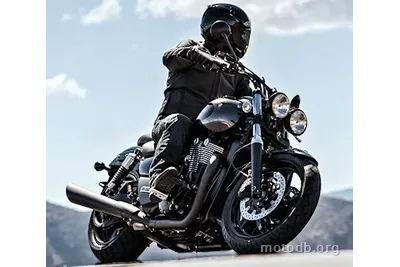
Thunderbird Nightstorm
Reviews & comments
No reviews yet. Be the first to share your opinion!