Key performance
Technical specifications
Engine
- Displacement
- 349 cc
- Power
- 20.0 ch @ 6100 tr/min (14.7 kW)
- Torque
- 27.0 Nm @ 4000 tr/min
- Engine type
- Monocylindre, 4 temps
- Cooling
- par air
- Compression ratio
- 9.5 : 1
- Bore × stroke
- 70 x 90 mm
- Valves/cylinder
- 2
- Camshafts
- 1 ACT
- Fuel system
- Injection
- Starter
- électrique
Chassis
- Frame
- double berceau tubulaire en acier
- Gearbox
- boîte à 5 rapports
- Final drive
- Chaîne
- Front suspension
- Fourche téléhydraulique Ø 41 mm, déb : 130 mm
- Rear suspension
- 2 amortisseurs latéraux, déb : 80 mm
Brakes
- Front brakes
- Freinage 1 disque Ø 300 mm, étrier 2 pistons
- Rear brakes
- Freinage 1 disque Ø 270 mm, étrier simple piston
- Front tyre
- 100/90-19
- Front tyre pressure
- 2.20 bar
- Rear tyre
- 140/70-17
- Rear tyre pressure
- 2.20 bar
Dimensions
- Seat height
- 765.00 mm
- Fuel capacity
- 15.00 L
- Dry weight
- 191.00 kg
- New price
- 4 990 €
Overview
When Royal Enfield releases a "Supernova" version of its Meteor 350, you almost expect fireworks. The reality is more nuanced, and that's precisely where the honesty of the proposition lies. This small 349 cc cruiser makes no attempt to dazzle: it embraces its vocation as a leisurely tourer with a straightforwardness that commands respect.
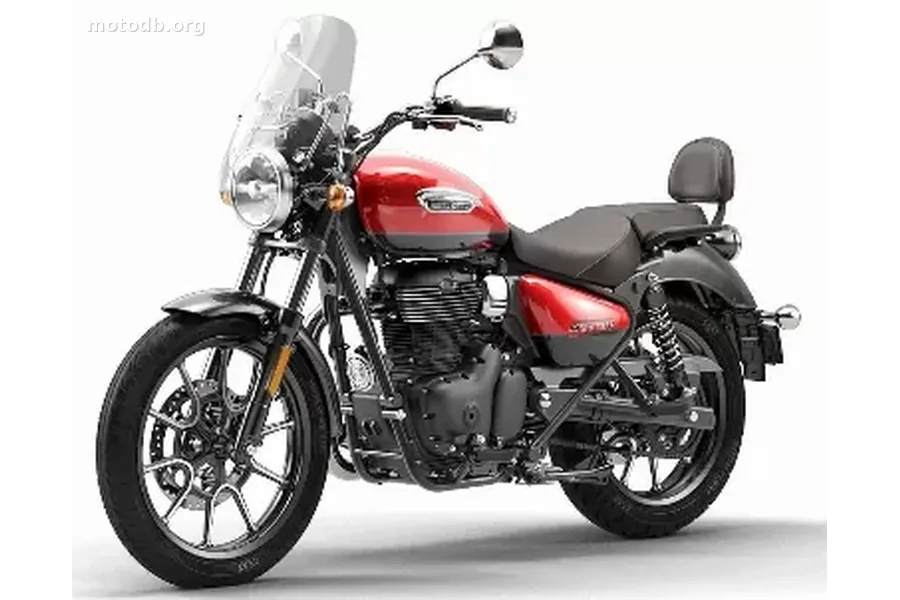
The Supernova sits at the top of the Meteor range, which translates concretely into carefully crafted two-tone color schemes, more attentively finished wheels, and comfort-oriented equipment: a sissy bar and touring screen fitted as standard. For €4,990, you get a motorcycle dressed for the road, not stripped down to sell. Compare it with a KTM 125 Duke in the same price bracket, and the logic becomes immediately apparent: here you're paying for cubic centimeters, not for sporty marketing.
That said, don't ask it to race. The four-stroke single develops 20 horsepower at 6,100 rpm and 27 Nm of torque available from 4,000 rpm. These figures won't unsettle the Japanese competition, but they ring true for the intended use. The claimed top speed of 110 km/h clearly places the Meteor in the realm of country rides, not motorway transfers. The engine, though recent, carries within it something deliberately anachronistic: a long stroke of 90 mm against a bore of 70 mm, a modest compression ratio of 9.5:1, two valves per cylinder. A philosophy at the opposite end of the spectrum from the highly strung small-displacement machines found everywhere today.
The steel double-cradle frame, the 41 mm telescopic fork, the twin rear shock absorbers with 80 mm of travel: all of it is conventional, predictable, unsurprising. The disc brakes on both wheels — 300 mm up front with a twin-piston caliper and 270 mm at the rear — do their job without pretension. A dry weight of 191 kg and a seat height of 765 mm make it accessible to a wide range of rider builds. For an average-sized rider, the controls feel immediately natural.
What sets the Meteor apart from many of its retro-styled rivals is that it doesn't fake its identity. It comes from India, it's engineered for markets where mechanical reliability takes precedence over electronic sophistication, and it wears that plainly through its simplicity of design. The Tripper navigation pod, the USB socket and LED lighting introduced in 2024, the new aluminum switchgear: these details signal that this is not a machine frozen in the past, but an object built with pragmatism. Its audience is clearly defined: the urban or suburban rider who wants genuine retro style, a mechanically uncomplicated powertrain, and a reasonable purchase price. Not the track day enthusiast, not the long-distance tourer, but the one who appreciates riding slowly with the feeling of going somewhere.
Standard equipment
- Assistance au freinage : ABS
- Prise USB
Practical info
- La moto est accessible aux permis : A
- Pays de fabrication : Inde
Reviews & comments
No reviews yet. Be the first to share your opinion!