Key performance
Technical specifications
Engine
- Displacement
- 998 cc
- Power
- 221.0 ch @ 11500 tr/min (161.3 kW)
- Torque
- 112.0 Nm @ 11500 tr/min
- Engine type
- V4, four-stroke
- Cooling
- Liquid
- Compression ratio
- 14.0:1
- Bore × stroke
- 81.0 x 48.4 mm (3.2 x 1.9 inches)
- Valves/cylinder
- 4
- Fuel system
- Injection. Electronic fuel injection system. Twin injectors per cylinder. Full ride-by-wire elliptical throttle bodies.
- Valve timing
- Desmodromic valve control
- Starter
- Electric
Chassis
- Frame
- Aluminium alloy. Engine is used as a structural chassis element. Trellis subframe.
- Gearbox
- 6-speed
- Final drive
- Chain (final drive)
- Clutch
- Slipper and self-servo wet multiplate clutch with hydraulic control
- Front suspension
- Öhlins 43mm fork
- Rear suspension
- Fully adjustable Öhlins unit. Aluminum single-sided swingarm.
Brakes
- Front brakes
- Double disc. ABS. Brembo
- Rear brakes
- Single disc. ABS. Brembo
- Front tyre
- 120/70-ZR17
- Rear tyre
- 200/60-ZR17
Dimensions
- Seat height
- 830.00 mm
- Wheelbase
- 1471.00 mm
- Fuel capacity
- 16.00 L
- Weight
- 193.00 kg
- Dry weight
- 172.00 kg
Overview
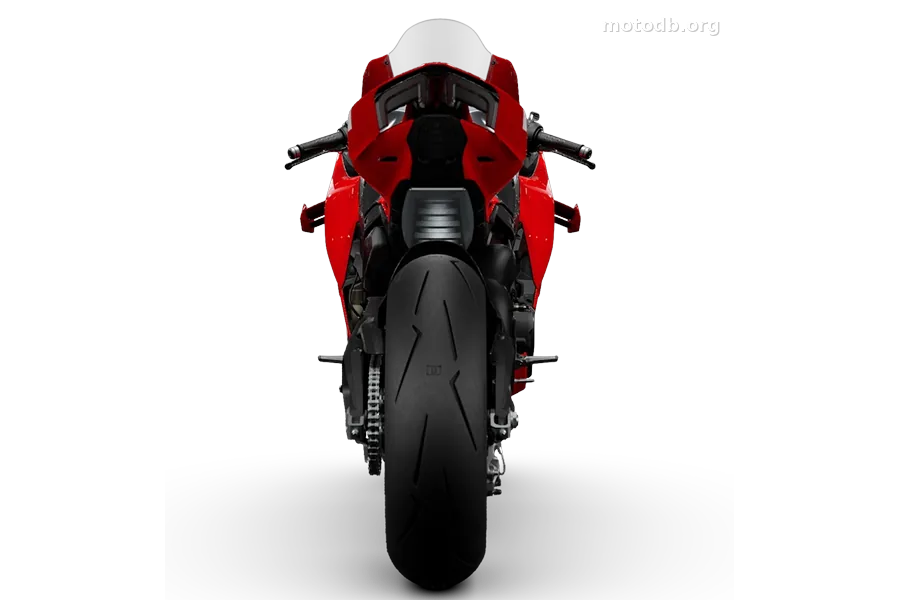
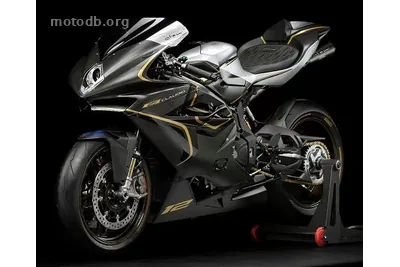
Some motorcycles are born of compromises. The Ducati Panigale V4 R, on the other hand, was born from an obsession: to reclaim the Superbike title that Kawasaki had taken from Bologna. When a brand of this stature brings out the big guns, it doesn't do things by half. It delivers a 998 cm³ 90-degree V4 engine, developing 221 horsepower at 11,500 rpm, in a package that weighs 193 kilograms fully fueled. Those who would compare the Ducati Panigale V4 R to the Kawasaki H2R are missing the point: one is built for SBK homologation, the other is a turbocharged dragster that has no place on a regulated circuit. The comparison stops at the raw numbers.
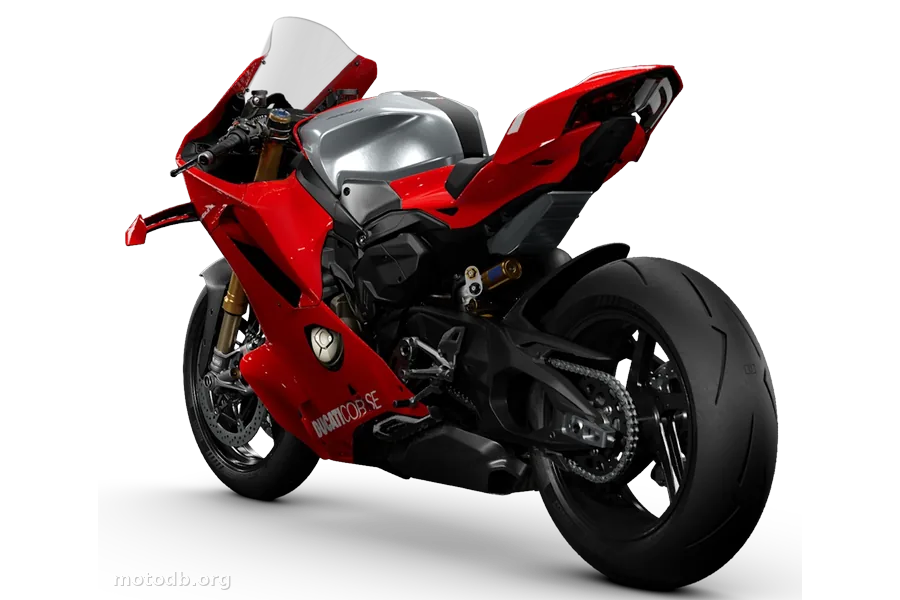
The heart of the matter is precisely this engine. To comply with Superbike regulations, engineers reduced piston stroke to 48.4 mm for a bore of 81 mm, forcing them to rev it high to extract power. Very high. The 221 horsepower arrives at 15,500 rpm, with a rev limiter intervening at 16,000 rpm under normal conditions, or even 16,500 in sixth gear. These revs typically belong to 600 Supersport machines, not liter bikes. The practical result is unambiguous: this engine doesn't have the low-end generosity of the Panigale V4 or V4 S with their 1,103 cm³. It demands to be worked, warmed up, and taken within its operating range. Those seeking a used Ducati Panigale V4 R often hope to find this beast at a reduced price, but they must also accept a racetrack engine character, with no concessions to urban use. The titanium Akrapovic line, available as an option, pushes the horsepower to 234 with a weight that drops to 165.5 kilograms. Even higher up in the hierarchy, the Panigale V4 R Superleggera takes the concept even further, but at prices that belong to another conversation.
Aerodynamics are not an ornament on this machine. The carbon winglets, directly derived from the MotoGP Desmosedici GP, generate 30 kilograms of downforce at 270 km/h on the front end. Aprilia’s RSV4 adopted a similar approach, but Ducati claims a directly raced lineage here. The windscreen has grown, the fork head has widened by 30 mm, and the side panels have widened by 38 mm on each side. The side vents on the fairing are not decorative; they evacuate 16% more heat from the oil radiator. The Ducati Panigale V4 R’s announced top speed is 300 km/h, a figure that mainly testifies to the coherence of the overall aerodynamic package.
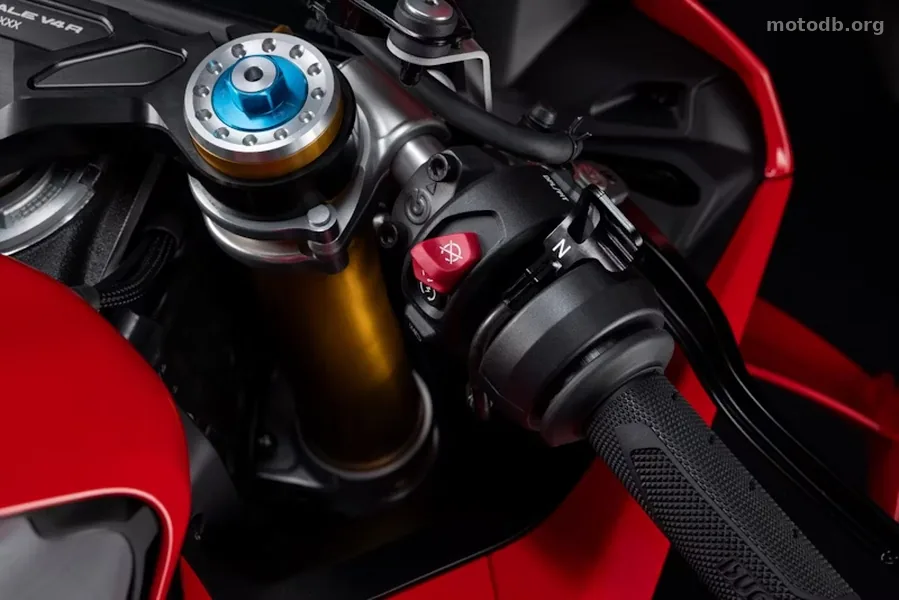
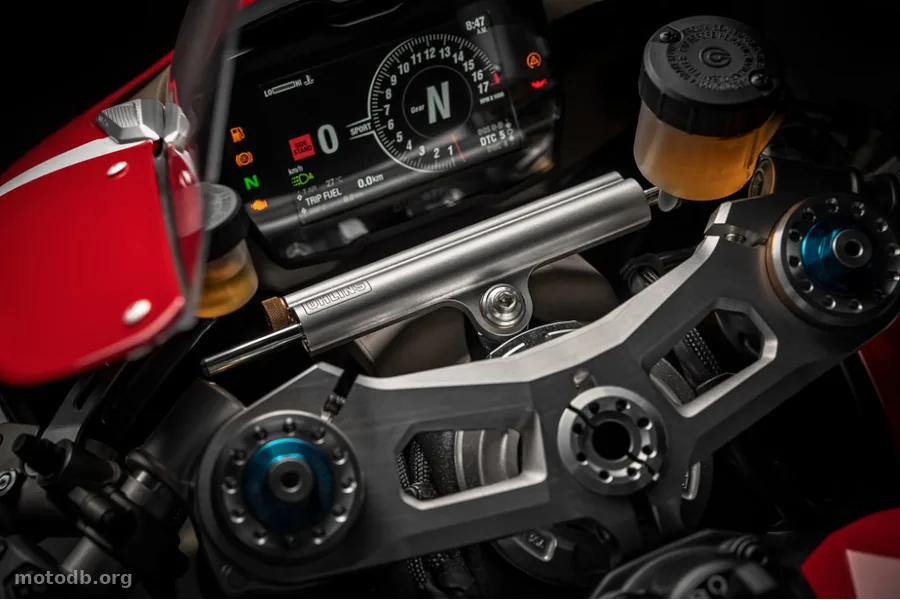
The aluminum chassis, lightened and stiffened at the front, is paired with a pressurized Öhlins NPX 25/30 inverted fork, 600 grams lighter than the version S’s, with separate compression and rebound management. The Öhlins TTX36 rear shock completes a track-oriented ensemble, with manual settings rather than semi-active ones, by deliberate choice of mass and precision. Brembo Stylema calipers bite on dual front discs, with a Cornering ABS coupled with a six-axis inertial unit. The electronics are complete, DTC Evo traction control, DWC Evo wheelie control, adjustable engine braking, three riding modes including Race mode which reduces assists to the bare minimum without ever limiting power. The 221 horsepower remain available in all modes, which says a lot about the target audience. With a power-to-weight ratio that allows you to sprint from 0 to 100 in less than 3 seconds, this Panigale is not a motorcycle you tame in a morning.
At €39,900 for the 2020 Ducati Panigale V4 R, you're not paying for an everyday motorcycle. You are buying a track weapon homologated for road use, intended for experienced track riders who already know their limits and want a machine that pushes theirs. The manufacturer is aware of this, which is why the Panigale V4 R inspired a Lego Technic 42107 set, a collector's item for those who prefer to admire the shape from their desk rather than in a leather suit. The real machine, however, is not meant to be looked at. It is ridden, and only by those who know precisely where they put their hands.
Reviews & comments
No reviews yet. Be the first to share your opinion!