Key performance
Technical specifications
Engine
- Displacement
- 1262 cc
- Power
- 158.0 ch @ 9500 tr/min (115.3 kW)
- Torque
- 128.0 Nm @ 7500 tr/min
- Engine type
- V2, four-stroke
- Cooling
- Liquid
- Compression ratio
- 13.0:1
- Bore × stroke
- 106.0 x 71.5 mm (4.2 x 2.8 inches)
- Valves/cylinder
- 4
- Camshafts
- 2 ACT
- Fuel system
- Injection. Bosch electronic fuel injection system, elliptical throttle bodies with Ride-by-Wire, equivalent diameter 56 mm
- Valve timing
- Desmodromic valve control
- Ignition
- Dual Spark
- Starter
- Electric
Chassis
- Frame
- Tubular steel Trellis
- Gearbox
- 6-speed
- Final drive
- Chain (final drive)
- Clutch
- Light action, wet, multiplate slipper clutch with hydraulic control. Self-servo action on drive, slipper action on over-run
- Front suspension
- 48mm fully adjustable usd forks.
- Rear suspension
- Fully adjustable Sachs unit. Remote spring preload adjustment. Aluminium single-sided swingarm
- Front wheel travel
- 185 mm (7.3 inches)
- Rear wheel travel
- 185 mm (7.3 inches)
Brakes
- Front brakes
- Double disc. ABS. Floating discs. Four-piston calipers. Radially mounted.
- Rear brakes
- Single disc. ABS. Two-piston calipers.
- Front tyre
- 120/70-ZR17
- Front tyre pressure
- 2.40 bar
- Rear tyre
- 170/60-ZR17
- Rear tyre pressure
- 2.50 bar
Dimensions
- Seat height
- 840.00 mm
- Wheelbase
- 1592.00 mm
- Fuel capacity
- 30.00 L
- Weight
- 254.00 kg
- Dry weight
- 225.00 kg
- New price
- 21 990 €
Overview
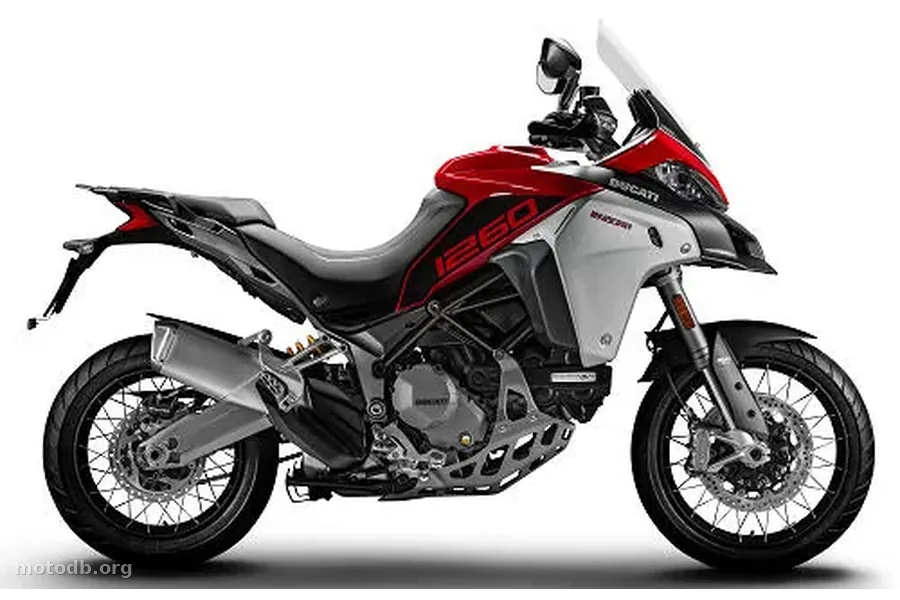
The entire Multistrada family has migrated to the V4. A new era has opened for Ducati with this powerful engine. However, the 1260 Enduro isn’t going anywhere and continues to defend the high-displacement twin. Less powerful than the 4-cylinder derived from the Panigale V4, certainly; but with a serious amount of horsepower and a higher peak torque. Having proven itself to be the most adventurous of the lineage, it retains its place and increases its differences from the newer models. What’s changed from yesterday to today?
The important thing is that the manufacturer didn’t want a SUV capable of exhilarating performance but lacking when approaching rough roads. Although few owners of this type of machine attack gravel and journeys where roads don't exist. But how do you cater for the few seasoned adventurers? Easy, create an Enduro version. This one is much better equipped for off-road trips than selfies in front of the Eiffel Tower. Now, it receives the latest version of the big DVT twin in its 1260 edition.
The MTS’s engine wasn’t lacking vigor. Between the displacement, variable distribution, and its sporty genes, there was plenty to get up to speed and tear up a tree for a campfire. Except that the "road" Multistrada of the time had adopted this big block, why not take advantage of it? With 64 cc more in the cylinders, power climbs to 158 horsepower (6 more) at the same 9500 rpm. Torque is strengthened a bit, to 13.1 mkg. An orgie of watts. Why seek to raise the gauntlet even further? For availability. By adopting the engine dimensions of the XDiavel, the 1262 cc Testastretta DVT offers much more force in the mid-range. A real plus for on-road acceleration, an even more virile aid for escaping situations where you don’t have time to change gear.
How do you recognize this 1260 evolution? With the large sticker on the tank sides. In terms of design, the Enduro didn’t deem it necessary to change its appearance. Remove the stickers and it will be impossible to distinguish one generation from another. Except for connoisseurs: they will have spotted the aluminum protection skid plate, of a larger size yet lighter. They will, however, only be able to estimate the morphological adaptations by getting on board. The riding position changes slightly but noticeably with a lowered seat by 10 mm and a handlebar 30 mm higher. Which led to the reshaping of the top of the tank.
The MTS Enduro also retains its beautiful 800x480 pixel color TFT display. Revising the interface and navigation. It’s true that with all the functions, the assists, the settings, the menus... It’s not necessarily simple to be intuitive, and Ducati had progress to make in that area. With the HMI (Human Machine Interface), everything should improve.
With each generation, it seems that you have to add an electronic widget at all costs. Sometimes it’s useless, sometimes it’s indispensable. Where does the new Ducati Link application stand? It should be quite good with the possibility of parameterizing the Riding Modes from your smartphone, displaying information on it, maintenance intervals, the nearest Ducati points, and also recording ride performance and routes and sharing them. Another arrival, the Up&Down shifter; we’re going to see it everywhere soon. Finally, the semi-active Skyhook suspension retains its place of choice and high-end status, while also moving into its Evo version, more efficient. Bearing synonymy with the name of the machine, the travel of the 48 mm inverted fork / single shock absorber is greater than on the Multistrada V4, at 185 mm all around. It is, however, a value lower than that of the ex-1200 Enduro, which moved on 200 mm. Would the Skyhook be as performant with less suspension travel? Would the manufacturer want to recalibrate the handling?
Few changes to the chassis if not an increase in wheelbase, a gain of 2 kilos in weight on the new rims and a lowered center of gravity (riding position + reduced suspension travel). Fans of the first hour will find the steel trellis frame, 19 and 17 inch spoke rims fitted with mixed trail-road tires, large 320 mm brake discs pinched by Brembo M4.32 radial 4-piston calipers, a sizable 30-liter tank allowing up to 450 km of range, and internal wiring to become an electrical engineer.
It takes a bit for the two 12V sockets, for the LED headlights, for the integrated turn signals in the handguards... and a lot more to inform the onboard electronics. The 1200 was already well-equipped, and the previous Enduro's features are re-parameterized due to the increased engine power. Especially the 4 riding modes (Sport – Touring – Urban – Enduro), each playing on the power, ABS, suspensions and assists to best suit the selected mood. The rest is up to today's standard and Ducati, worthy of an Audi: cruise control, IMU Bosch inertial unit on 6 axes, DWC anti-wheeling, DTC traction control, engine braking control, ABS active in curves, adaptive headlights in curves DCL, keyless start, hill hold control VHC, and, let's remember, semi-active suspensions, DQS shifter and 5-inch TFT screen.
A logical evolution for the Multistrada Enduro with the grafting of the 1260 engine. Fuller, torquey at all stages, it is a valuable ally in all situations. Adventurous this Ducati, overpowered, and attractive like any machine of great caliber. Totally out of place of course, like its competitors, compared to the original trail – that is, the light and fun machine that weighs nothing, goes everywhere and can take a beating. Except that we are no longer in trail but in hyper-trail. May Ducati not refrain from wanting (you) to take you on all possible roads, with or without asphalt.
M.B - Photos manufacturer
Standard equipment
- Assistance au freinage : ABS in curves
Practical info
- La moto est accessible aux permis : A
Indicators & positioning
Similar bikes
R 1250 RT Exclusive
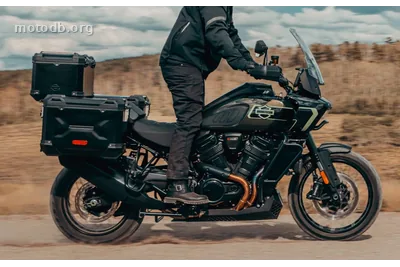
Pan America Limited 1250
Pan America 1250 Special G.I.
Reviews & comments
No reviews yet. Be the first to share your opinion!